
Aurora Hunting Tips for Anchorage 2026: Best Spots, Apps & When to Go
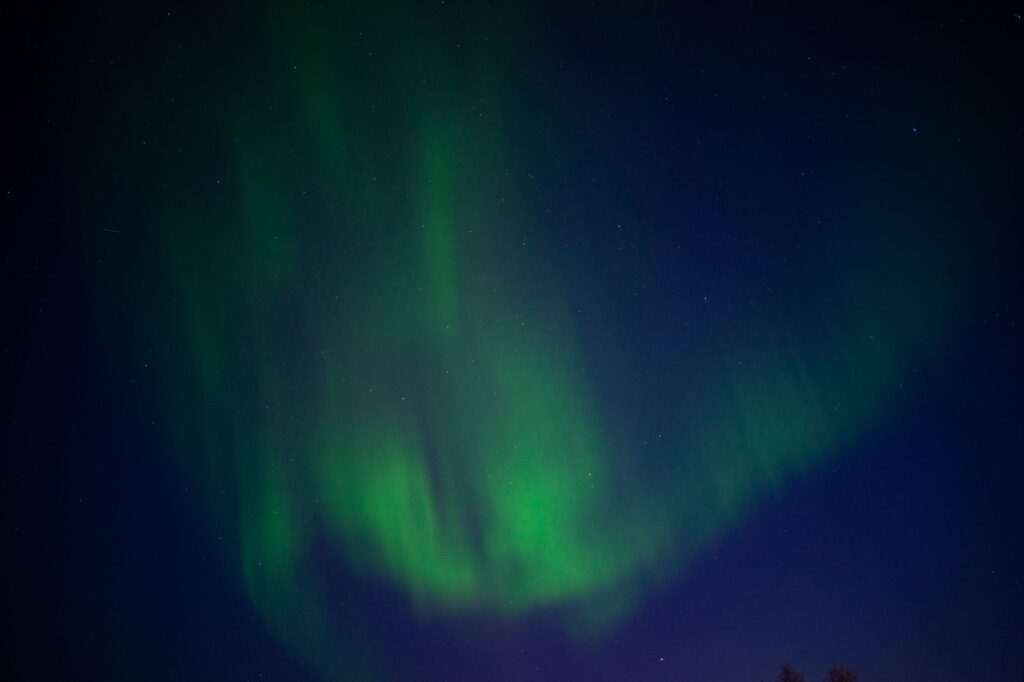
Anchorage sits at 61 degrees north latitude, well inside the auroral oval — the band of sky where charged solar particles collide with the upper atmosphere and produce the northern lights. On a clear night with active geomagnetic conditions between August and March, a 20-minute drive from downtown Anchorage can put you under a full display. This guide covers where to go, how to forecast the aurora, what camera settings to use, and how to survive the cold while you wait.
When Aurora Season Runs — and Why Summer Viewing Fails
The northern lights require two things: solar activity and darkness. Anchorage summer eliminates the second. From late May through late July, the sky never gets dark enough for aurora to be visible — the sun barely dips below the horizon at midnight, leaving the sky in a prolonged civil twilight that washes out any auroral display. The result is an effective aurora blackout from late spring through midsummer.
Aurora season in Anchorage runs from late August through late March, with the darkest and most productive months falling in October, November, February, and March. The equinox periods (late September and late March) historically see elevated geomagnetic activity due to the angle of Earth’s magnetic field relative to the solar wind — some aurora researchers call these the “equinox effect” windows. The December solstice brings the longest nights (roughly 5.5 hours of daylight), which means the most hours of potential darkness for viewing, even if solar activity is average. For a focused aurora trip, October through February offers the best combination of reliable darkness, active solar season, and manageable winter conditions. Our Anchorage winter activities guide covers other cold-weather activities to fill non-aurora evenings.
Best Aurora Viewing Spots Near Anchorage
The goal is to escape Anchorage’s light dome, which is substantial enough to reduce the visibility of fainter auroral displays. Light pollution spreads north and east from the city center; the most effective escapes head northwest toward Cook Inlet or northeast into the Chugach foothills.
Kincaid Park (Southwest Anchorage)
Kincaid Park’s coastal bluff section faces west across Cook Inlet, with a dark western horizon and minimal competition from city glow behind you. The park is a 15-minute drive from downtown and accessible by car at night. The open sky above Cook Inlet gives a full field of view for wide northern lights displays. In winter, Kincaid is open to vehicles through its main road, though the parking lots close at 10 p.m. — plan to arrive before the lot gate closes or park near the entrance and walk in. This is the most accessible option for city-based visitors who want a quick aurora chase.
Eklutna Flats (Glenn Highway North)
The Eklutna Flats wetlands sit about 26 miles north of downtown Anchorage on the Glenn Highway — a flat, open expanse of lowland that provides a wide-open sky above dark terrain with the city glow behind you rather than overhead. Multiple highway pullouts along the Glenn Highway between Chugach State Park and Eklutna offer viewing positions with minimal obstruction. The open flatlands give a better view of the full sky dome than wooded viewpoints closer to town. Drive time is 30–35 minutes from downtown.
Hatcher Pass
Hatcher Pass, approximately 60 miles from Anchorage in the Talkeetna Mountains, is the gold-standard aurora destination for Southcentral Alaska — high elevation, dark skies in every direction, and no city light interference. The summit area of Hatcher Pass Road reaches 3,886 feet, above treeline, with panoramic views that produce exceptional aurora photographs on active nights. The tradeoff: Hatcher Pass Road closes to vehicles at its summit section in winter, and the lower portions require careful driving on packed snow and ice. At a minimum, plan for a 90-minute drive each way and check Alaska DOT road conditions before going.
Knik River Road
The Knik River Road off the Glenn Highway, about 35 miles from Anchorage, runs east toward the Chugach Mountains and provides a dark sky backdrop with the mountain silhouette framing auroral displays. The river flats along this road are open and dark, with a clear northern horizon. Drive time is 40–45 minutes from downtown. This route is less well-known than Eklutna Flats but equally effective and often less crowded.
Turnagain Arm Pullouts (Seward Highway South)
The Seward Highway south of Anchorage passes a series of pullouts along Turnagain Arm that face south and east with the dark inlet below and minimal obstructions. The southern viewing axis falls outside the traditional aurora direction (displays typically appear in the northern sky), but active high-KP aurora events cover the full sky and make Turnagain Arm pullouts usable for wide-sky photography. The drive is 20–30 minutes from downtown.
Forecasting Apps: How to Know When to Go
Chasing aurora without a forecast is a dice roll. The following tools are the standard toolkit for Anchorage-area aurora hunting:
| Tool | What it shows | Best for |
|---|---|---|
| NOAA Space Weather | Real-time KP index + 3-day forecast | Planning 1–2 days ahead |
| My Aurora Forecast (app) | Location-based aurora probability + cloud cover | Night-of go/no-go decisions |
| UAF Geophysical Institute | 27-day solar rotation forecast for Alaska | Trip planning weeks in advance |
| Aurorasaurus | Citizen science real-time sighting reports | Confirming active displays during an event |
The KP index (planetary K-index) is the key number. KP 0–2 means minimal activity; KP 3 means aurora is likely visible at Anchorage’s latitude on a clear night; KP 5+ (geomagnetic storm) means strong aurora visible even through some light pollution. Anchorage sits at a latitude where KP 3 is the practical threshold for a reliable display. NOAA updates the real-time KP every 3 minutes via their Space Weather Prediction Center — the real-time data is the tool to watch during evening hours when cloud cover is acceptable.
Cloud cover is the aurora hunter’s other enemy. Even a KP 7 event produces nothing visible under overcast skies. My Aurora Forecast combines the geomagnetic forecast with cloud cover predictions for your specific location — it reduces the number of wasted drives by integrating both variables into a single go/no-go recommendation. Download it before your trip and set up KP threshold notifications.
Aurora Photography: Settings and Gear
Photographing the northern lights requires a camera that handles high ISO — a smartphone with night mode can capture faint aurora, but a mirrorless or DSLR with manual controls produces the images that actually look like what you see. Our Alaska aurora photography guide goes deep on camera settings and location scouting; the essentials are:
- ISO: 800–3200 depending on aurora brightness and your camera’s noise performance. Start at ISO 1600.
- Aperture: f/2.8 or wider. A fast wide-angle lens (14–24mm, f/2.8) captures the full sky arc.
- Shutter speed: 8–25 seconds. Faster shutter freezes movement in active aurora; longer shutter captures fainter displays. For sharp stars, apply the 500 rule: divide 500 by focal length to get maximum shutter in seconds before star trails appear.
- Focus: Manual focus to infinity, with a bright star as confirmation. Autofocus fails in the dark.
- Tripod: Non-negotiable. Hand-held 15-second exposures produce motion blur without exception.
For composition, use foreground elements — treelines, mountain silhouettes, the inlet surface — to anchor aurora photographs that would otherwise be just green against black. Our Anchorage photography spots guide covers locations that provide strong foreground options for night photography.
What to Wear for Cold-Night Aurora Hunting
Aurora viewing is stationary — you stand outside in the cold for 30 minutes to two hours, often past midnight, with no movement to generate body heat. Alaska winter night temperatures run 0°F to 25°F in Anchorage, with wind chill on exposed bluffs and inlet edges dropping the effective temperature significantly lower. Dressing for aurora hunting requires more insulation than dressing for a winter hike.
The standard layering system for cold-night standing:
- Base layer: Wool or synthetic thermal underwear. Avoid cotton, which retains moisture and loses insulation.
- Mid-layer: Insulated fleece or down jacket. A 600-fill down jacket performs better than a bulky fleece at equal weight in dry cold.
- Outer layer: Windproof and waterproof shell. Wind off Cook Inlet accelerates heat loss significantly even at moderate temperatures.
- Boots: Insulated, waterproof winter boots rated below -20°F. Cold feet end aurora nights fast. Vapor barrier socks (plastic bag over a wool sock) in extreme cold.
- Extremities: Mittens rather than gloves for aurora photography pauses. A balaclava or neck gaiter covers the exposed face during extended waits. Hand and foot warmers extend tolerance significantly.
See our Anchorage winter emergency preparedness guide for a full cold-weather gear checklist applicable to night excursions. For snowshoeing or a more active winter approach to reach dark-sky spots, our snowshoeing near Anchorage guide covers winter trail access points near the city.
Guided Aurora Tours vs. Self-Drive
Anchorage has multiple operators running guided aurora tours — typically van-based excursions that transport small groups to dark-sky locations, provide hot drinks, and stay out for 2–3 hours watching the sky. Tour prices run $80–120 per person for a standard 3-hour aurora excursion. The advantages of a guided tour: the operator monitors the forecast and makes the go/no-go decision for you, provides transportation on winter roads, and carries emergency equipment. The disadvantages: a fixed group schedule means you leave when the tour ends regardless of aurora activity, and the group setting limits solitary photography time.
Self-drive aurora hunting gives full schedule flexibility — you can wait for a late-night KP spike at 1 a.m. or stay at a location for four hours without group pressure. The prerequisites are confidence driving on packed-snow roads at night, appropriate cold-weather gear for standing outside the vehicle, and a reliable app for real-time forecasting. For visitors renting a car and comfortable with Alaska winter driving conditions, self-drive produces more sightings per trip simply because of schedule flexibility. For first-time Alaska visitors arriving in shoulder winter months (September, October, March), guided tours remove the logistical complexity of a first cold-night excursion.
Note that aurora viewing carries no guarantee regardless of tour type — cloud cover, solar cycle variability, and the unpredictability of geomagnetic storms mean even well-planned nights produce nothing. Plan multiple evenings for aurora attempts if aurora viewing ranks as your primary trip objective. A visitor arriving for three nights in February with clear-sky forecasts has a reasonable probability of seeing at least one display from a dark-sky location near Anchorage. Arriving for two nights with mixed cloud cover reduces the odds significantly.
Practical Planning Notes
Aurora is best viewed away from urban light pollution on nights with clear skies, a KP index of 3 or higher, and minimal moon interference (a full moon reduces contrast for aurora photography but leaves visible displays intact). The peak display window is typically between 10 p.m. and 2 a.m., with midnight the most reliable center hour. Late-night coffee at a 24-hour location in Anchorage while monitoring the KP is a standard local strategy — go when the index spikes, not on a fixed schedule.
For visitors combining an aurora trip with other Anchorage winter activities, our Anchorage winter guide covers daytime options from Alyeska Resort skiing to Iditarod ceremonial start viewing that pair naturally with late-night aurora attempts. Flattop Mountain’s lower slopes, accessible from Glen Alps trailhead, are also a viable winter dark-sky option — the Flattop Mountain trail guide covers winter access and conditions on the mountain’s lower terrain.
The Alaska Public Lands Information Center on 4th Avenue carries current winter road condition information for Hatcher Pass and other northern routes, and staff can advise on access road status before a planned aurora excursion. Enterprise Rent-A-Car at Anchorage Airport is the most convenient vehicle pickup for self-drive aurora hunting — request a vehicle with all-wheel drive or four-wheel drive for winter road confidence.
Anchorage is the ideal starting point for Alaska travel. Visitors can get trip-planning assistance at the Alaska Public Lands Information Center, walk the Tony Knowles Coastal Trail before heading further afield, or pick up a vehicle at Enterprise Rent-A-Car Anchorage Airport for self-drive Alaska exploration.
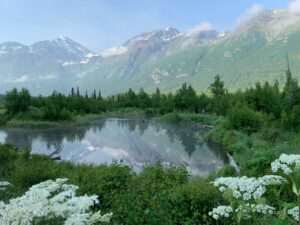
Photo by Tobias Bjørkli on Pexels.
No comments yet.