
Matanuska Glacier Day Trip from Anchorage 2026
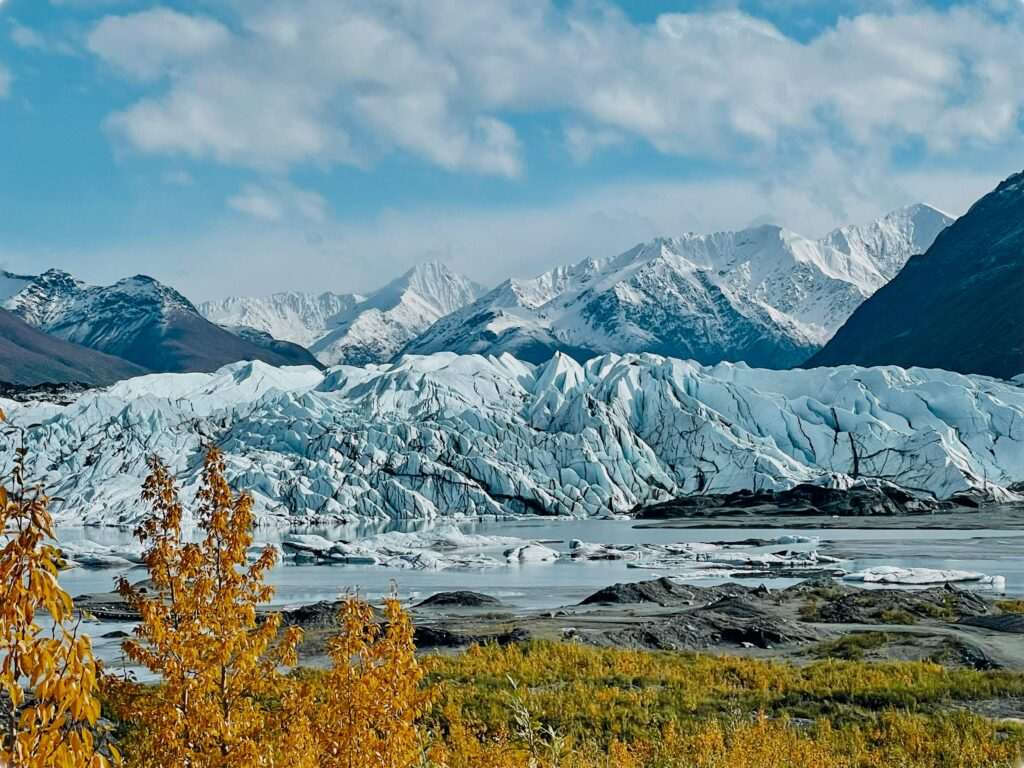
Most glacier experiences in Alaska put you at a distance — on a boat watching a calving face, on a shoreline scanning a retreating terminus, or at the end of a road looking across a lake. Matanuska Glacier is different. This 27-mile-long valley glacier in the Chugach Mountains northeast of Anchorage allows visitors to walk directly onto the glacier surface, navigate crevasse fields with a guide, and experience the interior of Alaska’s ice in a way that requires no technical climbing experience and only two hours of driving from the city. It is one of the most accessible walk-on glaciers in the United States and the defining glacier day trip from Anchorage for visitors who want contact with the ice rather than a view of it.
Getting There: The Glenn Highway Drive
Matanuska Glacier sits at mile 102 of the Glenn Highway, approximately 100 miles northeast of Anchorage. The drive takes about two hours under normal conditions and passes through some of the most varied terrain on the Alaska road system in a short distance. Leaving Anchorage, the highway climbs through the Eagle River valley — the Eagle River Nature Center is a worthwhile twenty-minute stop for wildlife viewing and trail access before the urban sprawl thins and the mountains close in.
Past Eagle River the highway crosses into the Matanuska-Susitna Valley, the agricultural region known locally as the Mat-Su. The valley opens dramatically after the Chugach front range, with Pioneer Peak (6,398 feet) rising directly above the town of Palmer and the Matanuska Valley’s farm fields spread below. The Matanuska Valley was settled in the 1930s under a New Deal agricultural program that relocated Minnesota and Michigan farming families to Alaska — the old farmsteads and the Colony Inn in Palmer mark this history. Bodenburg Butte, a glacially deposited hill rising above the valley floor near Butte, offers a short hike with panoramic views of Pioneer Peak, the Chugach Range, and the Talkeetna Mountains across the valley.
From Palmer the highway continues northeast through the Matanuska River corridor, gaining elevation as it approaches the glacier. The river itself is braided and silty with glacial meltwater, running turquoise-gray alongside the road. The glacier terminus comes into view from the highway at approximately mile 100 — a white wall of ice filling the valley head, visible from the road for the final two miles before the turnoffs.
Access Options: Guided Tours vs. Self-Guided
Access to the Matanuska Glacier surface falls into two categories: guided tours through private concessionaires on the glacier, and self-guided access through the Matanuska Glacier State Recreation Area at the east end of the parking area.
Most of the glacier’s accessible edge sits on private land managed by concessionaires who charge separate access fees and provide guides, equipment, and safety oversight. The primary operator — MICA Guides, with offices near the highway — offers half-day and full-day guided ice hikes that include crampons, ice axes, helmets, and a guided route across the glacier’s lower field to crevasse zones and ice formations that self-guided visitors cannot safely reach. Guided tours run approximately $90–130 per person for a three-hour hike and include all technical gear rental. The guided experience is recommended for first-time glacier visitors and anyone interested in reaching the more dramatic interior sections — the crevasse fields, ice caves (when they form), and meltwater channels that characterize the upper accessible zones.
The Matanuska Glacier State Recreation Area provides public access to a portion of the glacier terminus at lower cost. The park charges an entry fee (approximately $5 per person) and allows visitors to walk to the glacier edge on marked trails. The self-guided area covers the flat lower tongue of the glacier rather than the crevassed middle zones. Visitors can walk on ice without crampons in the immediate margin area but should not venture onto steeper or more crevassed terrain without technical equipment and guidance. The state recreation area is appropriate for visitors who want to touch and photograph glacier ice without committing to a full guided hike.
What the Ice Hike Experience Is Like
Walking on a glacier is physically demanding in ways that differ from trail hiking. The ice surface is rarely flat — it ripples, tilts, and breaks into ridges and hollows shaped by internal movement and meltwater drainage. Crampons are essential for stable footing; the metal points grip the ice reliably, but learning to walk with them takes fifteen minutes of adjustment. Guided groups move slowly and deliberately, learning route-finding that avoids unstable snow bridges over crevasses and stays on ice that has been assessed as safe for the day’s conditions.
The reward for that caution is immersive: standing in a meltwater canyon, watching blue-green water pour through channels carved into ancient ice, or peering into a crevasse that drops into darkness below is an experience with no equivalent on a standard Anchorage day trip. The ice color itself is striking at close range — surface ice is white and opaque from trapped air bubbles, but interior ice exposed in crevasse walls is intensely blue-green, the color produced by light passing through hundreds of feet of compressed ice with most air removed. On full-day tours, guides reach formations deep enough in the glacier to produce this effect consistently.
What to Wear and Bring
The glacier surface is 20–30°F cooler than the surrounding valley regardless of the air temperature. A summer day at 65°F in the valley will feel like 40°F on the ice with any wind. Layering is essential: a moisture-wicking base layer, insulating mid layer, and windproof outer shell cover the range of conditions. Waterproof footwear is practical; the glacier surface is wet from meltwater in summer, and trail runners will be soaked within twenty minutes. Sturdy hiking boots or waterproof trail shoes are the minimum; rubber boots work well for the lower glacier.
Sunglasses are non-negotiable on clear days — the combination of high-latitude sun angle and reflective white ice produces intense glare that can cause corneal damage without UV protection. Glacier glasses or standard sunglasses with UV protection both work. Bring water; physical exertion on an ice hike is real, and dehydration in cold environments is a common oversight. Guided tours provide crampons, ice axes, and helmets in the rental; visitors do not need to own technical equipment.
Best Season and Conditions
May through September is the guided ice hike season. June and July offer the best combination of reliable road access, long daylight hours, and stable ice conditions. August and September bring the possibility of fresh snow on the upper glacier that changes the visual character of the hike, and the fall foliage of the birch and alder forests below the glacier line creates striking color contrast against the white ice. The glacier is visible from the highway year-round — a winter drive on the Glenn Highway on a clear day reveals the glacier against the snow-covered mountains in dramatically different light than summer — but the guided walking tours operate in the ice-free season only.
Adding Hatcher Pass
The Hatcher Pass area near Palmer makes a logical addition to a Matanuska Glacier day trip for visitors with time. The Hatcher Pass Road branches north from the Glenn Highway in Palmer and climbs into alpine tundra above the treeline, passing the Independence Mine State Historical Park — a gold mine complex from the 1930s and 1940s now preserved as a state park with walking tours. The upper pass reaches 3,886 feet elevation and provides views north across the Matanuska-Susitna Valley to Denali on clear days. The combination of the Matanuska Valley farm country, the glacier, and the alpine pass above treeline compresses three visually distinct Alaska environments into a single day’s driving on connected highways.
Practical Notes
Book guided ice hike tours in advance for July weekends; popular departures sell out. The MICA Guides website lists current availability and departure times. The Glenn Highway to the glacier is well-maintained two-lane pavement with no technical driving challenges in summer conditions. The drive back to Anchorage in early evening during June and July provides the best light for the Pioneer Peak and Chugach Range views, which face southwest. There are no gas stations between Palmer and the glacier; fill up in Palmer before the final 60-mile stretch.
No comments yet.