
Alaska Photography Workshops & Tours 2026: Capture the Last Frontier
Alaska is one of the most photographed places on earth, and also one of the most technically demanding. The light behaves differently here — golden hours that last for hours in summer, complete darkness for months in winter, and in spring and fall a quality of alpenglow and twilight color that professional photographers travel specifically to capture. Add active wildlife, tidewater glaciers, and the northern lights, and you have a destination where the difference between a good photograph and a great one often comes down to local knowledge. Guided photography tours and workshops based out of Anchorage provide exactly that.
Local Photography Tour Operators
Alaska Photo Treks is the most photography-specific operator in the Anchorage area — a guide service built around helping photographers of all experience levels access Alaska’s most productive shooting locations at the right times. They run small-group outings to locations including Flattop Mountain, Potter Marsh, and Chugach State Park, with an emphasis on working the light rather than just visiting the site. Their northern lights tours in winter are structured specifically for long-exposure photography, including vehicle transport to dark-sky locations and on-site coaching for aurora technique. For dedicated photographers, this is the operator to book first.
Chugach Adventures runs guided outdoor excursions into the Chugach terrain that are particularly well-suited for wildlife photography — their guides know the seasonal animal movement patterns and can position groups for morning golden-hour wildlife encounters in a way that independent visitors can’t easily replicate. For anyone who wants to combine physical adventure with wildlife photography, their half- and full-day outings deliver both.
907 Tours operates general Anchorage and Southcentral Alaska tours that regularly draw photographers for their access to locations and timing — their Turnagain Arm bore tide tours and wildlife viewing excursions are particularly photogenic, and their guides can accommodate photographers who need to stop and work a scene rather than keeping pace with a standard tour group.
Best Locations for Iconic Alaska Shots
Flattop Mountain delivers what might be the single most iconic Anchorage composition: the city lights spread across the Knik Arm below, the Chugach peaks rising behind, and often a dramatic sky bridging the two. Sunrise from Flattop is extraordinary in clear weather — the alpenglow on the Alaska Range, visible on clear days to the northwest, turns the entire horizon pink and gold. The hike is about 3.5 miles round trip with 1,300 feet of gain; plan your ascent to arrive at the summit 30–40 minutes before golden hour.
Potter Marsh, just south of Anchorage along the Seward Highway, is one of the premier bird photography locations in Southcentral Alaska. The boardwalk over the marsh allows close approaches to nesting Arctic terns, various duck species, and the occasional sandhill crane. In morning light, the still water surface creates mirror reflections that compress the scene — arrive early and shoot with the sun behind you for the strongest reflection geometry.
Portage Glacier is approximately an hour south of Anchorage and offers dramatic blue-ice glacier photography accessible to all fitness levels. The Portage Glacier tours include boat access to the glacier face — the position for capturing calving, ice texture, and the scale of the glacier wall that’s not achievable from shore. Overcast conditions are actually ideal for glacier photography; harsh sun washes out the blue tones that make ice photographs compelling.
Denali viewpoints along the Parks Highway north of Anchorage — particularly the Talkeetna area at mile 98 and the various pullouts between Wasilla and Trapper Creek — offer the best accessible views of the Alaska Range’s highest peak. Denali is only visible in clear weather (roughly 30% of the time), so plan this shoot with flexibility and check the weather forecast specifically for the Alaska Range, which operates independently of Anchorage conditions.
Seasonal Lighting Opportunities
Midnight sun (May–July). Anchorage receives nearly 20 hours of daylight at peak summer solstice, with the sun dipping just below the horizon but never producing full darkness. This creates extended golden-hour windows — two to three hours of warm, directional light in the evening that photographers in other latitudes can only dream about. The “magic hour” here is more like a magic quarter-day. Schedule your most important landscape shoots for 9:00 PM to midnight in June.
Blue hour and autumn (August–October). As daylight shortens through fall, Alaska’s light becomes more conventionally dramatic — sharper contrast, lower sun angles, and the combination of autumn birch color against snow-dusted peaks. The alpenglow in September and October is among the most photogenic light in the state. This is also prime aurora season as darkness returns.
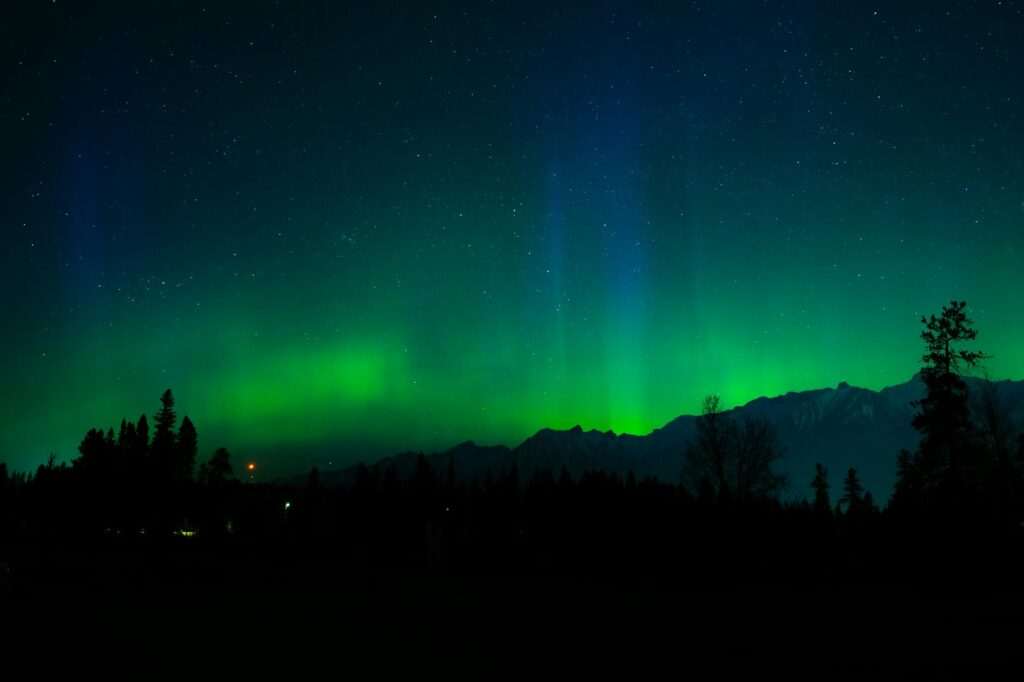
Northern lights (October–March). The aurora borealis is active above Anchorage on clear winter nights, and the city’s position in the auroral oval means strong events are relatively common. For serious aurora photography, drive 30–60 minutes from the city for darker skies — the Glenn Highway east toward Palmer or the Seward Highway south toward Turnagain Arm both provide accessible dark-sky pullouts with wide northern horizons. Monitor space weather forecasts (SpaceWeatherLive and the Geophysical Institute’s aurora forecast) rather than relying on general weather apps.
Gear for Alaska Conditions
Weather sealing is not optional — Alaska’s weather changes fast, and a sudden rain shower on Flattop or mist off a glacier will find any gap in an unprotected camera body. Mirrorless and DSLR systems with weather sealing are worth the investment for Alaska travel.
Battery management in cold is the most common failure point for winter photographers. Cold temperatures drain lithium-ion batteries to apparent zero while the cells are still functional — keep a spare battery warm in an interior jacket pocket and swap regularly. Budget two to three batteries per full shooting day in winter.
Lens selection depends on your primary subjects: a wide-angle (16–35mm equivalent) for landscapes and aurora, a telephoto (200–500mm) for wildlife, and a mid-range zoom (24–105mm) for general travel. For bear and moose photography, 400mm minimum is the practical standard for frame-filling shots at safe distances.
Polarizing filter cuts glare off water and glacier ice and deepens blue-sky contrast — worth carrying for any glacier or coastal shoot. A tripod is essential for aurora photography and early-morning long-exposure work; a compact carbon-fiber travel tripod that fits in carry-on luggage is the practical compromise for most visitors.
Subject-Specific Tips
Aurora: Use a wide-angle lens, f/2.8 or faster, ISO 1600–6400, and a shutter speed between 5–20 seconds depending on aurora movement speed. A remote shutter release eliminates camera shake. Include a compelling foreground — a frozen lake, spruce trees, a cabin — rather than shooting empty sky.
Bears and moose: Shoot from a vehicle when possible — wildlife habituates to vehicles more readily than pedestrians. Use the longest lens available and a fast shutter speed (1/500s or faster) to freeze movement. Early morning and late evening light produces the most flattering animal portraits. Never position yourself between an animal and its escape route. For bears specifically, the Portage Valley, Hatcher Pass area, and the Glenn Highway corridor near Palmer are consistently productive shooting locations accessible without a guide.
Glaciers: Overcast is your friend — diffused light preserves the blue-teal tones of glacier ice that direct sun washes out. A polarizing filter cuts surface glare and deepens color saturation further. Shoot during tide changes at tidewater glaciers for more active calving.
Photo: Donovan Kelly / Pexels

No comments yet.