
Moose in Anchorage 2026: How to Spot, Photograph & Stay Safe Around Alaska’s Giants
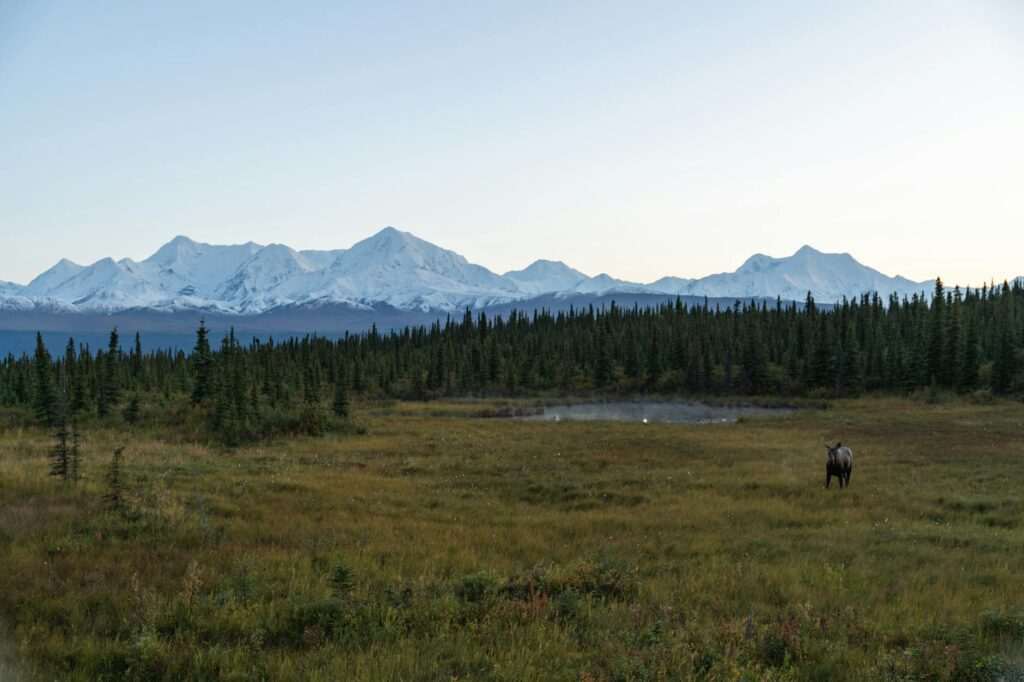
Anchorage is a city of roughly 290,000 people, two major highways, a busy international airport, and approximately 1,500 moose. The moose don’t care about the first three. They graze in office park landscaping, bed down in suburban backyards, and occasionally block traffic on Tudor Road with the unhurried confidence of animals that have lived here longer than the city has. Anchorage’s resident moose population is one of the largest urban moose concentrations in the world, and understanding it is essential knowledge for any visitor — whether you want to find one, photograph one, or simply get to work without incident.
Why Anchorage Has So Many Moose
The city sits in a natural moose corridor. The Chugach Mountains to the east and the wetlands and forest patches running from Eagle River through Kincaid Park create an interconnected habitat that supports a year-round population without requiring the moose to go anywhere. Moose are browsers — they eat willow, birch, and aquatic plants — and Anchorage’s greenbelts, parks, and landscaped areas provide all of that in abundance.
The urban environment also offers a survival advantage: no hunting. Moose in Anchorage face virtually no predation pressure within the city limits. Wolves and bears operate at the city’s edges but rarely venture into dense residential areas. The result is a population that’s acclimated to humans, functionally fearless, and increasing over time. Alaska Department of Fish and Game estimates put the population at 1,000–1,500 animals within the municipality at any given time, with numbers fluctuating seasonally as moose move in and out of the foothills.
Where to See Moose in Anchorage
Far North Bicentennial Park is arguably the single best moose-spotting location in the city. This 4,000-acre natural area in east Anchorage is crisscrossed with trails and bisected by the Campbell Creek drainage. Moose are present here year-round, and early morning or evening visits produce reliable sightings. The park’s interior, away from the main trailheads, sees less foot traffic and more wildlife activity.
Campbell Creek Greenway follows the creek through mid-Anchorage for miles, connecting several neighborhoods with riparian willow habitat that moose favor heavily. The lower sections near Taku Campbell Regional Park are particularly productive for moose sightings from May through October when the willow browse is at its best.
Kincaid Park at the southwestern edge of the city covers 1,400 acres of mixed forest and meadow bordering Cook Inlet. Moose are common here, especially in the interior trail network away from the beach access area. The park’s ski trails make excellent wildlife corridors in summer.
Westchester Lagoon, just west of downtown, is a small urban wetland that attracts moose browsing in the willow margins. It’s compact and accessible, making it a quick check for visitors staying downtown who want to look for moose without driving far.
Russian Jack Springs Park in midtown has a trail system running through a forested area that serves as a moose travel corridor between the larger greenbelts. The Russian Jack Springs Trail winds through mature spruce and birch that moose use for cover during the day — visit at dawn or dusk for the best chance of a sighting.
The Eagle River area, north of the city proper, is prime moose habitat where the valley floor, riparian corridors, and adjacent Chugach State Park terrain concentrate wildlife year-round. The Eagle River Bear Viewing Trail passes through habitat that’s equally productive for moose encounters, particularly in the cottonwood and alder thickets along the river.
Moose Behavior Through the Seasons
May–June: Calf season. This is the most dangerous time to encounter a cow moose in Anchorage. Cows give birth in May and spend the following weeks in an extremely protective state. A cow with a calf will charge without hesitation at anything she perceives as a threat — dogs, joggers, cyclists, anyone who gets between her and the calf. Give cows with calves a very wide berth. If you encounter one on a trail, turn around and take a different route.
July–August: Relative calm. Calves are mobile and growing, cows have settled into summer feeding patterns, and bulls are putting on weight for the fall rut. This is the most relaxed season for moose encounters, though they’re still wild animals and unpredictable.
September–October: The rut. Bull moose become aggressive and unpredictable during the breeding season. A rutting bull can weigh over 1,500 pounds and will charge vehicles, people, and other bulls. Their behavior is erratic in a way that’s categorically different from the rest of the year. If you encounter a bull in September or October, maintain significant distance and retreat if he shows any signs of agitation — lowered head, laid-back ears, raised hackles, or direct eye contact.
November–April: Winter concentration. Moose move into neighborhoods and greenbelts more heavily in winter, seeking shelter from snow and browsing on ornamental shrubs. Encounters in driveways and backyards spike. This is also when moose-vehicle collisions peak on roads like the Glenn and Seward highways.
The Danger You Don’t Expect
Visitors to Alaska often fixate on bears as the primary wildlife danger. The statistics tell a different story: moose injure significantly more Alaskans each year than bears do. A moose is larger than a horse, faster than most people expect (they can run 35 mph), and capable of delivering lethal kicks with front and rear hooves. They don’t broadcast aggression the way bears do — a moose that looks calm can charge in seconds.
The core error people make is approaching for photographs. Any moose that stops eating, raises its head, pins its ears, or shows the whites of its eyes is telling you to back off. A moose that licks its lips and drops its head is about to charge.
What to Do If a Moose Charges
Moose protocol is the opposite of bear protocol. Run. Get behind something solid — a tree, a car, a building. Moose don’t pursue humans the way a predatory bear might; they’re defensive chargers who will usually stop once the perceived threat has retreated. If you’re knocked down, curl up, protect your head, and don’t move until the moose leaves the area. Fighting back is not effective.
Never get between a cow and her calf. Never approach a moose that’s feeding — they’re on a caloric schedule and interruptions make them aggressive. Keep dogs on leash; loose dogs frequently trigger moose charges in Anchorage parks, and the moose pursues the dog directly back to the owner.
Photography Tips for Safe Encounters
The minimum safe distance for moose photography is 50 feet, and that’s a floor, not a target. A 200–400mm telephoto lens will get you frame-filling shots from a distance that keeps both you and the moose comfortable. Early morning light in Far North Bicentennial Park or the Campbell Creek Greenway delivers excellent natural light and active moose behavior. Avoid the middle of the day — moose rest in cover during peak heat.
Shoot from behind cover when possible and never position yourself to cut off a moose’s escape route. A moose that feels cornered is a moose that charges. For guided wildlife photography experiences with expert naturalist context, Chugach Adventures runs excursions into the Chugach terrain where moose, bears, and other wildlife are reliably encountered under professional supervision.
The moose will find you in Anchorage eventually — the city guarantees it. The question is whether you’re ready for the encounter.
Photo: John De Leon / Pexels
No comments yet.