
Northern Lights in Anchorage 2026 — Best Viewing Spots, Timing & Photography Tips
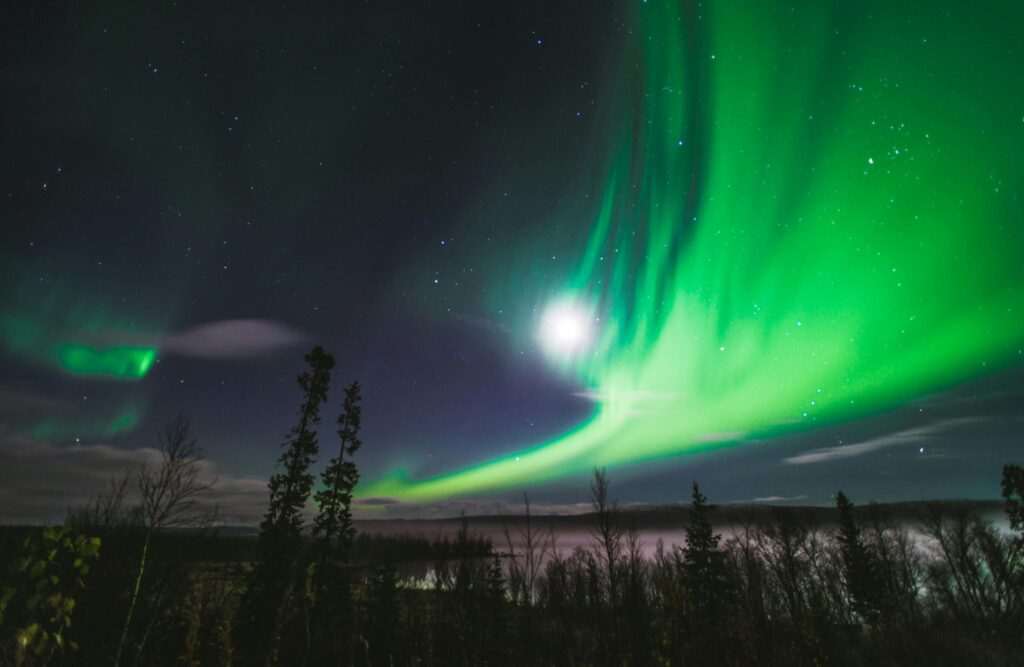
The aurora borealis is the defining Alaska winter experience, and Anchorage sits at a latitude — 61 degrees north — that places it squarely in the auroral oval, the ring of maximum aurora activity that circles the magnetic pole at roughly 65 to 72 degrees latitude. On a clear night with an active geomagnetic storm, the sky above the Chugach Mountains fills with curtains of green, violet, and occasionally red light that shift and pulse in ways that photographs can capture but can never fully convey. The challenge in Anchorage is not latitude or aurora frequency — it is cloud cover and light pollution, two problems that a prepared visitor can manage with the right tools and a willingness to drive 20 to 40 minutes from the city center. This guide covers when to come, how to forecast, where to watch, how to photograph, and how to stay warm enough to enjoy the experience.
Why Anchorage Works for Aurora Viewing
Anchorage’s position at 61 degrees north puts it inside the auroral oval during moderate geomagnetic activity — classified as KP index 3 or higher. On nights when the KP index reaches 5 or above, aurora can be visible from the city itself, despite the light pollution. On KP 7 or higher events, which occur several times per year during solar maximum periods, aurora is visible as far south as the lower 48 states. In 2026, the current solar cycle (Solar Cycle 25) is near its predicted maximum, meaning geomagnetic activity is at a roughly 11-year peak. The timing is favorable for aurora watchers.
Equally important: Anchorage has winter darkness. From late November through mid-January, the city sees fewer than six hours of daylight, meaning the dark sky window for aurora viewing spans from around 4 PM to 10 AM the following morning. Even in September and March — the shoulder aurora months — darkness arrives early and the nights are long. Anchorage is also a fully functional travel hub with direct flights from Seattle, Los Angeles, and other major gateways, which removes the bush-plane logistics that aurora chasers in more remote Fairbanks-area locations must navigate.
Best Months: September Through March
September and October offer the best combination of reasonable temperatures and increasing darkness. September nights in Anchorage are cold but manageable — typically 25 to 40°F — and the auroral activity at the autumn equinox historically runs higher than the rest of the year due to seasonal variations in the Earth’s magnetic field orientation. The trees still hold their fall color in early September, which creates striking foreground compositions for aurora photographers.
November through February is peak darkness season but also the coldest period. Temperatures routinely reach -10°F to -20°F in Anchorage and significantly colder in the hillside and valley areas used for aurora watching. The trade-off is that the nights are very long — you have a large window of opportunity — and snowpack on the ground reflects aurora light in ways that create photographic opportunities unavailable in the fall. March is the final good aurora month before the equinox-to-summer light progression eliminates dark skies through September.
How to Forecast the Aurora
Aurora forecasting has become remarkably reliable at the 1 to 3 day range, and real-time alerting has made spontaneous aurora chasing genuinely viable. The tools to use:
The NOAA Space Weather Center (spaceweather.noaa.gov) publishes the official KP index forecast and 3-day outlook. The KP index runs from 0 to 9; for Anchorage at 61 degrees north, KP 3 or above produces visible aurora outside the city, KP 5 or above can produce visible aurora from the city itself, and KP 7 or above is a significant event visible at unusually low latitudes. The site is authoritative but requires some fluency to navigate.
The Soft Serve News app provides the most user-friendly KP forecasting and alerting for non-specialist aurora watchers. Configure it to alert at KP 3 (or KP 4 if you want to filter out marginal events) and it will notify you when conditions are approaching your threshold. The Aurora Forecast app by the University of Alaska Fairbanks shows the auroral oval position in real time — a visual representation of where the oval is positioned relative to Alaska that helps calibrate whether the current night is worth pursuing. Both apps are free and together cover the full forecasting workflow from initial alert to real-time monitoring.
Cloud cover is the aurora chaser’s primary adversary. Anchorage sits in a precipitation shadow of the Chugach Mountains for some weather systems, but fronts from the Gulf of Alaska bring cloud cover frequently through the winter. The practical response: check cloud cover forecasts (Windy or Dark Sky give hour-by-hour cloud maps) and be prepared to drive to find breaks. The Turnagain Arm corridor and the valley north of Anchorage often have different cloud cover conditions than the city proper, and a 20-minute drive can mean the difference between an overcast ceiling and a clear sky.
Where to Watch: Dark-Sky Sites Within an Hour
Anchorage’s downtown and midtown areas have too much light pollution for quality aurora viewing. The aurora must compete with streetlights and the general sky glow of a city of 300,000 people. Getting outside that glow requires a drive, but the options are accessible and well-established.
The Flattop Mountain trailhead parking area in the Chugach foothills above South Anchorage is the city’s most-used aurora spot for good reason: it’s 20 minutes from downtown, sits above much of the city’s light dome, and has an open view of the northern and eastern sky that is exactly what you want for aurora watching. The parking lot is plowed in winter and accessible with two-wheel drive in normal conditions. The view north, with the lights of Anchorage visible below and the sky open above, is spectacular on a clear high-KP night.
The Potter Marsh area along the Seward Highway south of Anchorage provides a flat, open viewing platform with the marsh in the foreground and minimal light pollution from the south. The highway pullouts here face a sky largely free from city glow, and the marsh itself can create compelling reflections of strong aurora displays in its open water sections.
The Turnagain Arm pull-offs on the Seward Highway southbound — particularly the Bird Point and Beluga Point areas — are among the most dramatic aurora viewing sites accessible from Anchorage. The wide water of Turnagain Arm stretches to the south, the mountains rise on both sides, and the sky visibility in multiple directions is excellent. The drive is 40 to 50 minutes from downtown, which makes it a committed destination rather than a casual stop, but the setting rewards the effort substantially.
The Greatland Adventures Northern Lights Tours north of Anchorage, accessible via the Glenn Highway, offers dark-sky sites in the river valley that are shielded from Anchorage’s light dome by the intervening ridges. Eagle River Road turnouts provide open sky to the north and east — the most productive aurora directions — with the silhouetted Chugach peaks as foreground. Driving north on the Glenn Highway past the Eagle River exits and pulling into any safe turnout with an open view also works well.
Hatcher Pass, roughly 90 minutes north of Anchorage via the Glenn Highway and the Fishhook-Willow Road, is the region’s best dark-sky site but requires the most commitment. At elevation in the Talkeetna Mountains, the site offers minimal light pollution from any direction and panoramic sky visibility. Reserve Hatcher Pass for nights when the KP index is forecast at 5 or above and cloud conditions are confirmed clear — the drive is long enough that you want assurance before committing.
Staying Warm: Cold-Weather Essentials
Aurora watching requires standing still outdoors in mid-winter Alaska for extended periods. The cold that is merely uncomfortable while moving becomes genuinely dangerous while stationary. Dress for temperatures 10 to 15 degrees below the forecast, because standing at a pull-off while waiting for aurora activity is effectively standing still in the wind for 30 to 90 minutes.
The layering system: a moisture-wicking base layer, an insulating mid-layer (down or synthetic), and a windproof outer layer rated for serious cold. Wool or synthetic insulated boot liners inside waterproof insulated boots. Mittens over liner gloves — mittens retain warmth far better than any glove at -15°F, and liner gloves allow you to operate camera controls between shots. A balaclava or neck gaiter covers the face and neck, which are the most heat-sensitive areas for stationary outdoor exposure.
Note Anchorage’s vehicle idling regulations: idling is restricted to five minutes except in temperatures below 0°F, when it is permitted for heating purposes. In practice, most aurora watchers on clear winter nights are parked at pull-offs where the regulation is not enforced strictly, but be aware of it and carry a sleeping bag or heavy blanket in the vehicle as backup warmth.
Aurora Photography Settings
The camera settings for aurora photography are more forgiving than many beginners expect. Use a wide-angle lens — 14mm to 24mm covers the vast majority of aurora display sizes — with the widest aperture available, f/2.8 or faster. Set ISO between 800 and 3200 depending on the strength of the display: a faint aurora at KP 3 needs ISO 3200 and 20-second exposures; a strong KP 6 display at its active peak may be captured at ISO 800 with a 10-second exposure to prevent motion blur in fast-moving curtains. Experiment freely — aurora photography rewards experimentation because the conditions change continuously.
A sturdy tripod is non-negotiable: exposure times of 10 to 25 seconds require complete camera stability. A remote shutter release or the camera’s 2-second timer eliminates camera shake at shutter press. Keep spare batteries warm in a jacket pocket — cold drains lithium cells at twice the normal rate, and a battery that reads 40% in warm conditions may die at -10°F within minutes of being inserted. Hand warmers taped to the camera body help in extreme cold. Focus: set to manual and focus on a distant bright star or the horizon before the aurora starts; autofocus fails in the dark.
Guided Aurora Tours
Several Anchorage-based tour operators offer guided aurora excursions that take small groups to dark-sky sites with transportation, hot drinks, and a guide who monitors conditions in real time. The advantage is logistical: the guide handles the driving, knows the best current pull-off conditions, and provides the social experience of watching the aurora with other enthusiasts. For first-time visitors without a rental car, or for photographers who want to focus entirely on shooting without managing logistics, a guided tour is the most reliable aurora-viewing option. Search for current operators offering winter aurora tours from Anchorage; rates typically run $75 to $125 per person for a 3 to 4 hour excursion.
Managing Expectations
Aurora is never guaranteed. The KP forecast is probabilistic, cloud cover is unpredictable, and some nights that look perfect on paper produce nothing visible. The preparation that matters: plan multiple nights in Anchorage during the right season, download the forecast apps before you arrive, identify two or three dark-sky sites you can reach quickly, and have warm clothing ready to go at a moment’s notice. The aurora chaser’s mindset is reactive — staying flexible and going when the conditions align rather than trying to schedule aurora as a fixed itinerary item. Visitors who build in this flexibility, and who treat a clear night with a KP forecast of 4 or above as an occasion to be in the car within 30 minutes, will almost certainly see the lights during a week-long winter visit.


No comments yet.