
Northern Lights in Anchorage 2026 — Aurora Viewing Guide & Best Spots
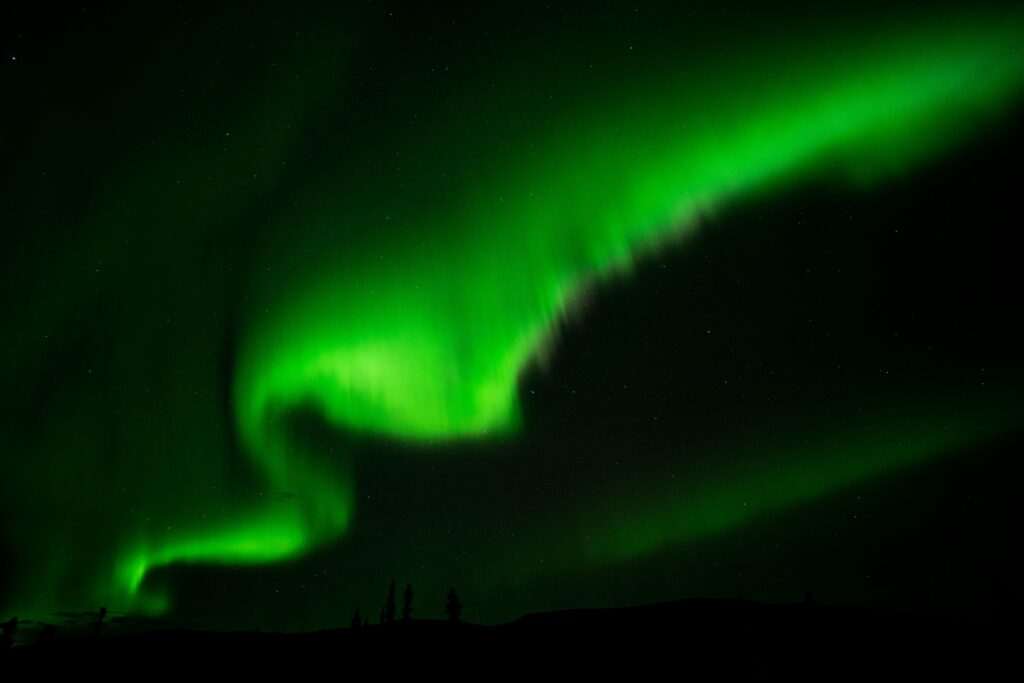
Anchorage sits at 61 degrees north — the same latitude as Helsinki, St. Petersburg, and Oslo — and the aurora borealis dances above it regularly from September through March. The city’s light pollution reduces visibility within its boundaries, but Anchorage’s greatest advantage for aurora hunters is what surrounds it: within 45–90 minutes of downtown, you can be under dark skies in the Matanuska-Susitna Valley, on the upper slopes of Hatcher Pass, or at any of dozens of pullouts along the Glenn Highway where the aurora unfolds overhead without interference. No flights to Fairbanks required.
When to See the Northern Lights Near Anchorage
The aurora is visible from Anchorage whenever the sky is dark — which means it effectively disappears from late May through mid-August, when the midnight sun prevents true darkness. The viewing season runs from approximately mid-August through late April, with the peak months being February and March.
Why February and March? Several factors converge: days are lengthening but nights remain long (giving you a full 8–10 hour dark window), temperatures often moderate slightly compared to January’s extremes, and geomagnetic activity statistically peaks near the spring equinox. September and October offer another strong window with relatively mild temperatures and stable weather patterns.
The equinoxes (around March 20 and September 22) historically correlate with increased geomagnetic storm activity — the mechanism is not fully understood, but the pattern is well-documented among aurora researchers and holds up across multiple solar cycles.
Best Viewing Spots from Anchorage
Hatcher Pass (45–60 min north)
The most popular dedicated aurora-viewing destination among Anchorage locals. The road into Hatcher Pass (north of Palmer off the Fishhook Road) climbs into the Talkeetna Mountains, leaving valley fog and city glow behind. The open alpine terrain above the treeline provides 270-degree sky views. On active nights, the aurora frequently appears directly overhead, reflecting off snowfields below. The parking areas at Independence Mine State Historical Park at mile 17 are a common staging point. Dress for temperatures 10–15°F colder than Anchorage at the pass elevation.
Chugach State Park (20–30 min from downtown)
Chugach State Park’s upper trailheads and viewpoints offer dark sky conditions accessible without a long highway drive. The Eagle River area, the upper Hillside neighborhoods, and the Glen Alps trailhead all put you above the worst of Anchorage’s light dome. On nights with KP 3 or higher, the aurora is visible from these locations. The advantage: you can be parked and watching within 30 minutes of seeing a good forecast.
Glenn Highway Corridor (30–90 min north)
The Glenn Highway heading northeast from Anchorage toward Palmer and beyond offers consistent dark-sky pullouts as it moves away from the city. By Mile 40 (near Palmer), light pollution drops sharply. By Mile 100 and beyond, you are under genuinely dark skies with mountain backdrops on multiple sides. The highway is well-maintained in winter with regular plowing — reliable for a night drive in most conditions.
The area around Matanuska Glacier (Mile 100) provides one of the most dramatic aurora backdrops in the region: a glacier face lit green or white by the aurora, surrounded by canyon walls. The parking area at the glacier viewpoint is accessible year-round and free.
Mat-Su Valley Open Areas
The flat agricultural fields of the Matanuska-Susitna Valley northeast of Palmer — particularly around Wasilla and along the Palmer-Fishhook Road — have minimal light pollution and wide horizon views ideal for aurora watching. The low terrain means you can see the aurora from horizon to horizon when it’s active at lower elevations of the display. Pullouts along rural Mat-Su roads are informal but effective viewing spots.
Understanding Aurora Forecasts
The aurora is driven by solar wind — charged particles from the sun interacting with Earth’s magnetic field. Predicting it requires monitoring two things: KP index (a measure of geomagnetic activity on a 0–9 scale) and cloud cover.
KP index guide for Anchorage:
- KP 1–2: Possible in very dark skies, often just a faint arc on the northern horizon
- KP 3–4: Visible from dark suburban areas, often with movement and color
- KP 5+ (geomagnetic storm): Visible from within or near Anchorage; bright, active, often multi-colored
- KP 7+: Overhead displays, red aurora visible, extraordinary conditions
Forecast tools:
- NOAA Space Weather Prediction Center (swpc.noaa.gov): The authoritative source. Check the 3-day forecast and the real-time Kp index.
- Space Weather app: Reliable mobile app with alerts; set a KP threshold notification for your target location.
- Aurora Forecast app (University of Alaska Fairbanks Geophysical Institute): Alaska-specific, widely used by locals.
- Clear Outside: Cloud cover forecasting tool preferred by aurora photographers for its granular hourly data.
The 27-day solar rotation cycle sometimes makes aurora predictions possible further out: if a sunspot region produced a significant storm 27 days ago, it may be returning to face Earth again. NOAA’s long-range outlook covers this.
Aurora Photography Tips
You do not need professional camera equipment to photograph the aurora, but a smartphone alone is unlikely to capture it well. A mirrorless or DSLR camera with manual controls is the standard tool.
- Settings starting point: ISO 1600–3200, aperture f/2.8 or wider, shutter speed 5–15 seconds. Adjust based on aurora brightness — a very active storm may require only 2–3 second exposures to avoid blur from the aurora’s movement.
- Tripod: Essential. Any camera shake at these shutter speeds destroys the image.
- Manual focus: Set focus to infinity (use a distant light or the stars to confirm before the aurora starts). Autofocus fails in the dark.
- Foreground: The best aurora shots include a compelling foreground — mountains, trees, a frozen lake, or a road leading into the frame. Pure sky shots rarely hold the eye.
- Battery: Cold temperatures drain batteries rapidly. Carry spares in an inside pocket and swap as needed.
Alaska Photo Treks offers guided aurora photography sessions from Anchorage, combining transport to dark sky locations with instruction on camera settings and composition — a good option for photographers who want to maximize a limited window in the aurora season.
Staying Warm: Winter Aurora Viewing Essentials
Standing still in a field at midnight in February in Alaska is far colder than it sounds. Anchorage winter temperatures regularly reach -10°F to -20°F, and Hatcher Pass can be 15 degrees colder than the valley floor.
- Base layer: Merino wool or synthetic moisture-wicking base. No cotton — it holds moisture and kills warmth rapidly.
- Mid layer: Fleece or down insulation over the base layer.
- Outer layer: Windproof, waterproof shell. Wind on an open pass can drive apparent temperature well below the ambient reading.
- Extremities: The most common aurora-watching mistake is underdressed feet and hands. Insulated boots rated to -30°F or below, wool socks, and mittens (warmer than gloves) over liner gloves.
- Hand warmers: Chemical hand warmers in pockets and in boots on very cold nights.
- Vehicle prep: Keep a sleeping bag in your car. If you drive to Hatcher Pass in winter, conditions can change quickly. Know your turn-around point.
The aurora does not wait. The best displays often peak and fade within 20–30 minutes. Setting a KP alert, checking forecasts each evening from late September through March, and being ready to leave on short notice gives you the best odds of catching a significant display.
Adventures by True North runs winter aurora tours that handle the logistics — transport, warm clothing rental, and experienced guides who know the best vantage points on a given night’s conditions.
Featured photo by Jonas Robrecht on Pexels.


No comments yet.