
Moose Watching Near Anchorage Alaska 2026 — Best Spots & Tips
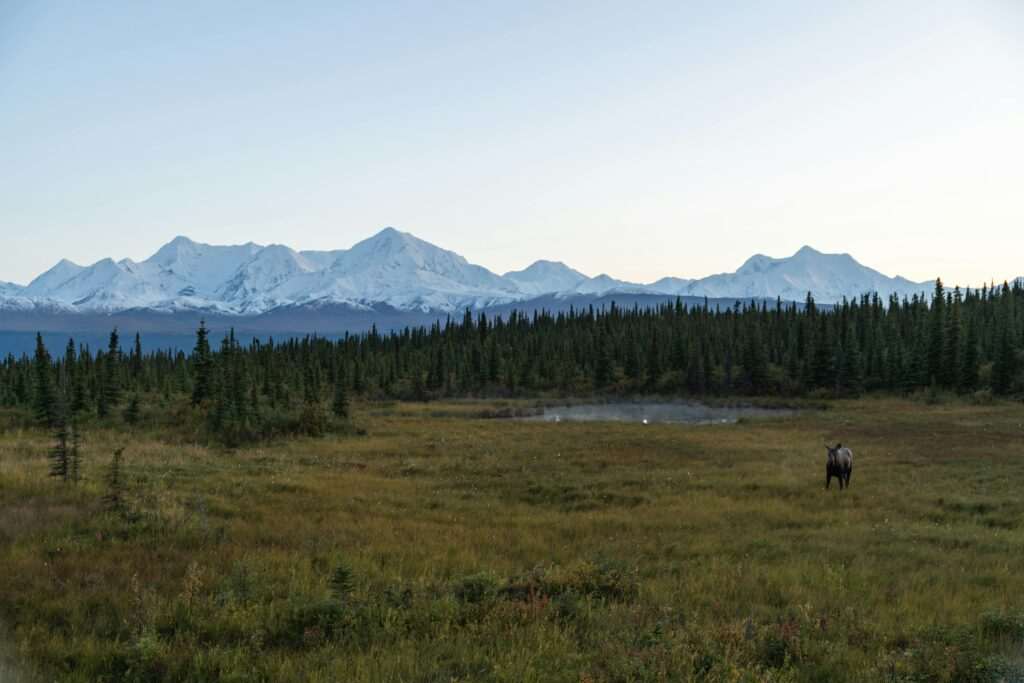
Anchorage is home to an estimated 1,500 moose in the greater metropolitan area — one of the highest concentrations of urban moose anywhere in North America. These are not zoo animals or habituated feeders; they are fully wild Shiras moose that have learned to coexist with a city built in their historic range. They appear in backyards, on golf courses, in school parking lots, and on city trails with a frequency that surprises most visitors and impresses even long-time residents. The combination of accessible greenbelts, productive wetland habitat, and a large surrounding wilderness means that moose watching in Anchorage requires no special equipment, no tour booking, and no remote location — only time outdoors and reasonable awareness of where to look.
Best Spots in Anchorage
The Tony Knowles Coastal Trail and the Westchester Lagoon area at its north end are among the most reliable urban moose locations in Anchorage. The trail corridor runs through mixed spruce and birch forest adjacent to Cook Inlet, and the dense willow thickets along the lagoon margins provide exactly the browse habitat that moose prefer. Early morning walkers on the coastal trail encounter moose several days per week during summer; the willows around Westchester Lagoon are a favored feeding area for cows with calves in late May and June. The trail is paved and accessible from multiple trailheads near downtown.
The Kincaid Park trail system at the south end of the Coastal Trail covers more than 1,400 acres of boreal forest and is one of the densest moose areas in the city. The birch and alder forest along the park’s interior trails supports resident moose year-round, and the park’s size means encounters are spread across the trail network rather than concentrated at single points. Moose are particularly active in Kincaid during the September–October rut, when bulls move widely and are visible from trails at dawn and dusk. The park’s ski trails provide wide sight lines in winter when moose stand out against snow cover.
The Campbell Creek corridor connects several Anchorage greenbelts through the city’s midsection and offers moose sightings in a genuinely urban context — the creek bottom provides willow habitat within blocks of residential neighborhoods and commercial areas. Moose follow the creek corridor seasonally, moving between larger habitat patches at Kincaid to the west and Far North Bicentennial Park to the east. Earthquake Park, at the north end of the Coastal Trail near Point Woronzof, is another productive spot: the open spruce and birch fringe along the bluff edge sees regular moose activity, particularly in early morning. The creek and park corridors are practical moose watching routes for visitors staying in midtown or west Anchorage who want wildlife without driving to distant trailheads.
The Alaska Wildlife Conservation Center
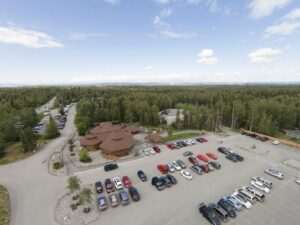
For guaranteed moose encounters without the uncertainty of wild viewing, the Alaska Wildlife Conservation Center at mile 79 of the Seward Highway maintains resident moose in large natural enclosures alongside brown bears, bison, musk ox, caribou, and other Southcentral Alaska species. The AWCC moose are habituated to vehicle and foot traffic, allowing close-range observation that would be impossible with wild moose, and the interpretive signage covers moose biology, behavior, and the center’s rehabilitation program. The AWCC is worth the drive for visitors who want educational context for the moose encounters they may have in the city, or who want a guaranteed close look at an animal they’ve only seen at distance.
Moose Behavior by Season
May and June are the most dangerous months for moose encounters in Anchorage. Cows calve in May, and a cow with a newborn calf is the most hazardous moose scenario for humans — cows are aggressively protective, will charge without warning, and are faster than they appear. Calves are often hidden in tall grass or dense brush near where the cow is visible; approaching what appears to be a single moose may put you between a cow and a calf she has concealed. The fifty-foot safety distance that applies to moose year-round should be extended significantly during calving season, and trail sections where recent calf activity has been reported should be given wide berth.
July and August are productive months for moose watching with lower behavioral risk. Cows are still with calves but the immediate post-birth protectiveness has settled; moose are feeding heavily on willows, sedges, and aquatic vegetation in wetland areas. Early morning and evening hours produce the highest activity. Moose are active feeders for most of the day in Alaska’s long summer light, but the midday hours in warm weather often see them standing or lying in shaded areas.
September and October are the rut. Bull moose become aggressive, move over large territories seeking cows, and behave unpredictably. A bull in rut will approach humans, vehicles, and other large objects without the wariness typical outside the breeding season — this is not friendliness; it is a behavioral shift that makes rutting bulls particularly dangerous. The rut also produces dramatic visible behavior: bulls with full antler racks thrashing brush, sparring with rival males, and following cows through open areas. Viewing from inside a vehicle is safest during this period.
November through April, moose move into Anchorage neighborhoods more heavily as deep snow in the surrounding mountains pushes them to lower elevations where browse is accessible. Urban and suburban moose are common from November onward, appearing in yards, under trees heavy with fruit, and along roads where vegetation is accessible above the snow line. Winter moose are thin and stressed; avoid approaching them as the energy expenditure of fleeing is genuinely harmful to a moose that is already managing a caloric deficit.
Safety: The Basics
Moose are not dangerous because they are aggressive predators; they are dangerous because they are very large, very fast, and unpredictable when they feel threatened or cornered. A mature bull moose weighs 1,000–1,600 pounds and can run 35 miles per hour. The distance that feels respectful from a human perspective — ten or fifteen feet — is well within the threshold that triggers a defensive response from a moose. The Alaska Department of Fish and Game recommends staying at least fifty feet from moose at all times.
If a moose charges, the standard advice is to run and put a solid object between yourself and the animal — a large tree, a vehicle, a building. Unlike bear charges, which may be bluffs, moose charges often continue to contact. A moose that has knocked a person down will typically stomp repeatedly; the correct response if you go down is to curl into a ball, protect your head with your hands, and stay down until the moose has moved away. Do not stand up while the moose is still present.
Warning signs that a moose is about to charge include flattened ears, raised hackles along the back, lowered head, and whites visible around the eyes. Any of these signs at close range means back away immediately and find cover. Dogs are a particular trigger — moose perceive dogs as wolves and respond accordingly. Keep dogs on leash in moose country and be prepared to release the leash if a moose charges; the dog will flee faster than you, and a moose following a leashed dog will reach you.
Photography Tips
A telephoto lens of 200mm or longer is the practical minimum for moose photography at safe distances. At fifty feet, a 200mm lens on a crop-sensor camera produces images that fill about a third of the frame for a full-body moose — adequate for environmental shots but limiting for portrait work. A 400mm lens at the same distance allows cropping to head and shoulder shots without sacrificing resolution. Moose in Anchorage’s urban greenbelts are often encountered at shorter distances than this; resist the temptation to move closer for a better shot and use whatever focal length you have from the safe distance.
Early morning light on an Anchorage trail in June — golden light, dew on the willows, a cow and calf at the edge of a wetland — is among the best wildlife photography setups accessible from any North American city. The combination of the moose’s scale and the Anchorage backdrop (mountains visible from almost any location in the city) produces images that do not require explanation or context to communicate that you are somewhere exceptional.
No comments yet.