
Urban Sketching in Anchorage: Pen-and-Wash Technique and Sketch Walk Guide (2026)
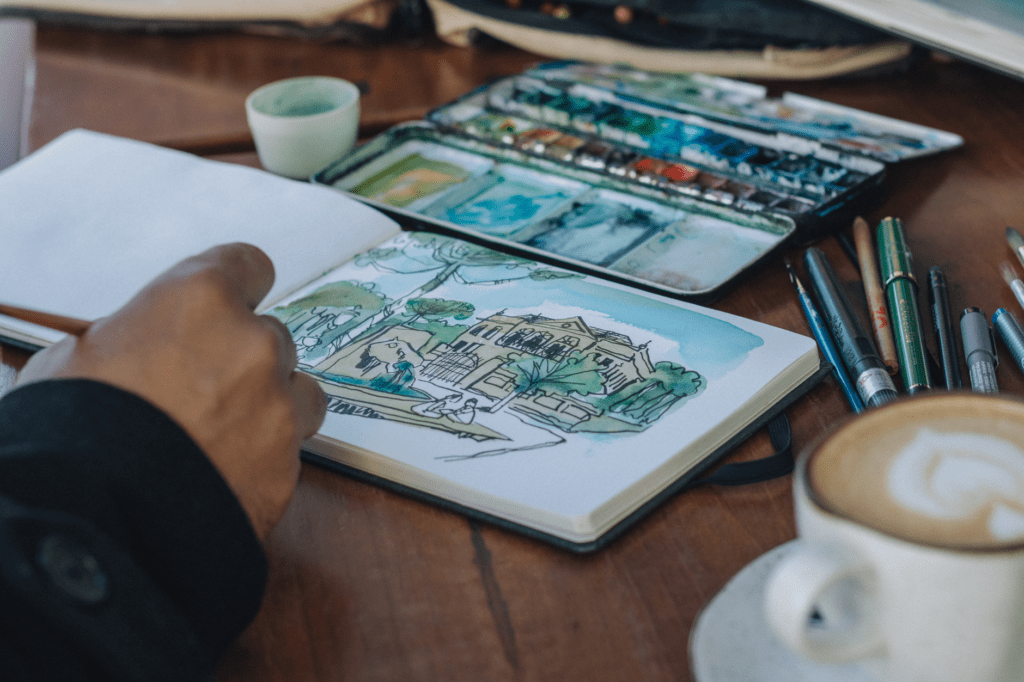
Urban sketching is the practice of drawing the world from direct observation — on location, in real time, without the mediation of photographs or studio reference. It’s a drawing practice that treats the city, the neighborhood, the coffee shop, and the bus stop as subjects worth sustained visual attention, and it’s produced a global community of practitioners connected by the Urban Sketchers organization whose manifesto principles have defined the movement since 2007. Where traditional life drawing focuses on the figure and plein air painting on landscape, urban sketching takes the built environment — architecture, streetscapes, transit scenes, markets, cafés — as its primary subject, with the people and life of those spaces layered in. In Anchorage, urban sketching connects to a city with distinctive architectural character: the mix of mid-century building types, the dramatic mountain backdrop visible from downtown streets, the seasonal transformation of the landscape, and the mix of Indigenous cultural architecture with commercial and industrial vernacular. This guide covers the Urban Sketchers manifesto, pen-and-wash technique, architectural perspective, sketchbook setups, and how to find the sketching community in Anchorage in 2026.
The Urban Sketchers Manifesto
Urban Sketchers was founded in 2007 by journalist and illustrator Gabi Campanario, who started a Flickr group to share location-based drawings. The organization has since grown to include chapters in cities on every continent, producing symposia, workshops, and an enormous body of shared work. The manifesto’s principles define what separates urban sketching from general illustration:
- We draw on location, indoors or out, capturing what we see from direct observation.
- Our drawings tell the story of our surroundings, the places we live and where we travel.
- Our drawings are a record of time and place.
- We’re truthful to the scenes we witness.
- We use any medium and cherish our individual styles.
- We support each other and draw together.
- We share our drawings online.
The “on location” principle is the central one: urban sketching specifically rejects drawing from photographs, because the process of drawing while present — making decisions about what to include, simplify, or emphasize in real time — produces a fundamentally different relationship to the subject than copying a photograph. The time constraint and the immersion in a real place force choices that improve draftsmanship more quickly than studio work from reference.
Pen-and-Wash Technique
The characteristic urban sketching technique combines ink line work with watercolor wash — the pen establishes structure, shadow, and texture with confident linework, and the watercolor adds color, atmosphere, and tonal unity. The combination is fast, portable, and produces results that read clearly even in small sketchbook formats:
The Pen Foundation
Most urban sketchers use a waterproof fine-tip pen (Micron, Staedtler Pigment Liner, or a waterproof fountain pen) for their line work. Waterproof ink is essential — watercolor washes over non-waterproof pen lines will smear, blurring the line drawing underneath. Line weight variation (heavier lines for foreground elements, lighter for middle distance, very faint or omitted for background) creates the illusion of depth without shading. Urban sketching lines tend toward confident, continuous strokes rather than tentative scratching — hesitation shows in ink line work.
The sequence varies by practitioner: some sketch lightly in pencil first, then ink over the pencil before erasing; others go directly to pen without preliminary pencil (the “direct ink” approach that’s riskier but forces confidence and produces more energetic drawings); others use a light pencil understructure only for major proportions and perspective lines, not for detail.
Watercolor Wash
After the ink line work is complete (and fully dry), watercolor washes are applied to add color and tonal structure. Urban sketching watercolor tends toward loose, gestural washes rather than tight photographic rendering — the goal is to suggest atmosphere and color rather than to compete with the pen linework for detail. Three to five color washes over well-placed ink lines produce more successful urban sketches than tight, overworked color rendering. Keeping the sky wash loose and allowing some granulation adds to the sketch’s vitality.
Perspective for Architecture
Buildings and streets require a basic understanding of perspective — the way parallel lines converge to vanishing points on the horizon — that figure drawing and landscape work don’t demand in the same way:
One-point perspective applies when you’re looking directly at a building’s face, with the street receding away from you. All horizontal lines parallel to the street converge at a single vanishing point directly ahead.
Two-point perspective applies when you’re at a corner, with the building’s two visible faces each angling away to separate vanishing points on either side. This is the most common perspective configuration for urban sketching.
The key insight for beginners is that perspective isn’t a formula to calculate but a visual phenomenon to observe: the convergence of lines is something you can see by looking carefully at what’s in front of you. Using a pencil held horizontally at arm’s length to check the actual angle of a building’s roofline or windowsill against the horizon is a reliable, low-tech way to calibrate perspective without calculation. Slight perspective “mistakes” that convey the right general sense of depth and three-dimensionality are far less damaging to an urban sketch than timid, uncommitted lines.
Drawing on Location vs From Photos
Urban sketching specifically requires on-location drawing — but understanding why makes the practice more productive. Drawing from a photograph produces a flattened, frozen image that’s already been translated by a camera’s perspective distortion and tonal compression. Drawing from life requires your eyes to continuously translate three-dimensional space into two-dimensional marks, which exercises the visual processing that photographs short-circuit. The resulting drawings have a liveliness and spatial coherence that most photo-reference drawings lack.
The practical challenges of on-location drawing — weather, passersby, moving subjects, changing light — aren’t obstacles to work around but part of the practice. A subject that moves (a bus, a pedestrian, a cloud) requires the sketcher to capture an impression quickly and move on, which builds drawing fluency faster than unlimited time with a static reference. The limited time available in any location forces decisive choices about what to include and what to simplify.
Travel Sketchbook Setups
The urban sketcher’s kit needs to be small enough to carry without thinking about it, so it gets used habitually rather than only on dedicated sketching excursions:
- The minimal kit: A waterproof pen (Micron 05 or equivalent), a small half-pan watercolor set (Winsor & Newton Cotman or Schmincke tins work well), a small water brush, and a pocket sketchbook (Moleskine Watercolor, Leuchtturm, or Handbook). Everything fits in a jacket pocket.
- The extended kit: Adds a second water brush for clean water, a small folding stool for longer sessions, and a slightly larger sketchbook (A5 or 5×8 inches) with heavier paper weight (140 lb minimum for watercolor without buckling).
- Paper matters: Cheap sketchbook paper buckles with watercolor and produces frustrating results. Cold-press watercolor paper (textured) or hot-press (smooth) in a dedicated sketchbook is worth the investment — the paper’s quality directly affects how the watercolor washes behave.
Finding the Sketching Community in Anchorage
Sketch walks — organized group sketching events where participants meet at a location, draw independently for 1–2 hours, then share their sketches — are the social infrastructure of the urban sketching community. They’re beginner-friendly by design: there’s no instruction, no critique, and no pressure to produce finished work. Participants of all skill levels draw side by side and share what they made at the end.
Anchorage sketch walks operate through the visual arts community, connecting to galleries, the Alaska Center for the Arts, and informal online groups. Popular Anchorage sketching locations include the Historic Fourth Avenue corridor, the Saturday Market (summer), the Delaney Park Strip, downtown building facades, and Ship Creek’s industrial waterfront. The dramatic mountain backdrop visible from almost any downtown location gives Anchorage urban sketches their distinctive character — the combination of built environment foreground and Chugach Range background is unlike anything in a lower-48 city.
Workshop prices for urban sketching instruction run $40–$85 for a half-day session covering technique and a supervised sketch walk. Anchorage craft workshop participants can show and sell their finished work at year-round events including the Anchorage Market & Festival, the Anchorage Native Arts & Culture Festival, and the Alaska State Fair. Our free things to do in Anchorage guide covers the markets, public spaces, and downtown destinations that serve as the best sketch walk starting points in Anchorage. Our Anchorage hiking guide covers the trailheads and natural areas on Anchorage’s edges where urban sketching extends into nature journaling and landscape drawing — the boundary between urban and plein air sketching in Anchorage is particularly blurry given how close the wilderness is to the city center.

No comments yet.