
Best Time to Visit Anchorage 2026: Season-by-Season Guide
The best time to visit Anchorage depends entirely on what you want to do. Alaska’s largest city runs on extremes: nearly 20 hours of summer daylight versus fewer than six in December, a shoulder season defined by ice breakup and the world’s most famous sled dog race, and a fall that delivers both vivid foliage and the first appearances of the northern lights. Every season has a legitimate case to make. Here is what each window actually delivers — month by month — and how to match the calendar to your interests.
Month-by-Month Quick Reference
| Month | Avg High (°F) | Crowds | Key Highlights |
|---|---|---|---|
| January | 22°F | Low | Northern Lights, dog sledding, ski season |
| February | 26°F | Low–Med | Fur Rendezvous festival, aurora prime window |
| March | 34°F | Medium | Iditarod ceremonial start, last of the ski season |
| April | 44°F | Low | Ice breakup, wildlife emerges, best hotel value |
| May | 55°F | Low | Wildflowers, bears out, trails opening |
| June | 65°F | High | Midnight sun, halibut season opens, hiking peak |
| July | 66°F | Peak | Salmon runs, whale watching, all trails open |
| August | 63°F | High | Salmon peak, berries, Alaska State Fair approaches |
| September | 52°F | Medium | Fall foliage, moose rut, aurora returns, fewer crowds |
| October | 37°F | Low | Aurora prime window begins, dramatic skies, shoulder value |
| November | 24°F | Low | Early snow, cross-country skiing opens |
| December | 19°F | Low | Shortest days (5.5 hrs), Northern Lights, winter sports |
Spring (April–May): Breakup Season and the Best Value Window
Spring in Anchorage is defined by breakup — the dramatic, messy transition when winter releases its grip on the landscape. Ice on rivers and lakes fractures and flows, the trails that were packed snow become soft mud, and the city shakes off months of cold with a visible collective energy. It is not the prettiest time to visit from a conventional tourism standpoint, but it offers something that no other season can: Anchorage at its most local and least crowded, with shoulder-season hotel prices that can be 40–50% below summer peak rates.
April brings the first serious wildlife activity. Brown and black bears emerge from dens with cubs, moose calves begin appearing in late April and May, and the Chugach trails start drawing hikers and trail runners as soon as the snow level recedes to higher elevations. Birdwatching picks up significantly in May, with migratory species returning along the coastal flyway.
The practical constraint of spring is trail conditions. Lower-elevation trails like the Tony Knowles Coastal Trail are rideable and walkable by mid-April. Higher-elevation routes into Chugach State Park — including popular destinations like Flattop Mountain — can hold snow into May and turn muddy during the thaw. Check trail condition reports before heading out above the tree line.
Summer (June–August): Peak Season, Midnight Sun, and Outdoor Everything
June through August is when Anchorage delivers its most famous version of itself. The weather is reliably mild — daily highs in the mid-60s°F, rain possible but rarely sustained, mountains visible on clear days that arrive frequently. The midnight sun extends outdoor activity windows in ways that are genuinely difficult to convey to someone who hasn’t experienced them: it is fully light at 11 PM, still glowing at midnight, and the sky barely darkens before the sun comes back up. Restaurants are still full at 9:30 PM. Trail parking lots fill at 7 AM and stay busy until 9 PM.
The Mayor’s Midnight Sun Marathon in June is one of the most distinctive race experiences in North America — a mass start at midnight in full daylight. The summer solstice (June 20–21) brings nearly 19.5 hours of official daylight and several hours of civil twilight on either side.
Salmon runs define the summer biology calendar. King salmon enter Ship Creek — the urban stream that runs through downtown Anchorage — starting in late May and peaking in June, making Ship Creek one of the few places in Alaska where you can watch (and catch) salmon within walking distance of downtown hotels. Sockeye runs peak in July and August across the Kenai Peninsula and other accessible watersheds. Beluga whales follow the salmon into Turnagain Arm and Cook Inlet, and summer is the prime window for viewing them from the coastal overlooks on the Seward Highway.
The Alaska State Fair in Palmer (45 minutes from Anchorage) runs from late August through Labor Day and is the largest annual event in the state — over 300,000 attendees, giant vegetables, livestock, carnival rides, and major music acts. Late August is the sweet spot for combining peak outdoor season with the fair.
The tradeoff of summer: it is crowded, accommodation prices peak, and advance booking is essential. Downtown Anchorage hotels in July can sell out weeks ahead. Tours — particularly flightseeing, glacier trips, and guided fishing — book up quickly on good-weather days. Plan and reserve well in advance for any summer visit.
Fall (September–October): Shoulder Season, Foliage, and Aurora Returns
September is arguably the best-kept secret on the Anchorage tourism calendar. The summer crowds thin dramatically after Labor Day. Hotel prices fall. The birch and aspen forests turn gold and amber across the Chugach foothills — the color peaks in mid-September and is legitimately spectacular on clear days when the yellows are backlit against snow-dusted peaks. The moose rut runs from late September through October, which means large bulls are visible from roads and trails and behaving unpredictably (maintain your distance).
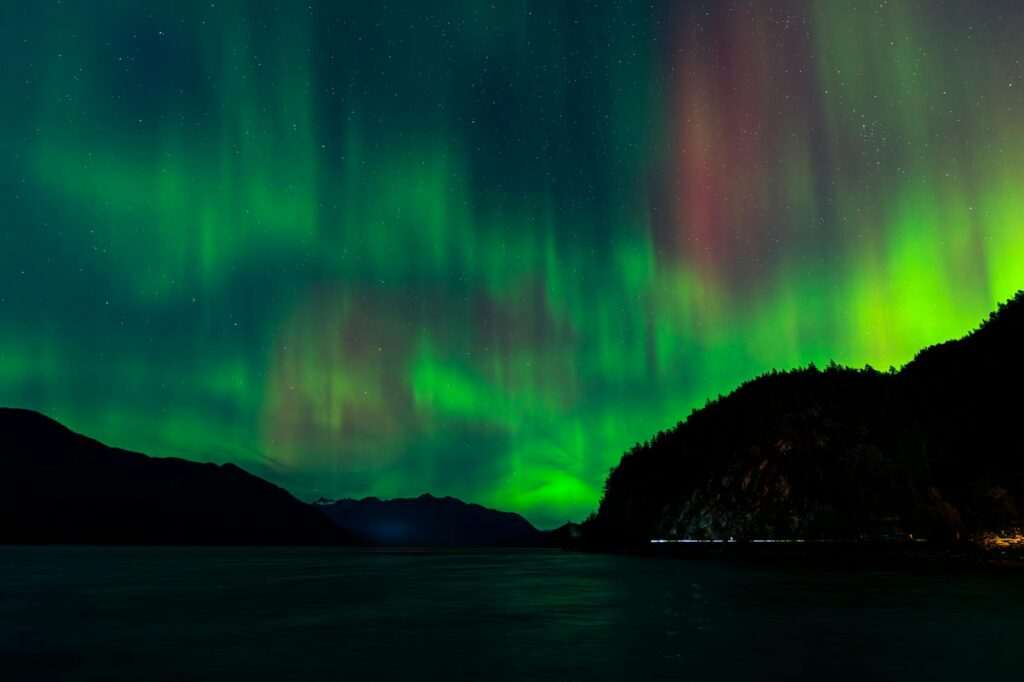
Most importantly, the aurora borealis returns. The midnight sun of summer makes aurora viewing impossible; after the autumnal equinox, darkness returns to Anchorage and the northern lights can appear as early as late August. October brings the first genuinely reliable aurora window, with clear nights and dark skies that are absent for four months in summer. The Anchorage Aurora & Astrophotography Workshop Series runs programming for visitors who want expert guidance on forecasting and photography.
Trail conditions in September are often the best of the year at mid-elevations — summer moisture has firmed the surfaces, the mud of spring is long gone, and the cooler temperatures make extended hiking more comfortable than July. Snow typically arrives at higher elevations by mid-October and closes the upper Chugach routes for the season.
Winter (November–March): Northern Lights, the Iditarod, and Snow Culture
Anchorage winters are cold, dark, and — for the right visitor — deeply rewarding. The period from November through February has fewer than seven hours of daylight at the solstice, which sounds challenging but compresses activity into a vivid, intentional window rather than eliminating it. The city maintains an extensive cross-country ski and snowshoe trail network through the winter, including the Kincaid Park Winter Sports Center with groomed Nordic trails and a biathlon facility that hosted the 1994 World Championships.
The northern lights are at their most reliable from December through March — clear nights, which Anchorage gets regularly in the interior ridge, combined with long hours of darkness mean multiple aurora opportunities in a single week during good solar activity periods. Aurora chasers who plan specifically around Kp-index forecasts can optimize their chances significantly.
The cultural highlight of Alaska winter is the Iditarod, whose ceremonial start runs through downtown Anchorage on the first Saturday of March. Sixty-plus dog teams running a four-mile urban course through massive street crowds is one of the most memorable public events in North American sports. Iditarod Trail Headquarters in Wasilla offers year-round context for the race history and organization. Downtown hotels book out months in advance for Iditarod weekend.
Best Time for Specific Interests
- Aurora borealis: October through March. Peak darkness and solar activity align best in mid-winter (December–February). September is the earliest reliable window after summer.
- Hiking and outdoor adventure: Mid-June through September. Peak conditions July–August for all-trail access; September for solitude and fall color.
- Salmon fishing: June (king), July–August (sockeye and pink). The Kenai River and Ship Creek are the most accessible options.
- Wildlife viewing (bears, whales, moose): May–September for bears and belugas; moose year-round, most active in September–October rut and May–June calving.
- Budget travel: April–May and October–November offer the best hotel rates and least competition for reservations. December is also underrated value-wise for indoor-culture visitors.
- Families with children: July–August for the widest activity access and the most predictable weather. The Alaska State Fair in late August is a reliable family anchor event.
- Iditarod experience: First Saturday in March. Book downtown accommodation 3–6 months in advance.
Practical Tips by Season
What to pack: Summer (June–August) requires layers even in warm weather — a light rain shell, fleece mid-layer, and sun protection. Sleep masks are essential in June and July when the sun never fully sets. Fall (September–October) demands a proper waterproof jacket and warm layers for evening aurora-watching. Winter visits require serious cold-weather gear: insulating layers, wind-blocking outer shell, warm boots rated to at least -20°F, and face and hand protection for extended outdoor time.
Booking lead times: July and August — book accommodation and key tours (flightseeing, glacier trips, fishing charters) 4–8 weeks ahead minimum, longer for peak dates. Iditarod weekend (early March) — book 3–6 months ahead. Shoulder seasons (April–May, September–October) — 1–2 weeks typically sufficient for accommodation, though specific tours may still sell out quickly on good-weather days.
Daylight management: Summer visitors should plan for the disorienting effect of 24-hour light. Pack a sleep mask and blackout curtains won’t hurt. Don’t rely on darkness to signal bedtime — use a watch. Winter visitors get the opposite: maximize the short daylight window for outdoor activity and plan indoor or aurora-watching activities for the long evenings.


No comments yet.