
Alaska Reindeer Farm & Unique Animal Encounters Near Anchorage 2026
Alaska’s wildlife watching reputation is built on bears, whales, and eagles — the charismatic megafauna that visitors come from across the world to see in wild settings. But some of the most memorable animal experiences near Anchorage happen at closer range, in curated settings where ancient species stand within arm’s reach and the encounters feel genuinely improbable. The Palmer Valley, 45 minutes north of Anchorage, is home to two of the stranger attractions in the state: a working reindeer farm where a herd of domesticated animals wanders up for hand-feeding, and the only domestic musk ox farm on earth. Combine those with the Alaska Wildlife Conservation Center on the Seward Highway, the Alaska Zoo inside the city, and the Alaska SeaLife Center in Seward, and you have a region unusually well supplied with close-contact animal encounters that reward families with children and anyone curious about Alaska’s fauna beyond the roadside moose.
Alaska Reindeer Farm, Palmer
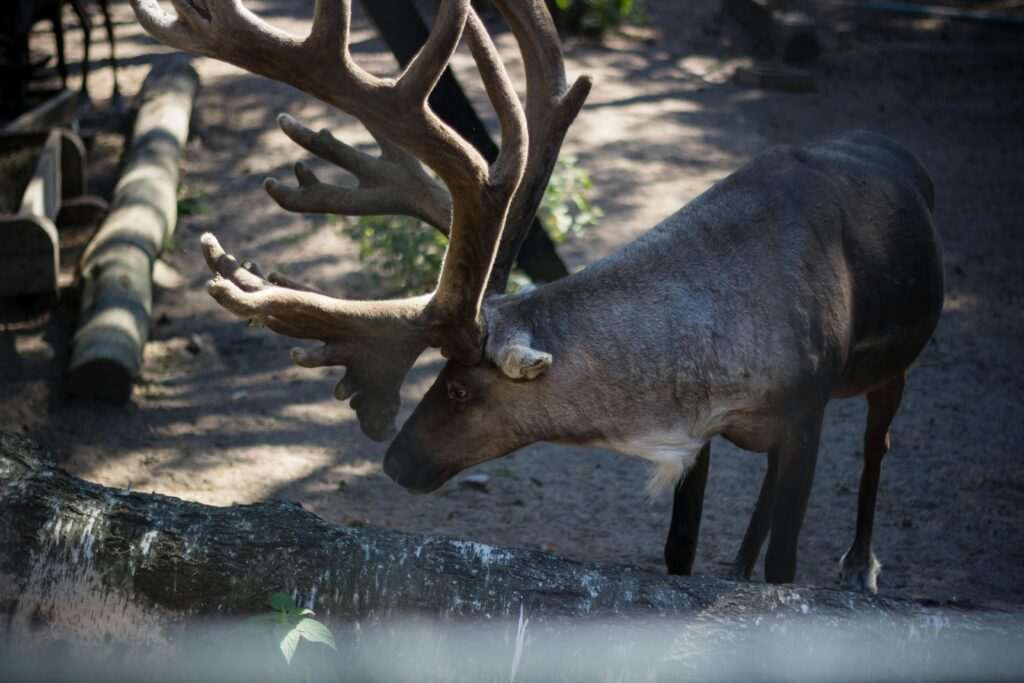
The Alaska Reindeer Farm sits on a working homestead outside Palmer, and its appeal is entirely about access. You walk into a large enclosed pasture, a herd materializes from wherever they were lounging, and you spend the next 30 to 45 minutes surrounded by animals large enough to be slightly intimidating and tame enough to eat pellets from your palm. The antlers — present on both males and females, since reindeer are the only deer species where both sexes grow them — are either velvet-soft in summer or fully hardened by fall, and the up-close view is something wildlife watching tours simply cannot provide.
Spring calving season (April–May) brings newborns into the petting area. Summer tours run daily. Christmas-season programming from Thanksgiving through the holidays plays up the obvious theme with decorated facilities and Santa-adjacent photo opportunities — a regional Anchorage tradition that reads as charming rather than kitschy because the animals remain the draw.
Admission runs approximately $15–$20 for adults and $10–$15 for children, with family rates available. The farm is located at 5561 S Bodenburg Loop Road in Palmer. Open seasonally; call ahead or check the website during shoulder months. Best season: May through September for regular tours, late November through December for the holiday experience. All ages, excellent for young children.
Musk Ox Farm, Palmer
The Musk Ox Farm outside Palmer is a more serious enterprise — a nonprofit research and breeding facility that is, by any account, the only place on earth where musk oxen are domesticated and farmed for their fiber. Qiviut, the underfleece that musk oxen shed each spring, is one of the finest natural fibers in the world: warmer than wool by weight, softer than cashmere, and produced in small enough quantities that garments made from it carry prices that reflect genuine scarcity. The farm maintains a herd of about 80 animals and has been developing the domestication program since 1964.
Tours run May through September: a guided walk along the fence lines of pastures holding different age and gender groups. Guides explain the biology of musk oxen — Ice Age survivors whose range once covered the Northern Hemisphere — alongside the practical realities of domestication: fiber-combing in spring, the breeding program, the challenges of working with an animal neither fully wild nor fully tame. Baby musk oxen in late spring are among the more improbable things you can see on any farm.
Admission is approximately $15 for adults, less for children, with combination tickets available for families. The farm is at 12850 E Archie Road, Palmer. Open daily 10 AM–6 PM from Memorial Day through Labor Day; limited hours in May and September. Best season: late May through June for calves, any summer month for the full tour experience. A shop on site sells qiviut goods — hats, scarves, neck rings — made by rural Alaska Native women through the Oomingmak Co-operative, making it a natural combination stop for anyone interested in authentic Alaska craft.
Alaska Wildlife Conservation Center
The Alaska Wildlife Conservation Center near Portage, on the Seward Highway 50 miles south of Anchorage, is a rescue and rehabilitation facility that houses animals that cannot be released to the wild — orphaned or injured bears, moose, bison, elk, wolves, lynx, caribou, eagles, and other Alaska species that arrived as injured or imprinted animals and could not safely survive independently. The facility’s mission is rehabilitation and conservation, but its practical function for visitors is something close to a drive-through safari through Alaska’s most iconic fauna.
The format is unusual: you drive or walk a 1.5-mile loop road past large, naturalistic enclosures where the animals live year-round. Brown bears and black bears, often multiple animals in a single enclosure, are visible at close range in conditions that do not exist in any other accessible Alaska venue. A bison herd grazes a meadow visible from the main loop. Moose, elk, and caribou appear along the road at distances that would be genuinely dangerous in the wild. The scale of the property — set against the Chugach peaks at the head of Turnagain Arm — provides a visual context for the animals that indoor zoo settings cannot replicate.
Open year-round, though winter hours are reduced (check the website). Summer admission is approximately $20 for adults, $12 for children ages 4–12, free under 4. The drive-through loop takes 1.5 to 2 hours at a casual pace. Best season: May through September for maximum animal activity; October and November for fall light and bear viewing before hibernation. All ages, genuinely impressive for older children and adults.
Alaska Zoo, Anchorage
The Alaska Zoo in south Anchorage is a city-sized facility with a specific focus: Alaska and Arctic species, with some Asian and northern-climate animals that share ecological parallels with Alaska’s native fauna. The collection includes polar bears, brown and black bears, snow leopards, Amur tigers, Tibetan yaks, Bactrian camels, musk oxen, mountain goats, caribou, wolverines, and a range of Alaska birds including bald eagles, owls, and ravens. What distinguishes the Alaska Zoo from larger urban zoos is the coherence of its collection — almost everything on exhibit connects to either Alaska’s native species or the broader Arctic and subarctic world.
The zoo runs summer events including keeper talks, feeding demonstrations, and seasonal programs for children. Polar bear feeding presentations, when scheduled, draw significant crowds — watching an 800-pound bear interact with its keepers at close range is a genuine spectacle. The zoo’s layout rewards a 2-hour walk and gets less crowded in the morning hours.
Admission is approximately $20 for adults, $13 for children 3–17, free under 3. Open year-round, 9 AM–6 PM in summer, reduced hours in winter. The zoo is at 4731 O’Malley Road in south Anchorage, 20 minutes from downtown. Best season: summer for maximum outdoor animal activity and programming, but the zoo operates year-round and winter visits have their own appeal. All ages.
Alaska SeaLife Center, Seward
The Alaska SeaLife Center in Seward is the only public aquarium in Alaska and the state’s primary marine wildlife rehabilitation facility. The research mission is genuine — the SeaLife Center has been involved in species recovery work for Steller sea lions, sea otters, and seabirds — but for visitors the main draws are the exhibits: harbor seals and Steller sea lions in large indoor/outdoor tanks visible from underwater viewing windows, a seabird colony with puffins and murres that nests directly above the fish tanks in a multi-story open enclosure, sea otters, touch tanks for children, and rotating exhibits on Alaska marine ecosystems.
The sea otter exhibit tends to stop visitors in their tracks — resident animals float and groom in an enclosure with excellent multi-angle viewing. The seabird colony above the fish tanks, where puffins nest on artificial rock ledges while fish swim below, is the kind of spatial design that makes clear the center was built for serious naturalists as well as families.
Admission is approximately $29 for adults, $20 for youth 3–17, free under 3. Open daily 9 AM–5 PM in summer, reduced winter hours. Seward is 2.5 hours south of Anchorage via the Seward Highway — a drive worth making independently of the SeaLife Center, but the center makes a natural anchor for the day. Best season: May through September. All ages; the touch tanks are especially popular with young children.
Planning Your Encounters
The Palmer farms pair naturally into a half-day loop: drive the Glenn Highway 45 minutes to Palmer, visit the Reindeer Farm and Musk Ox Farm back-to-back (they are within 15 minutes of each other), and return to Anchorage. The Alaska Wildlife Conservation Center combines well with any Seward Highway day trip, particularly alongside Portage Glacier. The Alaska Zoo is a standalone city attraction, easy to add to any Anchorage day. The SeaLife Center requires committing to the Seward drive but is routinely cited as one of the best single destinations in Southcentral Alaska for families. Any two of these stops in a day makes for a full and genuinely unusual Alaska experience.
Photo: Valeria Boltneva / Pexels
No comments yet.