
Portage Glacier Day Trip from Anchorage 2026: Boat Tours, Hikes & What to Expect
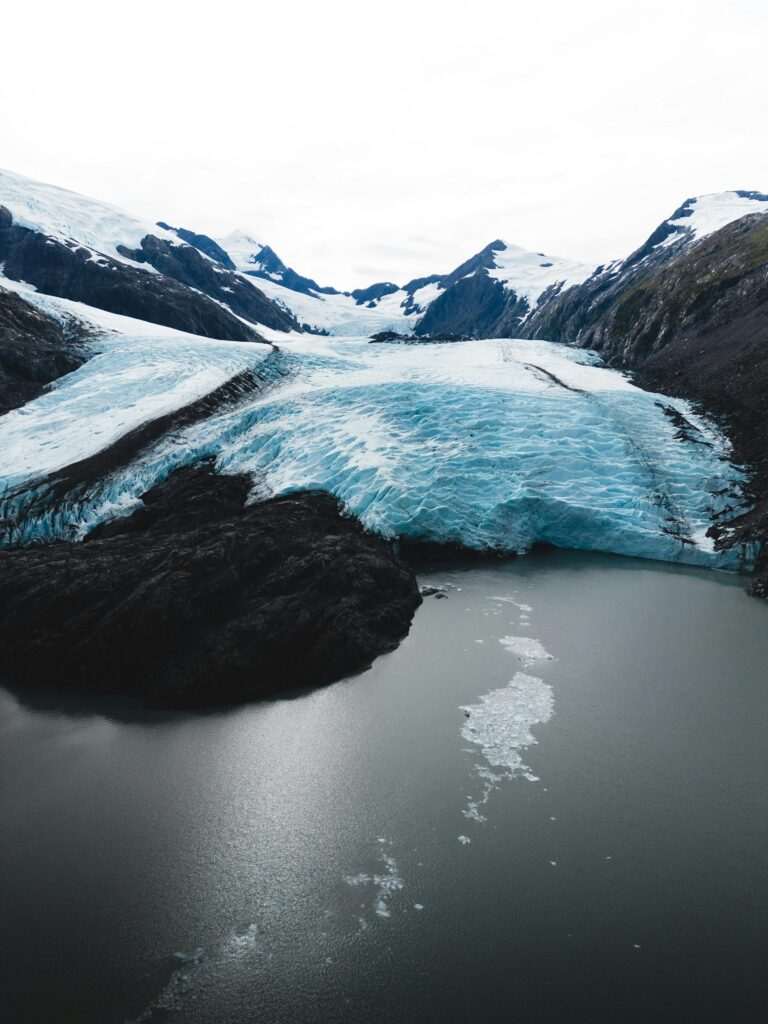
Fifty miles south of Anchorage, tucked into a steep-walled valley off Turnagain Arm, Portage Glacier is the most accessible glacial experience in Alaska. You don’t need a bush plane or a multi-day expedition to reach it — just a one-hour drive down the Seward Highway, one of the most scenic roads in North America, and you’re standing at the edge of a glacier-carved lake with floating icebergs and a wall of blue ice at the far end.
For first-time Alaska visitors, Portage is often the moment it all becomes real: the scale, the color of the ice, the cold air coming off the water. It fits comfortably into a half day, pairs perfectly with Whittier for a full-day excursion, and requires no technical skill or special gear. This guide covers everything you need to make the most of the trip.
Getting to Portage Glacier
From Anchorage, take the Seward Highway south along the western edge of Turnagain Arm. The drive itself is worth lingering over — the arm is one of the best bore tide viewing locations in Alaska, and Dall sheep frequently appear on the cliffs above the road. After about 48 miles, turn left onto Portage Glacier Road and follow it 5 miles into the valley to the Begich-Boggs Visitor Center and Portage Lake parking area.
Parking at the visitor center is managed by the U.S. Forest Service. An America the Beautiful annual pass (the federal interagency pass) is accepted in lieu of the day-use fee. The lot can fill on summer weekends; arriving before 10 a.m. helps. Restrooms are available at the visitor center.
Cell service in the Portage Valley is limited or nonexistent depending on your carrier. Download offline maps before leaving Anchorage and check the boat tour schedule in advance rather than relying on on-site phone access.
Begich-Boggs Visitor Center
The Begich-Boggs Visitor Center, operated by the U.S. Forest Service, is the hub of the Portage Valley experience. The building sits on the shore of Portage Lake with a viewing deck that faces up the valley. The exhibits inside cover glacial geology, the ecology of the valley, and the 1964 Great Alaska Earthquake — a magnitude 9.2 event that was the most powerful earthquake ever recorded in North America and reshaped much of southcentral Alaska. The scale of the earthquake is one of the more sobering natural history exhibits you’ll encounter in the region.
There is one important thing to know before arriving: Portage Glacier is no longer visible from the visitor center deck or parking lot. The glacier has retreated dramatically since the 1970s due to warming temperatures. The ice face that once extended nearly to the visitor center is now several miles up the lake. To actually see the glacier, you need to either take the boat tour or hike to a viewpoint. The visitor center still offers an excellent orientation to the valley and is worth the time, but managing this expectation before arrival prevents disappointment.
The MV Ptarmigan Boat Tour: The Best Way to See the Ice
The MV Ptarmigan cruise is operated by Gray Line Alaska and remains the most compelling way to experience Portage Glacier. The tour runs across Portage Lake to within a short distance of the glacier face — a journey of about a mile across open water that would be difficult to replicate on foot. The boat passes floating icebergs that have calved from the glacier, some large enough to climb on if you could reach them. At the glacier face, the boat pauses for photographs and narration about the glacier’s history and retreat.
The full tour takes approximately one hour. Conditions on the lake can be brisk even in mid-summer — the air coming off the glacier is significantly colder than ambient temperature, and wind is common. Bring a fleece or windshell regardless of how warm it feels in Anchorage before you leave. The narration provided by boat staff covers glaciology, the 1964 earthquake, and local wildlife.
July and August are the most active months for calving ice — the warm water beneath the glacier accelerates the calving process, and the lake fills with floating fragments. Early morning departures often see calmer water and better photography conditions. Check current ticket prices and schedules directly with Gray Line Alaska before your trip, as rates and departure times vary by season and can change year to year.
The boat tour is the highlight of most Portage Valley visits and is worth the additional cost beyond the visitor center entry fee. Book in advance for July and August visits; summer weekends sell out quickly.
Byron Glacier Trail: Ice Without the Boat
The Byron Glacier Trail is a one-mile round-trip walk to a permanent snowfield and small glacier that requires no boat ticket and is accessible to virtually everyone, including families with young children. The trailhead is near the visitor center, and the path follows the valley floor through alder and cottonwood toward a narrowing canyon. The trail gains minimal elevation — it is as flat as glacier-country hiking gets.
At the trail’s end, a permanent snowfield fills the valley. In early summer (May through July), ice caves form at the base of the snowfield where meltwater has carved tunnels through the ice. The caves are fragile and potentially unstable — the Forest Service advises against entering them, and for good reason — but viewed from the outside, the pale blue light filtering through the ice is extraordinary.
The Byron Glacier hike is the best option for visitors who want to get close to glacial ice without taking the boat tour. It’s ideal for families, non-swimmers who prefer to stay on land, and anyone adding Portage to a longer day that doesn’t include the boat tour budget. It also pairs well with the MV Ptarmigan cruise — the two together give a comprehensive view of the valley’s ice from multiple angles.
More Hiking in the Portage Valley
The valley has additional trail options for visitors with more time or energy. The Portage Lake shoreline trail is a short, flat walk along the lakeshore with views across the water toward the glacier valley — more of a scenic stroll than a hike, but a good option for visitors who want to linger without committing to a longer route.
The Williwaw Lakes Trail is a longer backcountry option that climbs out of the valley and connects to the broader Chugach wilderness system. It is significantly more demanding than the Byron Glacier Trail and appropriate for experienced hikers who want solitude and high-alpine terrain. The round trip to the lakes is roughly 8 miles with substantial elevation gain. This route is best done with a map and good weather; the terrain above the valley is exposed.
Wildlife in the Portage Valley
The Portage Valley is excellent bear country — primarily black bears, which are common throughout the valley in summer, particularly near the berry patches and salmon streams that feed into Portage Creek. Carry bear spray and have it accessible, not zipped into your pack. Make noise on the trails, especially in the dense alder sections where visibility is low.
Moose are regularly seen along the valley floor and in the wetland areas near the creek. They are large, occasionally aggressive, and should be given plenty of space. Dall sheep appear on the high ridges flanking the valley — binoculars make them easier to spot against the rock face. Ptarmigan are present on the high slopes and in valley heath, particularly in autumn when their plumage transitions.
The creek running through the valley supports salmon runs in late summer. Bears fishing in the creek occasionally appear along the Portage Glacier Road itself; slow down and watch from your vehicle rather than stopping on the roadway.
Adding the Portage Pass Trail and Whittier
The Anton Anderson Memorial Tunnel — a 2.5-mile road/rail tunnel through the Chugach Mountains — connects the Portage Valley to Whittier, just 5 miles from the Portage Glacier Road turnoff. The tunnel charges a toll and operates on a schedule (trains and cars share the single bore on alternating 30-minute windows), so check the tunnel schedule before planning to use it.
The Portage Pass Trail offers a spectacular alternative to the tunnel: a 4-mile round-trip hike from a Whittier-side trailhead over a high pass with sweeping views of Portage Glacier and Portage Lake from above. This perspective — looking down onto the glacier and the valley you’ve been walking through — is one of the best views in the region. The trail is moderate, gaining about 750 feet to the pass, and requires starting from Whittier.
Combining Portage Glacier and Whittier into a single day is one of the best day-trip itineraries from Anchorage. The sequence that works best: drive to Portage Glacier first (boat tour + Byron Glacier trail), then drive through the tunnel to Whittier for lunch and a walk along the harbor, then return through the tunnel in the late afternoon. Allow a full 8–10 hours for the combination.
Best Time to Visit
The boat tour operates June through September. July and August offer the highest probability of active calving ice and the most icebergs on the lake. The valley wildflowers — fireweed, lupine, and cottongrass — peak in early to mid-July. September brings the first autumn color to the alders and the start of salmon-viewing season in the creeks.
For photography, early morning is consistently the best time. The lake surface is calmer before wind picks up, producing mirror-like reflections of the surrounding peaks. Late afternoon (after 5 p.m. in summer) produces warmer, golden light on the glacier face. Overcast days often produce better glacier color — the diffuse light brings out the deep blues in the ice that direct sun can wash out.
Practical Logistics
Pack layers regardless of the season. Valley temperatures run 10 to 15 degrees cooler than Anchorage even in July, and the air from the lake is colder still. A rain jacket is useful for both weather and the spray near the boat tour. Comfortable walking shoes are sufficient for the valley trails; waterproof boots are advisable if you plan to hike to the snowfield.
There are no food services in Portage Valley beyond a small snack offering at the visitor center. Pack a lunch if you’re spending the full day, particularly if combining with Whittier. The drive back along Turnagain Arm passes several pull-outs for bore tide viewing if you time the return for the tidal cycle.
Portage Glacier fits into any Alaska itinerary, whether as a first-day orientation to the landscape or a dedicated half-day excursion. It is, by a significant margin, the most convenient place in Alaska to experience what a glacier actually looks and feels like — cold air, blue ice, floating bergs, and the quiet sound of a landscape that is quite literally moving.

No comments yet.