
Zentangle Workshops in Anchorage: Tiles, Tangles, and the Meditative Drawing Method (2026)
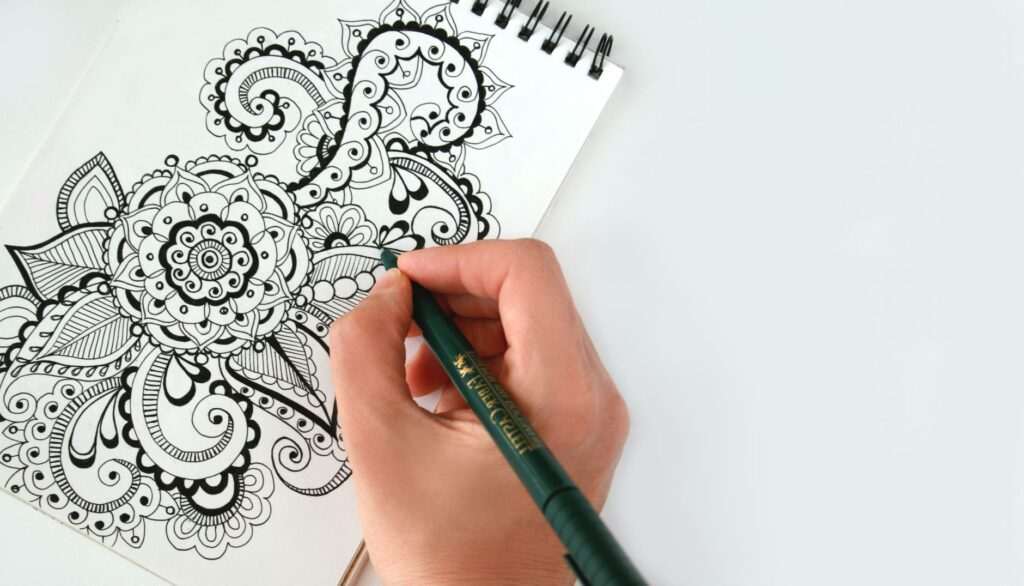
Zentangle is a structured, meditative drawing method created by Rick Roberts and Maria Thomas in 2004, built on the insight that the focused, repetitive process of drawing small abstract patterns produces a state of relaxed attention — what practitioners describe as being “in the zone” — that has genuine psychological and creative benefits. Unlike free-form doodling, the Zentangle method follows a specific protocol: small square tiles, deliberate tangle patterns built stroke by stroke, and a practice philosophy that emphasizes the process over the product. Zentangle has spread from a niche crafting practice to a method taught in hospitals, schools, and therapy settings for its well-documented capacity to reduce anxiety and build focus. The visual results — intricate black-and-white patterned tiles that combine precision with organic flow — are genuinely beautiful in their own right, and many practitioners discover a drawing capacity they didn’t know they had through the method’s non-intimidating entry point. In Anchorage, Zentangle workshops attract both people who have never considered themselves visual artists and experienced creatives who find the meditative structure a productive counterpoint to their other practices. This guide covers the official method, the Zentangle-vs-Zendoodle distinction, popular tangle patterns, materials, and the mental health research behind repetitive pattern drawing in 2026.
The Official Zentangle Method
The Zentangle method follows a specific sequence that’s consistent across all certified Zentangle Teacher (CZT) instruction:
The Tile
Zentangle is drawn on a 3.5-inch square “tile” — originally a specific Renaissance paper tile made by Fabriano, now available in several formats including white, black, and tan. The small size is deliberate: it’s completable in a single sitting (typically 30–60 minutes), it’s portable, and it establishes a defined workspace that eliminates the intimidation of a blank large canvas. Tiles are held in the hand and rotated as needed rather than fixed to a work surface — the small format makes this practical and allows the artist to approach each section of the tile from whatever angle is most comfortable.
The String
Before drawing any patterns, a “string” — a light pencil line drawn without lifting the pencil — divides the tile into sections. The string isn’t a border or a grid; it’s a flowing, organic line that creates irregular sections across the tile. These sections become the containers for different tangle patterns. The string remains visible in the finished tile as a subtle pencil line beneath the ink patterns. Strings are typically drawn quickly and intuitively without planning.
The Tangle
Each section defined by the string is filled with a “tangle” — a named, repeatable pattern built from basic strokes (dots, straight lines, curved lines, S-curves, orbs). The Zentangle library includes hundreds of official tangle patterns, each with a “recipe” of specific strokes drawn in sequence. The tangle is always built stroke by stroke — never sketched first, never erased. The no-erasing rule is foundational to the method: it removes the anxiety of mistakes (there are no mistakes, only “opportunities”) and builds confidence in deliberate mark-making.
Shade and Finish
After filling sections with tangles, graphite pencil shading is added to create dimension — the pencil shading gives tangles a three-dimensional quality by suggesting light source and depth. Finally, the tile is signed on the back with the artist’s name and date. The completed tile is then considered a small, finished artwork.
Zentangle vs Zendoodle
The terms are often used interchangeably outside the Zentangle community, but they’re not the same thing:
Zentangle refers specifically to the official method created by Roberts and Thomas — the tile format, the string, the named tangle patterns, the no-erasing principle, and the deliberate meditative practice philosophy. It’s a trademarked method with certified instructors (CZTs) who’ve completed official training.
Zendoodle (also “zenart,” “zen doodle,” or simply “doodling”) is a broader term for any repetitive, pattern-based drawing done in a meditative or relaxed way, without following the specific Zentangle protocol. Zendoodles might cover larger surfaces (journals, sketchbooks, canvas), use color, or incorporate representational imagery within the patterns. They’re not “wrong” — they’re just a different practice from the official Zentangle method.
The distinction matters because the Zentangle method’s specific constraints (tile size, no erasing, stroke-by-stroke construction) are what produce the focused mental state the practice is valued for. Free-form doodling produces a different (still pleasant) experience. For beginners, starting with the official method’s constraints builds the foundational stroke vocabulary that makes both Zentangle and broader Zendoodle work more satisfying.
Popular Tangle Patterns
The Zentangle tangle library includes hundreds of named patterns. A few of the most foundational and widely used:
Hollibaugh
One of the original Zentangle tangles — parallel lines drawn across the tile section, with some lines stopping where they pass “behind” other lines. The result creates the illusion of overlapping strands or ribbons at varying depths, producing a woven, three-dimensional quality from simple strokes. Hollibaugh demonstrates how careful attention to “aura” lines (lines following the contour of existing marks) creates depth without shading.
Crescent Moon
A repeating pattern of overlapping crescent shapes that creates an organic, scale-like texture. The pattern is highly scalable — small crescent moons produce a fine, delicate texture; large ones create bold, flowing patterns. Crescent Moon is excellent for filling organic, irregular sections and for combining with more geometric tangles as a textural contrast.
Paradox
A spiral-based pattern that begins at a corner of a square section and spirals inward in a specific sequence of strokes. The mathematical structure of Paradox (it’s based on a recursive geometric principle) produces a mesmerizing optical effect that looks far more complex than its simple construction. It’s a favorite demonstration tangle precisely because the striking visual result surprises people who expect complex patterns to require complex technique.
Printemps
Spiraling circles or coils distributed across a section, creating a light, bubbly texture. Easy for beginners and highly versatile as a background fill or contrast texture. The irregularity of hand-drawn coils gives Printemps a lively quality that perfectly-drawn spirals wouldn’t have.
Pens and Paper for Beginners
The official Zentangle method specifies specific materials, and for good reason — the quality of the mark-making surface significantly affects the experience:
- Pen: Sakura Micron pens (0.05 and 0.01 tip sizes) are the standard Zentangle pen — they produce smooth, consistent ink lines that don’t bleed on Fabriano paper and come in multiple tip sizes for line weight variation. A single 01 (medium-fine) Micron works for all beginner tangles. Avoid ballpoint pens (inconsistent ink flow) and felt-tip markers (too wide and bleed-prone).
- Pencil: A soft graphite pencil (2B or 4B) for the string and for final shading. Mechanical pencils work but produce thinner shading; a soft wood pencil’s side can shade broad areas quickly.
- Tile: Official Zentangle tiles (available from the Zentangle website or through CZT instructors) are the ideal surface. Good-quality smooth Bristol paper cut to 3.5 inches square is an economical substitute. Avoid textured watercolor paper — it’s too rough for the fine lines that many tangles require.
- Blending stump: For smooth graphite shading, a small blending stump (tortillon) produces cleaner gradients than a finger.
Mental Health Benefits of Repetitive Pattern Drawing
The mental health benefits of Zentangle-style repetitive pattern drawing are increasingly well-documented:
A 2016 study in the Journal of the American Art Therapy Association found that Zentangle significantly reduced anxiety in college students after a single 45-minute session. The focused attention required by stroke-by-stroke pattern construction engages the prefrontal cortex in a way that interrupts the ruminative thinking associated with anxiety — the mechanism is similar to mindfulness meditation but anchored to a concrete physical task that many people find more accessible than pure meditation.
The no-erasing principle contributes directly to this effect: by removing the possibility of “correcting mistakes,” Zentangle reduces the self-critical internal commentary that derails creative practice for many people. Each stroke is complete in itself, and the pattern emerges from cumulative marks rather than from a planned outcome — a structural analog to mindfulness’s present-moment focus.
Healthcare applications have expanded significantly: Zentangle appears in cancer treatment centers (as a coping tool during infusion therapy), in occupational therapy for fine motor skill development, in educational settings for attention and focus, and in therapy contexts for anxiety management. Its value in these settings is precisely what Zentangle’s creators intended — a practice accessible to anyone, requiring no artistic training, that produces both a meditative state and a beautiful physical artifact.
Zentangle Workshops in Anchorage
Anchorage Zentangle workshops typically run 2–3 hours and cover the complete official method sequence — introducing the tile, string, three or four foundational tangles, and the shading pass. Certified Zentangle Teachers (CZTs) offer both group workshops and individual instruction; check with Anchorage art studios and community education programs for current class offerings. Beginner kits (tiles, Micron pen, pencil) are often included in workshop fees of $35–$65.
Anchorage craft workshop participants can show and sell their finished work at year-round events including the Anchorage Market & Festival, the Anchorage Native Arts & Culture Festival, and the Alaska State Fair. Our free things to do in Anchorage guide covers the community spaces and wellness centers where Zentangle and mindfulness art programs are offered as part of Anchorage’s broader creative wellness programming. Our Anchorage hiking guide covers the natural environments whose organic forms — the patterns in birch bark, river ice, and lichen-covered rock — inspire the kind of observational pattern vocabulary that enriches tangle drawing.
Photo by Alena Koval on Pexels.




No comments yet.