
Sterling Highway Road Trip 2026: Kenai Peninsula Guide
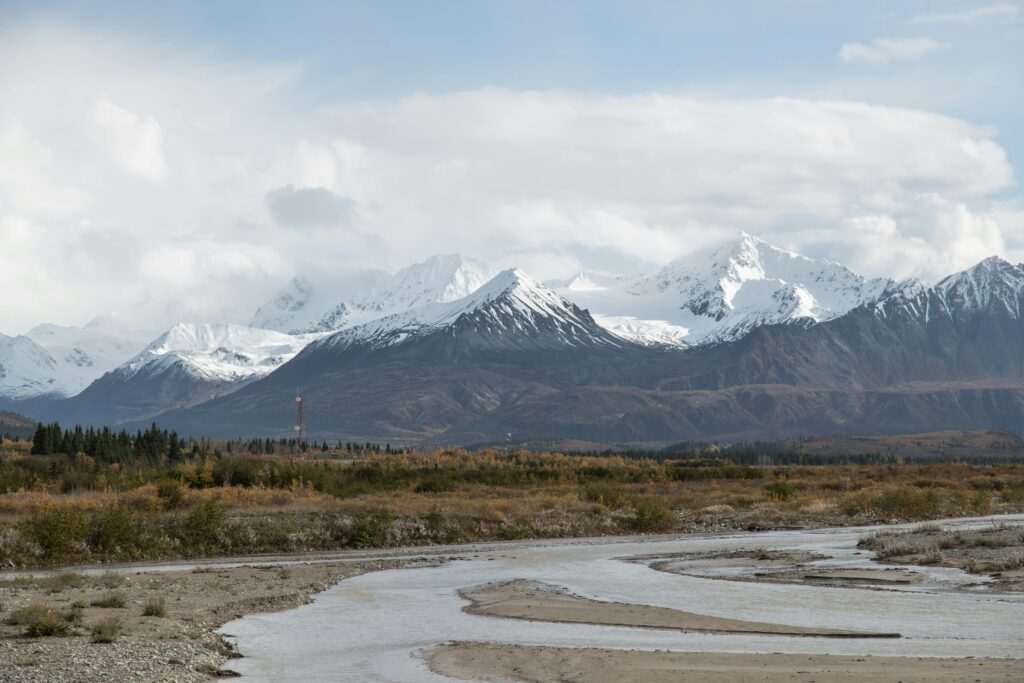
The Sterling Highway begins where the Seward Highway ends — at the Tern Lake junction, 37 miles south of Anchorage, and runs west and south for 143 miles to Homer at the tip of the Kenai Peninsula. Where the Seward Highway hugs the coast and delivers glaciers and fjords, the Sterling cuts inland through boreal forest, river valleys, and fishing towns before opening onto Kachemak Bay. It is the other half of the Kenai Peninsula loop, and it is best understood as a driving route organized around one thing: the Kenai River and the fishing culture that has grown up around it. This guide covers the main stops from the junction to Homer, with a suggested 3-day itinerary for the complete Kenai Peninsula circuit.
Cooper Landing
Cooper Landing sits at mile 48 of the Sterling Highway, where the highway drops into the Kenai River canyon and the river runs fast, clear, and cold through a gorge flanked by spruce and the Kenai Mountains. This is the upper Kenai — technical whitewater with Class II–III rapids through Kenai Canyon, a stretch that float trip operators run through summer on oar boats and rafts. The canyon float is 17 miles of river, past the confluence with the Russian River and through sections of riverside wilderness that have no road access. If you drive the Sterling without doing a float, you will have driven past the best part of it.
The Russian River confluence, 2 miles from the highway on a maintained trail, is where Russian River sockeye salmon pile up during their late-June and mid-August runs. The sockeye here are so abundant that the confluence becomes one of the most fished spots in Alaska — hundreds of anglers sometimes shoulder-to-shoulder in peak season, wading the shallows and casting to fish moving through the current at their feet. The upper Kenai River itself holds king salmon from mid-May through July and rainbow trout year-round. Cooper Landing has a small cluster of lodges, outfitters, and tackle shops at the highway. Book any float trip in advance for July; capacity fills weeks ahead.
Kenai National Wildlife Refuge
The Sterling Highway passes through the western edge of the Kenai National Wildlife Refuge from Cooper Landing to Sterling — 1.9 million acres of boreal forest, wetlands, and lake country that is one of the largest wildlife refuges in the state. The refuge holds moose, brown and black bears, wolves, and Dall sheep; the lake country visible from the highway — the Kenai Peninsula’s interior plateau — is a breeding and nesting area for trumpeter swans, loons, and dozens of waterfowl species. The refuge visitor contact station at mile 57.9 has exhibits and maps; it is worth a 20-minute stop to orient to the scale of the landscape you are driving through.
The Swanson River canoe trail system, accessed from the refuge’s eastern side, is one of Alaska’s premier multi-day wilderness canoe routes — 80 lakes connected by portages and river sections, completely roadless, and rich in wildlife. It is beyond the scope of a Sterling Highway drive but worth noting for return visits with more time.
Soldotna and the Kenai River Dipnetting
Soldotna is the service center of the peninsula — grocery stores, fuel, chain hotels, and river access. The lower Kenai River here is wide, slow, and extraordinarily productive: it holds the world record for the largest sport-caught king salmon (97 lbs, 4 oz, taken in 1985), and the sockeye runs in July produce one of Alaska’s most unusual fishing spectaculars. Dipnetting — using a large-mouthed net on a pole to intercept salmon as they migrate upriver — is legal on the lower Kenai in July for Alaska residents only, and the Kenai River Personal Use Fishery draws thousands of families to the riverbanks to fill their household limits. Visitors cannot participate, but watching dipnetting from the Soldotna Creek Park or the river access at Centennial Park is an Alaskan summer scene unlike anything in the other 49 states.
Sport fishing for king and silver salmon on the lower Kenai is open to visitors with a license and king stamp. Charter guides operate from Soldotna and the nearby mouth of the river at Kenai; a full-day guided drift is the standard format. The lower Kenai also produces silver salmon from mid-July through September — a longer and more predictable window than the king run, and the silvers fight hard in the river’s current. Soldotna has full visitor infrastructure: hotels, restaurants, the Kenai National Wildlife Refuge visitor center, and tackle and sporting goods shops that stock current run reports.
Kenai City and the Bluff
The city of Kenai, 11 miles off the Sterling on the Kenai Spur Highway, is one of Alaska’s oldest non-Native settlements — established as a Russian trading post in 1791 and the site of Fort Kenay, built during the American purchase of Alaska. The Russian Orthodox Church of the Assumption of the Virgin Mary, built in 1894, still stands in Old Town Kenai and is among the oldest Russian Orthodox churches in Alaska open to visitors. The church remains an active congregation and houses historical artifacts from the Russian America period, including original icons and documents. Old Town Kenai is a walkable historic district in a state that does not have many of them; it is worth an hour.
The Kenai Bluff overlooks Cook Inlet from a height of 70 feet, with views across the water to the Alaska Range on clear days — Mount Redoubt and Mount Iliamna, both active volcanoes, visible across the inlet. The bluff is eroding rapidly from wave action; the view is dramatic and the geological instability visible in the slumping sections of cliff is its own kind of spectacle. Access is at the end of Spruce Street in Old Town.
Anchor Point
Anchor Point, at mile 157 of the Sterling, is the westernmost point on the continuous North American highway system — the last place you can drive west before the road ends and the Pacific takes over. The marker is modest, but the distinction is real. The beach below Anchor Point overlooks lower Cook Inlet, with views of the volcanoes across the water and some of the strongest tidal currents on the continent moving through the shallows. Halibut fishing from Anchor Point is accessible without a charter — shore fishing from the beach is productive during incoming tides, though a charter boat reaches better halibut grounds in deeper water. The beach access road, North Fork Road, runs 3 miles to the bluff edge and the boat launch; the drive down through the spruce-covered bluffs to the beach is a good leg stretch after a day of highway driving.
Homer
The Sterling Highway ends in Homer, 226 miles from Anchorage, at the entrance to the Homer Spit — a 4.5-mile gravel finger extending into Kachemak Bay that holds the charter fleet, seafood restaurants, galleries, and the most atmospheric harbor in Southcentral Alaska. Big Time Alaskan Fishing Adventures and other Spit operators run full-day halibut charters into lower Cook Inlet, where the grounds are reliably productive. Homer deserves at least one night; combining the Spit, the arts community on Pioneer Avenue, and a water taxi crossing to Kachemak Bay State Park across the water makes it the natural endpoint of the Kenai Peninsula loop.
Suggested 3-Day Kenai Peninsula Itinerary
Day 1 — Anchorage to Cooper Landing to Soldotna (3 hours driving, afternoon on the water): Depart Anchorage after breakfast. Drive the Seward Highway along Turnagain Arm — stop at Beluga Point for bore tide and beluga whale viewing — then continue south to the Tern Lake junction and west on the Sterling. Book a canyon float through Cooper Landing for the afternoon; plan for 4–5 hours on the river. Overnight at Cooper Landing or drive the additional 40 minutes to Soldotna for more accommodation options.
Day 2 — Soldotna to Kenai to Homer (2.5 hours driving): Morning at the Soldotna Kenai River access — check the dipnetting scene in July or hire a guide for the lower river. Drive to Kenai city and spend an hour in Old Town; walk to the bluff overlook. Continue southwest on the Sterling through Anchor Point to Homer. Arrive by mid-afternoon; spend the evening on the Spit, walk the harbor, have dinner at Fat Olives or the Fish Dock Restaurant. Book a halibut charter the following morning.
Day 3 — Homer to Anchorage (4.5 hours driving): Early morning halibut charter (6 AM departure, return by 2–3 PM), or water taxi to Kachemak Bay State Park for the Grewingk Glacier trail if fishing is not the priority. Depart Homer in the afternoon. Return via the Sterling and Seward Highways; option to stop in Seward for dinner and the Alaska SeaLife Center before the final drive to Anchorage. Arrive Anchorage by evening.
The Sterling Highway rewards the drive west. The fishing culture on the Kenai River, the scale of the wildlife refuge, the Russian history in Kenai city, and the endpoint at Homer add up to a road trip that is genuinely different from anything available on the Seward side of the peninsula — complementary rather than redundant. Drive both.
Featured photo by John De Leon on Pexels.


No comments yet.