Rabbit Lake Trail Anchorage 2026 — Alpine Lake Day Hike in Chugach State Park
Twenty minutes from downtown Anchorage, a parking lot at the top of a residential hillside marks the start of one of the most rewarding full-day hikes in Southcentral Alaska. The Glen Alps trailhead in Chugach State Park is the launch point for several trails that climb quickly into the high Chugach — and the longest and most demanding of the day-hike options from this lot is Rabbit Lake Trail, a 9-mile round trip that gains 1,800 feet to a remote cirque lake sitting beneath a dramatic mountain headwall. The lake itself feels far from the city. The hike back confirms you were never very far at all.
Trail Overview
Rabbit Lake Trail covers approximately 9 miles round trip from the Glen Alps parking area, with about 1,800 feet of cumulative elevation gain to the lake. The distance and gain put this firmly in the strenuous category — plan for five to seven hours depending on fitness and pace. The trail is well-used by Anchorage locals and requires no technical skills, but the terrain above treeline is rocky, can be wet, and has no maintained tread in the upper sections. This is not a casual hike. It is one of the best half-day objectives near any American city, which is a different thing.
The Route
The trail begins on the Powerline Trail, a wide gravel path shared with cyclists and other users that serves as the access corridor for several southern Chugach destinations. About a mile and a half from the trailhead, the Rabbit Lake route branches south and begins climbing into open terrain.
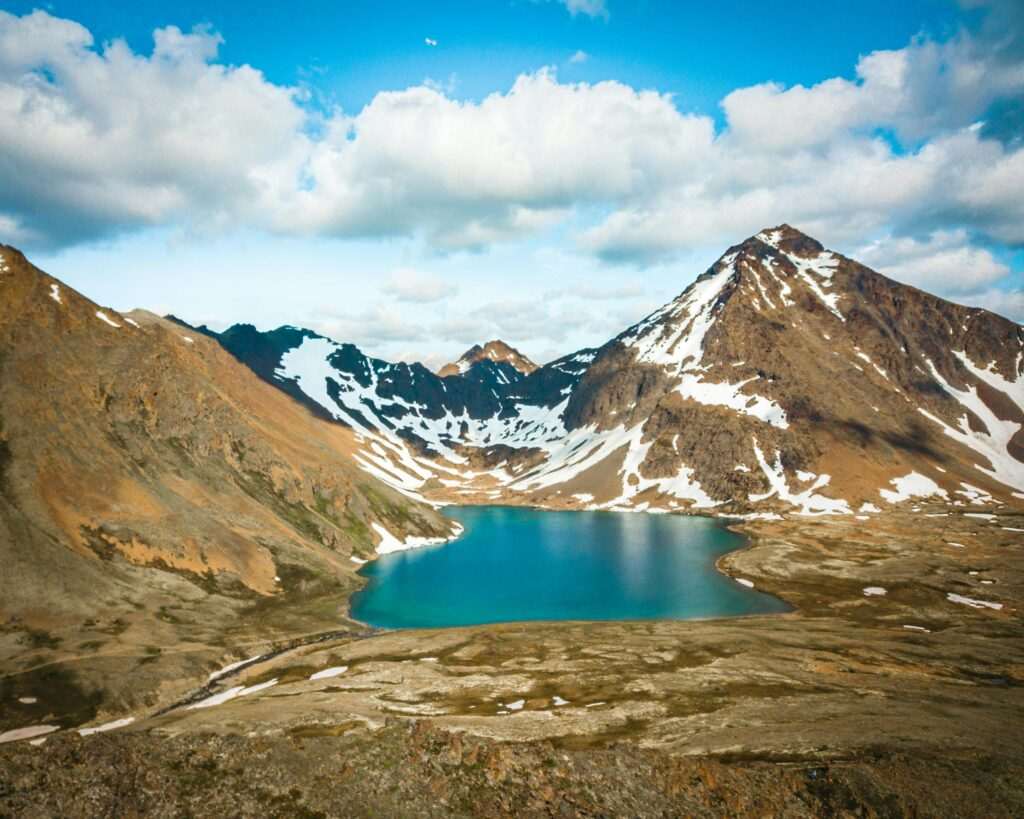
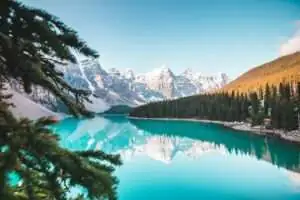
Above the Powerline junction, the trail climbs through late-season wildflower tundra and increasingly rocky ground toward the pass above the lake. The upper section — the final mile or so — involves navigating loose rock and exposed ridge terrain where the trail becomes less defined. Navigation is straightforward on clear days; in fog or low cloud, the route can be harder to follow above the last vegetation. The lake comes into view from the pass: a deep, cold blue-green pool contained by steep headwall cliffs on three sides, strikingly out of scale with the surrounding terrain until you’re standing at its edge.
Rabbit Lake Itself
The lake is a classic glacial cirque — carved by ice over thousands of years into a bowl at the base of a headwall. The water is cold year-round and deep enough that the color stays vivid even on overcast days. Snow lingers on the headwall into July in most years. The setting feels remote in the way that Alaskan alpine terrain tends to, despite being visible from parts of Anchorage on clear days. Most hikers eat lunch at the shore before the return descent.
Wildlife
Dall sheep are the signature wildlife encounter on Rabbit Lake Trail. The rocky upper slopes and cliff bands of the surrounding headwall provide exactly the terrain sheep prefer, and sightings — groups of ewes and lambs visible on the ridgeline, or rams traversing rock faces that look vertical from below — are common throughout summer. Ptarmigan are present in the upper tundra zone and are often approached quite closely before flushing. Golden eagles nest in the Chugach Range and are regularly seen riding thermals above the bowl. Marmots whistle from rock piles along the upper trail.
Brown and black bears use Chugach State Park. Bear spray is standard on any Chugach trail; the lower Rabbit Lake route passes through dense brush that limits sight lines.
Practical Information
The Glen Alps parking area requires a $5 state park day-use fee payable at the trailhead iron ranger. The lot fills early on summer weekends; arriving before 8am is strongly recommended from late June through August.
The trail is generally snow-free from late July through September. Snow patches can persist on the upper route into late June, and early-season attempts in May or June may require microspikes on the upper section. October can bring early snowfall. The stable summer window is July through mid-September.
Gear: waterproof trail boots, wind shell, insulating mid-layer (summit winds are cold even in August), trekking poles, bear spray, and enough food and water for a full day. There is no water source at the trailhead.
Combining with Nearby Hikes
The Glen Alps trailhead also serves as the starting point for Flattop Mountain Trail, the most climbed peak in Alaska. Flattop is roughly 3.5 miles round trip and gains about 1,350 feet — significantly shorter than Rabbit Lake but with panoramic summit views. Many hikers choose Flattop for a shorter outing at the same lot; those with time and fitness for a full day go to Rabbit Lake. Alaska Outdoor Adventures offers guided hikes in the area for first-time visitors.
How hard is Rabbit Lake Trail near Anchorage?
Rabbit Lake Trail is strenuous — 9 miles round trip with 1,800 feet of elevation gain, much of it on unmaintained rocky terrain above treeline. Good cardiovascular fitness is required. The trail involves no technical climbing but demands sure footing on loose rock in the upper section. Allow five to seven hours for the round trip.
When can you hike Rabbit Lake Trail?
The stable hiking window is late July through mid-September, when the upper route is reliably snow-free. Conditions vary by year; early summer attempts in June may require traction devices on snow patches above the Powerline junction. October can bring early snow. Check recent trip reports before heading out in shoulder season.
Is there parking at Glen Alps for Rabbit Lake Trail?
Yes — the Glen Alps parking area serves the Rabbit Lake, Flattop Mountain, and Powerline Trail routes. A $5 state park day-use fee is required. The lot fills early on summer weekends; arriving before 8am is recommended from late June through August. The trailhead is approximately 20 minutes from downtown Anchorage by car.
What wildlife can you see on Rabbit Lake Trail?
Dall sheep are commonly visible on the rocky headwall above the lake — often quite close. Ptarmigan inhabit the upper tundra, golden eagles patrol the ridge thermals, and marmots are frequent in the boulder fields. Brown and black bears use the lower trail corridor; carry bear spray. The upper alpine terrain is well outside typical bear range but spray is standard practice throughout Chugach State Park.
Rabbit Lake Trail delivers what most city hikers spend a weekend driving to find: an alpine cirque, Dall sheep on the headwall, and total quiet above the ridgeline — available on a Tuesday morning, forty minutes from downtown. The Glen Alps parking lot fills for a reason.
Featured photo by Andrew Hanson on Pexels.

No comments yet.