
Musk Ox Farm Palmer Alaska 2026 — Visiting the Only Domestic Musk Ox Farm
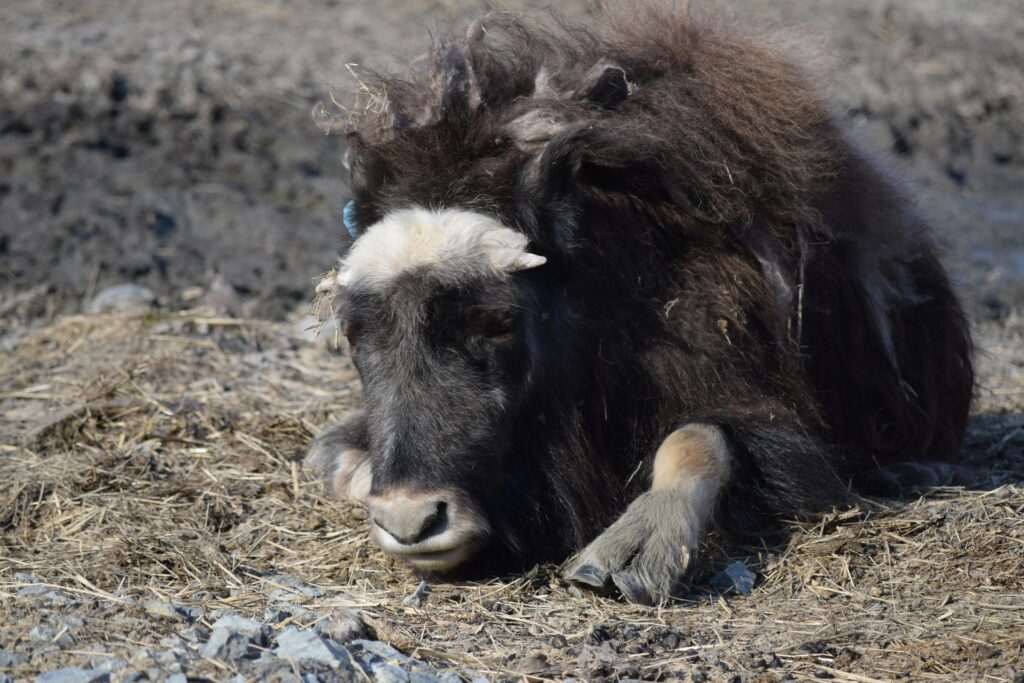
About 45 minutes northeast of Anchorage on the Glenn Highway, in the agricultural flatlands of the Matanuska-Susitna Valley, sits one of the most unusual farm operations on the planet. The Musk Ox Farm in Palmer is home to roughly 75 musk oxen — animals that have survived unchanged on Arctic tundra for more than 100,000 years — and it is the only farm in the world dedicated exclusively to the domestic husbandry of this species. The farm raises the musk oxen not for meat but for qiviut: the extraordinarily soft underfleece that insulates the animals against Arctic winters and is collected by hand each spring. That fiber feeds the Oomingmak Musk Ox Producers’ Cooperative, an Alaska Native women’s knitting cooperative that produces hand-knitted qiviut garments sold at the farm and in stores throughout Anchorage. Coming to visit means seeing the animals up close on guided tours and understanding a fiber-to-garment story that exists nowhere else on earth.
What the Musk Ox Farm Is — and Why It Exists
Musk oxen were hunted to extinction in Alaska by the early 20th century. The species was reintroduced from Greenland stock in the 1930s, and a small herd was established at the University of Alaska Fairbanks in the 1960s as part of a project to explore the commercial potential of qiviut. The farm in Palmer grew out of that research — it was established in 1954 and has operated since as a non-profit dedicated to the musk ox herd and the cooperative fiber economy the animals support.
The farm houses approximately 75 musk oxen at any given time, ranging from calves born in spring to adult bulls and cows with the full, dramatic appearance the species is known for: the distinctive thick outer guard hair that sweeps nearly to the ground, the curved boss horns of the adults, and the dark, massive build that evolved over millennia for cold-weather survival. Musk oxen are not cattle. They are more closely related to goats and sheep, and their behavior — particularly the herding and defensive formations adults use when threatened — reflects nothing in conventional livestock experience.
The Tours
The Musk Ox Farm operates guided tours from May through September. Tours run on a regular schedule throughout the day during peak season; the farm’s website publishes the current timetable. A typical tour runs 45 to 60 minutes and is led by a farm guide who covers the animals’ natural history, the farm’s history, the seasonal cycle of qiviut collection, and the cooperative’s operations. Groups are kept small enough that everyone has genuine close-range views of the animals.
The tour route takes visitors through the farm grounds and alongside the paddock fencing, where musk oxen approach to investigate guests. Adult animals stand roughly five feet at the shoulder and weigh up to 800 pounds; at close range their sheer mass is striking in a way that photographs don’t capture. The guide points out individual animals by name — the farm staff knows each musk ox personally, which speaks to the operational scale and the close relationship between the human caretakers and the herd. Admission fees support the farm’s ongoing operation; current rates are available on the farm’s website.
Qiviut: The Fiber at the Center of Everything
Qiviut (pronounced KIV-ee-uht) is the soft underfleece that musk oxen grow each winter as a thermal layer beneath their outer guard hair. By weight, it is warmer than wool and eight times finer than cashmere. The animals shed their underfleece naturally each spring, and farm staff collect it by combing — a process that requires the animals to be calm enough for close handling and that yields only a few pounds per animal per year. The entire domestic qiviut industry runs on this annual harvest from a relatively small number of animals worldwide, which is why qiviut garments cost what they do.
The Oomingmak Musk Ox Producers’ Cooperative, based in Anchorage, distributes raw qiviut to Alaska Native women in villages across the state — Bethel, Unalakleet, Mekoryuk, and others — who knit it into scarves, hats, and other garments following traditional stitch patterns specific to their villages. Each village uses a distinct pattern that has been codified and maintained by the cooperative, creating items that carry cultural specificity alongside the material’s exceptional properties. The garments are sold at the cooperative’s downtown Anchorage shop and at the farm itself. A qiviut scarf purchased at the farm is as close as any visitor comes to holding a directly traceable, locally produced Alaska material culture object in their hands.
Spring Calves: May and June
The farm’s spring season — May through June — is when musk ox calves are born. The calves arrive with the same thick coat the adults carry, already functional from birth in cold conditions. At two to three weeks old they are visibly energetic and stay close to their mothers while simultaneously beginning to investigate the world with the undirected curiosity of young animals. Watching a calf next to an adult cow illustrates the scale differential dramatically — and conveys something about the hardiness of the species that no amount of description does as effectively as seeing it.
If watching spring calves is a priority, aim for late May or early June. The farm can confirm whether calves have arrived for a given season — calling ahead or checking current updates is worthwhile, since birth timing varies by year and weather. The farm’s popularity spikes in the calf window, so arriving at opening or booking a morning tour slot keeps groups manageable.
Getting There from Anchorage
The Musk Ox Farm is located at 2100 Archie Road in Palmer, approximately 43 miles northeast of downtown Anchorage. The drive takes 45 to 55 minutes under normal conditions. From Anchorage, take the Glenn Highway (AK-1) northeast through Eagle River and past the Matanuska-Susitna Borough boundary into Palmer. The farm is well-signed from the highway approach and easy to find on a first visit.
The Glenn Highway drive itself is one of the scenic approaches in Southcentral Alaska — the Chugach Mountains flank the south side of the corridor and the Talkeetna Mountains appear ahead as you travel northeast. The valley floor opens into the characteristic flat agricultural terrain of the Mat-Su around Palmer, which provides a landscape context that makes the farm’s setting make intuitive sense: this is productive, temperate lowland that originally attracted agricultural settlement in the 1930s under a federal colonization program, and which now supports both conventional farming and the unusual enterprise of musk ox husbandry.
Combining the Visit with Other Mat-Su Attractions
Palmer sits at the gateway to several other Southcentral Alaska destinations that make a day trip from Anchorage rewarding beyond the farm alone. Hatcher Pass, about 30 miles north of Palmer, provides alpine hiking, wildflower meadows in summer, and the ruins of the Independence Mine gold operation — a substantial historical site with interpretive exhibits in a spectacular mountain setting. A morning Musk Ox Farm tour followed by an afternoon hike at Hatcher Pass covers two genuinely distinctive Alaska experiences in a single day.
The Matanuska Glacier, about 100 miles northeast of Anchorage on the Glenn Highway (roughly 50 miles beyond Palmer), is another natural extension of a Palmer-area day trip. The glacier is the largest accessible by vehicle in the country; guided walks on the ice surface are available from operators at the glacier base and provide a completely different kind of close-range encounter with Alaska’s natural systems than the farm offers. Combining the Musk Ox Farm and Matanuska Glacier makes for a long day but two experiences that have no overlap in character.
Practical Tips
The farm’s peak season is May through September, with tours available daily. Hours vary by season; verify the current schedule before driving from Anchorage. The farm grounds are outdoors and the tour route involves unpaved paths — sturdy shoes or boots are practical. Alaska’s weather doesn’t follow seasons in the conventional sense: a July morning in Palmer can be sunny and warm or overcast and 50°F. A light jacket is worth carrying regardless of the forecast.
Photography is welcomed and the distances between visitors and animals are close enough for compelling results without telephoto equipment. The musk oxen frequently approach the fence line out of curiosity, providing eye-level portraits at a few feet. The calves in spring present the most photographically striking subjects — they’re small enough relative to the adults that composition almost handles itself. Avoid flash, which startles the animals and degrades the image quality under the soft overcast light that’s common in the valley.
How far is the Musk Ox Farm from Anchorage?
The Musk Ox Farm in Palmer is approximately 43 miles northeast of downtown Anchorage via the Glenn Highway — about 45 to 55 minutes of driving under normal conditions. The highway is well-maintained year-round, and the drive itself passes through scenic Chugach Mountain terrain before opening into the Matanuska-Susitna Valley.
When is the best time to visit the Musk Ox Farm?
May and June, when musk ox calves are born, is the peak season for the most dramatic visit experience. Late May through early June brings newborn calves alongside adult cows in the paddocks. The farm runs tours May through September; outside of calf season the adult animals are still compelling subjects, and the qiviut and cooperative story is worth the visit year-round.
What is qiviut and why is it special?
Qiviut is the soft underfleece that musk oxen shed each spring. It is eight times finer than cashmere and warmer than wool by weight — one of the most insulating natural fibers on earth. The Oomingmak Musk Ox Producers’ Cooperative distributes raw qiviut to Alaska Native knitters in villages across the state, who produce hand-knitted garments with village-specific traditional patterns. The combination of material quality, cultural specificity, and limited supply makes qiviut garments genuinely unique Alaska products.
Is the Musk Ox Farm suitable for children?
Yes — it is one of the best family-oriented wildlife experiences accessible from Anchorage. The animals are large and visually striking, the farm guides engage children directly during tours, and the combination of animal encounters and the qiviut story gives kids something specific to remember. Spring calf visits are particularly effective with children.
The Musk Ox Farm in Palmer is the kind of place that’s easy to pass over in favor of more dramatic Alaska experiences — glaciers, bears, whale watching — and harder to forget once you’ve been. The combination of animals that look like they walked out of the Pleistocene, a fiber that outperforms anything synthetic engineering has produced, and an Alaska Native cooperative that has run for decades on that fiber’s value: this is a story that exists only here, only in this form. The 45-minute drive from Anchorage is one of the better investments of a Southcentral Alaska visit.
Featured photo by Lynne Jablonski on Pexels.
No comments yet.