
Hand Spinning Classes and Workshops in Anchorage: Drop Spindle, Spinning Wheel, and Fiber
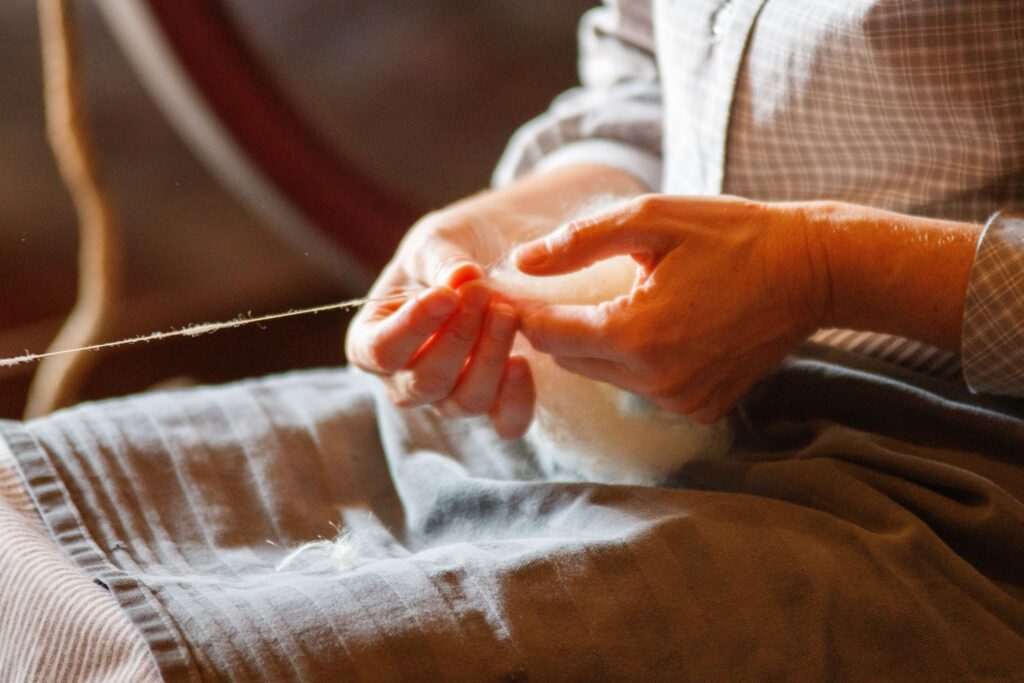
Hand spinning — the process of drafting and twisting raw fiber into yarn — is among the oldest textile technologies in human history, predating weaving by millennia. The spindle whorl (a weighted disk that keeps a stick spinning, drawing out and twisting fiber held above it) appears in archaeological records across nearly every early human culture. Spinning wheels, developed in medieval India and reaching Europe by the 13th century, mechanized and accelerated the same fundamental process: draft (draw out a thinner section of fiber), twist (rotate to lock the fibers together), and wind (collect the resulting yarn). Contemporary hand spinning is practiced as a connection to fiber’s pre-industrial origins, as a way to produce yarns with character unavailable commercially, and as a meditative practice with a long rhythmic quality that participants consistently describe as calming. In Anchorage, hand spinning connects naturally to Alaska’s wool traditions — Qiviut (muskox fiber), Alaska-grown wool from Icelandic sheep operations on the Kenai Peninsula, and the broader fiber arts community of the Anchorage Weavers and Spinners Guild. This guide covers spindles vs. wheels, fiber preparation, drafting techniques, plying, and fiber blending for 2026.
Spindle vs. Spinning Wheel
Hand spinning uses one of two main tools, each with different characteristics for the practitioner:
Drop Spindle
The drop spindle is the simpler, more portable, and more historically ancient spinning tool — a stick with a weighted whorl that’s set spinning and then “dropped” (allowed to hang freely from a length of drafted fiber) while the spinner continues drawing out fiber above. Gravity pulls the spindle downward, extending the drafted fiber and allowing more spinning before the yarn needs to be wound on. Drop spindles are inexpensive ($10–$30 for a quality beginner spindle), portable (usable anywhere), and require no mechanical setup. The trade-off is that they’re slower than a wheel and require developing a specific hand-eye coordination to maintain consistent twist and draft simultaneously.
Two main types: top whorl spindles (the whorl is near the top of the stick, producing faster spin) and bottom whorl spindles (whorl at the bottom, producing more stable, slower spin). Most instructors recommend bottom whorl spindles for absolute beginners for their forgiving spin stability.
Spinning Wheel
A spinning wheel automates the winding step — the treadle-driven flyer mechanism winds yarn onto a bobbin as the spinner drafts, allowing continuous spinning without stopping to wind. This makes spinning wheels significantly faster than spindles for producing substantial quantities of yarn. Wheels are also more consistent: the drive ratio (the relationship between the wheel size and the bobbin size) determines the twist rate, which can be selected for the fiber being spun rather than varying with each spindle drop.
Wheels range from simple great wheels (upright spindles driven by a large drive wheel, used for woolens) to the complex double-drive Saxony wheels with multiple ratios. Beginner wheels from Ashford (New Zealand) and Schacht (Colorado) are the standard recommendations for new spinners: well-engineered, reasonably priced ($500–$800), and well-supported with parts and instructional resources. Spinning wheel instruction typically requires a workshop or class setting rather than self-teaching, because the setup and adjustments for different fibers require guidance to understand initially.
Fiber Preparation
How fiber is prepared before spinning determines the character of the finished yarn:
- Roving: Fiber carded into a continuous rope of loosely aligned fibers. Roving retains some fiber length variation and produces a lofty, woolen-style yarn with a soft, fuzzy character. The most beginner-friendly preparation — it drafts easily and forgives inconsistent technique better than more processed preparations.
- Batts: Fiber carded into a flat sheet (rather than a rope), used by pulling strips off the batt for spinning or by folding and rolling the batt into a spinning preparation. Batts are common for blended fibers (wool with silk, wool with alpaca) and for art yarns where incorporated color variety is part of the design.
- Combed top: Fiber combed (rather than carded) to align all fibers parallel. Combed top produces worsted-style yarn — smooth, dense, strong, with a slight sheen — rather than the soft, airy woolen yarn that carded preparations produce. More difficult to draft than roving; requires more experienced hands to maintain even drafting.
- Raw fleece: Unprocessed wool directly from the sheep, requiring washing (scouring) and preparation (carding or combing) before spinning. Processing raw fleece is a separate skill set; beginners typically start with purchased prepared roving or combed top.
Drafting Techniques
Drafting — drawing the fiber out thinner before twist enters — is the core hand skill in spinning. Two main drafting styles produce different yarn structures:
Short Forward Draw
The fiber source (roving or combed top) is held in one hand, and the other hand pinches the fiber just ahead of where twist has entered, then moves forward (away from the fiber source) to draw out a short length of fiber before releasing the pinch and allowing twist to enter the drafted section. Short forward draw produces smooth, dense, worsted-style yarn with controlled twist entry. It’s more controlled than long draw but slower and requires more hand coordination. Most beginner instruction starts here because the controlled pinch prevents twist from running back into the fiber supply uncontrolled.
Long Draw
The spinning hand drafts freely backward away from the spinning wheel (or spindle), allowing twist to enter the fiber mass gradually as the hand moves back. Long draw produces woolen-style yarn more quickly than short draw and with less hand-eye effort once the technique is established, but it requires more spinning experience to control draft consistency. Long draw produces the characteristic lofty, air-filled structure of traditional woolen yarn — think the warmth-to-weight ratio of a Shetland sweater rather than the smooth density of a worsted sock yarn.
Plying and Setting the Twist
Freshly spun singles (single-ply yarn) have active twist that makes them unstable — they kink and coil back on themselves. Plying (twisting two or more singles together in the opposite direction from which they were spun) balances the twist and produces a stable, balanced yarn:
Two-ply yarn (two singles plied together) is the standard beginner ply. The singles are spun Z-twist (clockwise); they’re plied S-twist (counter-clockwise), and the opposing twists balance each other. The amount of plying twist determines the final yarn character — under-plied yarn is soft and loosely structured; over-plied yarn is dense and corded.
Setting the twist (wet finishing) stabilizes the finished yarn: the skein is soaked in warm water, the excess water squeezed out gently (not wrung), and the skein snapped firmly (“thwacked”) against a hard surface to open the fiber structure. Hung to dry with a light weight (to prevent excessive shrinkage), the finished skein dries into a stable, balanced yarn ready for knitting, weaving, or crochet use.
Fiber Blending: Wool, Alpaca, and Silk
Different fiber types bring different qualities to hand-spun yarn, and blending them produces combinations unavailable commercially:
- Wool: The foundational spinning fiber — elastic, forgiving, warm, and available in extraordinary variety. Merino (soft, fine) and Corriedale (medium, versatile) are the most popular beginner wools. Wool’s elasticity makes it forgiving of uneven drafting — the twist distributes more evenly through elastic fiber than through inelastic fiber.
- Alpaca: Warmer than wool, very soft, with a characteristic drape and lack of elasticity. Blended with wool (typically 20–30% alpaca to 70–80% wool), alpaca adds softness and warmth while wool provides the elastic structure that pure alpaca lacks. Alaska-relevant: Qiviut (muskox fiber, harvested from wild muskox in Alaska) is among the rarest and most luxurious natural fibers in the world — extraordinarily soft, fine, and warm. Qiviut spinning appears in advanced Alaskan fiber arts practice and is a distinctly Alaska-connected fiber experience.
- Silk: Adds sheen, strength, and a slippery luxurious hand to wool blends. Silk drafts differently from wool (no elasticity, very smooth fiber surface) and is challenging to spin on its own; blended with wool at 10–20%, it adds visual depth and fiber character without overwhelming the spinning experience.
Hand Spinning Workshops in Anchorage
Anchorage hand spinning workshops are offered through the Anchorage Weavers and Spinners Guild and independent fiber arts instructors. Beginner workshops typically run 3–4 hours, covering drop spindle technique and producing a small sample of spun yarn. Wheel spinning instruction usually requires multi-session courses to cover setup, multiple yarn weights, and plying. Alaska-specific fiber content — local wool, Qiviut exploration — gives Anchorage spinning instruction a regional dimension unavailable in most lower-48 fiber arts programs.
Workshop prices run $45–$90. A beginner drop spindle kit (a quality bottom-whorl spindle and 4 oz of prepared merino roving) costs $25–$40 and enables hours of practice. Anchorage craft workshop participants can show and sell their finished work at year-round events including the Anchorage Market & Festival, the Anchorage Native Arts & Culture Festival, and the Alaska State Fair. Our free things to do in Anchorage guide covers the fiber arts events and guild gatherings where Anchorage’s spinning community is most active. Our Anchorage hiking guide covers the landscapes where Alaska’s fiber-producing animals — sheep on the Kenai, muskox roaming boreal ranges — live in their natural environments.
Photo by Marian Strinoiu on Pexels.




No comments yet.