Anchorage Fur Rendezvous 2026: Guide to Alaska’s Biggest Winter Festival
In February, Anchorage goes to the dogs — in the best possible way. Fur Rendezvous, known locally as Rondy, is Alaska’s largest winter festival: ten days of sled dog racing, reindeer running, outhouse racing, fur auctions, and the formal spectacle of the Miners and Trappers Ball, all conducted at temperatures that regularly drop below zero. Rondy has been running since 1935, which makes it older than Alaska statehood, and it carries a cultural weight that distinguishes it from generic winter carnivals elsewhere. This guide covers the key events, the best places to watch them, what to wear, and how to plan a February visit around the festival’s schedule.
What Is Rondy? A Brief History
Fur Rendezvous began as a practical gathering. In the mid-1930s, Anchorage was a small railroad town and the commercial hub for a vast territory of trappers, miners, and Alaska Native communities spread across Southcentral Alaska. Each February, when trails were frozen solid, people came to town: to sell furs at the auction, to resupply, to see other people after months of isolation. The festival that grew up around those arrivals formalized the traditions that already existed — the sled dog races, the dances, the community gathering — and gave them an annual structure.
The Alaska Native traditions embedded in Rondy predate the festival by centuries. The blanket toss (nalukataq in Inupiaq) was originally a hunting practice — tossing a person high above the tundra to spot migrating game — and its inclusion in Rondy connects the modern festival directly to the subsistence culture of northern Alaska. The fur auction reflects the historic relationship between indigenous trappers and the market economy that developed in the early 20th century. Rondy is not just a winter party; it is a document of how Alaska was settled and how its communities interact.
World Championship Sled Dog Races
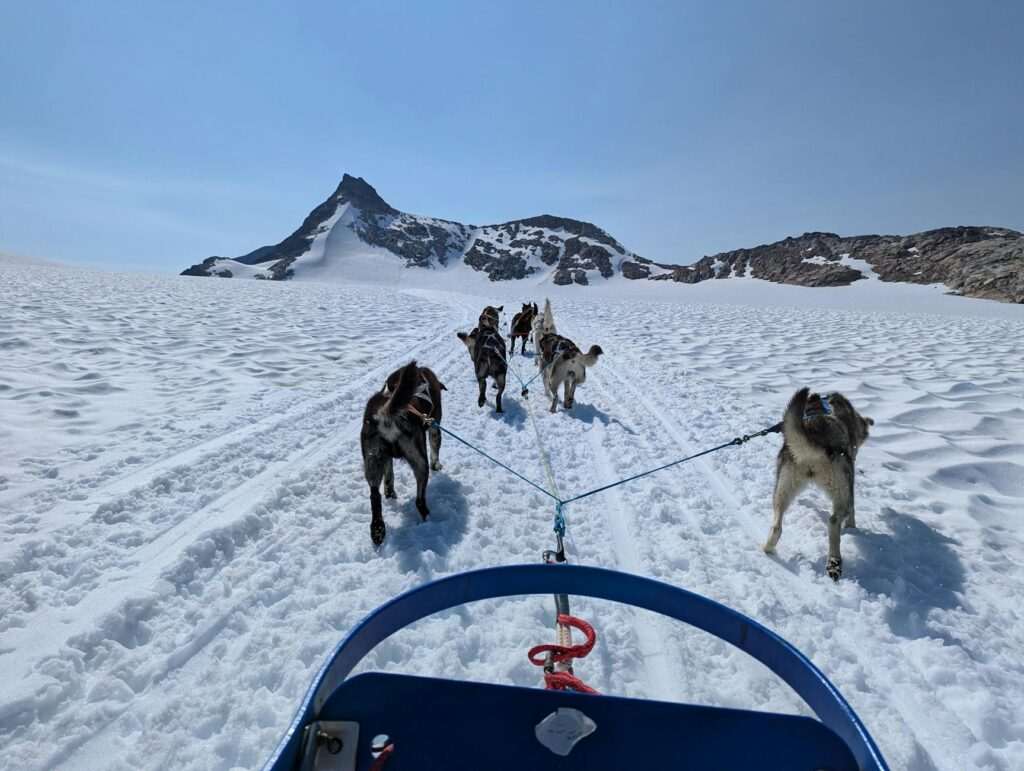
The centerpiece of Rondy is the World Championship Sled Dog Race — a three-day sprint event run on a course through downtown Anchorage. Unlike the Iditarod’s 1,000-mile endurance race, the Rondy sprint is exactly that: teams of 12 dogs racing a 25-mile loop at full speed, three times over three consecutive days, with cumulative times determining the winner. The course runs along 4th Avenue, through neighborhoods east of downtown, and back — a route that puts spectators within arm’s reach of the dogs at multiple points.
The sprint format produces a different experience than long-distance mushing. The dogs are running near their top speed, the mushers are leaning hard into turns, and the whole event covers the downtown core rather than disappearing into the wilderness. Standing on 4th Avenue as a 12-dog team launches off the start line in sub-zero temperature, the sound of paws on packed snow and the visual chaos of a full sprint team at speed, is one of the most purely Alaskan spectacles available in the city. The race runs Friday through Sunday of Rondy weekend; check the schedule at furondy.net for the 2026 start times and course map.
Signature Events
Running of the Reindeer. Participants pay to run alongside — and occasionally get outrun by — a herd of reindeer in a course through downtown Anchorage. Costumes are encouraged, chaos is guaranteed, and the reindeer are generally unimpressed by the human enthusiasm around them. The event runs Saturday morning of Rondy weekend, drawing hundreds of participants and a large crowd of spectators who made the correct choice not to get in the pen with the animals.
Outhouse Races. Teams build themed, wheeled outhouses — decorated and named according to whatever elaborate concept they have developed over the preceding weeks — and race them down 4th Avenue with a team member riding inside. The creative investment in the outhouses ranges from minimal to extraordinary, and the event has a devoted following of regulars who take the construction seriously. Outhouse racing is quintessential Rondy: a tradition so specific to this festival, in this city, that it could exist nowhere else.
Miners and Trappers Ball. The formal gala of Rondy, held on a Saturday evening at a downtown venue, is a full black-tie or period-costume event with live music, dancing, and a crowd that mixes Alaska dignitaries, longtime Rondy regulars, and visitors in rented furs. The Ball has been running since the earliest years of the festival and retains genuine social weight — this is not a themed party but a legitimate annual event on the Anchorage social calendar. Tickets sell in advance; check furondy.net for 2026 availability.
Blanket Toss. The nalukataq demonstration at Rondy is one of the few opportunities Anchorage visitors have to see traditional Alaska Native practices in a public setting. Participants are tossed from a large round blanket — historically made from walrus or bearded seal skins, laced together and held taut by community members around the perimeter — and skilled practitioners reach heights of 20–28 feet while performing aerial figures. The communal aspect of the activity — it requires coordinated effort from everyone holding the blanket — is as culturally significant as the acrobatics.
Fur Auction. One of Rondy’s founding purposes remains active: real furs — beaver, marten, lynx, fox, wolf — are auctioned over the festival period. The auction connects directly to the subsistence and commercial trapping economy that brought people to Anchorage in the first place. Attendance is open; bidding requires registration. The auction gives Rondy a weight that purely recreational winter festivals lack.
The Iditarod Ceremonial Start
The Iditarod Trail Sled Dog Race’s ceremonial start takes place in downtown Anchorage on the first Saturday of March, typically one to two weeks after Rondy concludes. The ceremonial start is free to attend and runs teams of 14 dogs down 4th Avenue — the same corridor as the Rondy sprint races — with tens of thousands of spectators lining the route. Mushers from across Alaska and the world take their official send-off on 4th Avenue before trailering north to Willow (the official restart) for the race proper.
Visitors who time a trip to catch both Rondy and the Iditarod ceremonial start get two of Alaska’s signature winter events in one trip. The gap between events is typically 7–10 days — fill it with a northern lights trip to Fairbanks or a dog mushing day tour outside Anchorage.
Best Vantage Points for the Sled Dog Races
The race course starts and finishes on 4th Avenue in front of the historic buildings near D Street. The start line area is the most crowded and provides the closest look at teams launching — arrive early for a front-row position. The course bends east through residential neighborhoods; local spectators set up along Tudor Road and the interior streets, where the crowds thin and you can watch teams pass at close range without fighting for position. The finish line, where cumulative time determines placement, draws the largest afternoon crowd. The entire race-day experience is walkable from downtown hotels.
2026 Dates and Tickets
Fur Rendezvous typically runs for ten days in late February, ending on the final weekend of the month. In recent years, the festival has run approximately February 20–March 1. Official 2026 dates and the full event schedule are published at furondy.net; check there for the confirmed race schedule, Ball ticket sales, and Running of the Reindeer registration. Most individual events are free to attend; the Miners and Trappers Ball, Running of the Reindeer participation, and some ticketed shows require advance purchase.
Lodging: Book Early
Anchorage hotel inventory during Rondy weekend fills weeks in advance — in some years, months. The race weekend (typically the second-to-last or final weekend of the festival) is the tightest booking window; Friday and Saturday nights of race weekend are the most contested. Downtown hotels within walking distance of 4th Avenue — the Hotel Captain Cook, Marriott Anchorage Downtown, Hilton Anchorage — are the most convenient and fill first. Mid-range options further from downtown along Minnesota Drive and the Northern Lights corridor fill next. Book as early as possible; last-minute rooms during Rondy, if available at all, carry significant premiums.
What to Wear
February in Anchorage runs -10°F to 25°F, with wind chill making exposed time feel colder. Watching the races means standing still on a street for extended periods. Layer: moisture-wicking base, insulating mid layer, wind and waterproof outer shell. Insulated boots rated to -20°F or colder are not excessive — cold feet end a day at Rondy faster than anything else. Add hand warmers, a face gaiter, and a warm hat covering the ears. Dress as if you will stand still outside for two hours, because you likely will.
Fur Rendezvous is the Alaska that existed before tourism discovered the state — a February gathering built on trappers and dog teams and community traditions that predate the highway system. It has grown into a full festival, but the core of it remains: the dogs on 4th Avenue, the fur auction, the blanket toss, the cold. Come for the races. Stay for the rest of it.
No comments yet.