
Alaska Wildflower Season 2026: When & Where to See Blooms Near Anchorage
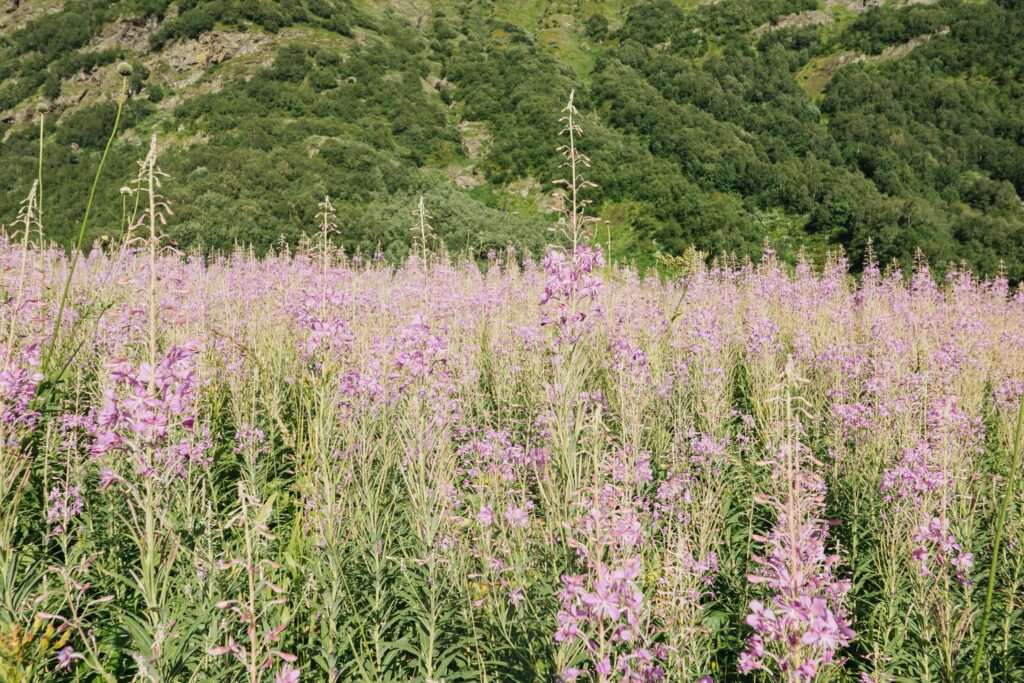
Alaska’s wildflower season is brief, vivid, and unlike anything in the lower 48. In the span of about twelve weeks — from late May through mid-August — the Anchorage region goes from snowmelt to full boreal meadow, with waves of color arriving and receding as summer progresses. Forget-me-nots open in June while snow still lingers on the peaks. Lupine fields paint entire mountain slopes purple in late June. And then fireweed arrives in July, spreading magenta across roadsides, hillsides, and old burns from Girdwood to the Valley, staying in bloom until the first frost signals the end of summer.
For visitors timing an Anchorage trip around wildflowers, the key is knowing which species peaks when — and which locations concentrate the most bloom in the most dramatic settings. This guide covers both.
Alaska’s Main Wildflower Species Near Anchorage
Forget-Me-Not — Alaska’s State Flower (Late May through June)
The forget-me-not is Alaska’s official state flower, and it earns that distinction by being among the first wildflowers to appear each season — often blooming while Chugach peaks are still snow-covered. The flowers are small (dime-sized) and sky-blue with a yellow center, typically found in moist open areas, along roadsides, and in clearings at lower elevations. Around Anchorage, expect forget-me-nots from late May through June, with peak bloom in the first two weeks of June. The Hillside trail networks in Chugach State Park and the approach to Flattop Mountain are reliable early-season spots.
Wild Geranium and Dwarf Dogwood (June through July)
Wild geranium — bright pink-purple, five-petaled — blooms throughout June and July in forest openings and disturbed areas throughout Southcentral Alaska. It’s a reliable background species in any mixed meadow wildflower display. Dwarf dogwood (also called bunchberry) is a low-growing ground cover with white four-petal flowers; look for it in the forest understory along Chugach trails from late June onward. Neither is a showstopper on its own, but both contribute to the layered look of a healthy boreal wildflower meadow.
Chocolate Lily (Late May through June)
One of Alaska’s more unusual wildflowers, the chocolate lily (or rice root fritillary) has a distinctive downward-facing bell-shaped flower in mottled brown and yellow-green — an odd but striking combination. It blooms in early summer, typically late May through late June, in open meadows and hillside grasslands. Flattop Mountain’s lower slopes and Powerline Pass in Chugach State Park are good bets. The chocolate lily is a favorite among wildflower enthusiasts precisely because it’s not what people expect from an Alaska bloom.
Lupine — The Hatcher Pass Spectacle (Late June through Mid-July)
Lupine is the showpiece of Alaska’s early-summer wildflower season. The tall, spiky purple-blue flower spikes grow in dense colonies, and when conditions are right, entire hillsides turn violet. In the Anchorage region, Hatcher Pass — about 60 miles north of Anchorage in the Matanuska-Susitna Valley — is the most celebrated lupine viewing destination in Alaska. The flower fills the lower slopes of the Talkeetna foothills in late June, often at peak intensity around the last week of June and first week of July. The drive up the Hatcher Pass Road through the flower fields, with Independence Mine State Historical Park visible above, is one of the more memorable roadside wildflower experiences in the state.
Lupine also appears at lower elevation near Anchorage — along the Glenn Highway corridor and in open areas of Chugach State Park — but the Hatcher Pass concentration is exceptional.
Fireweed — Alaska’s Unofficial Season Marker (July through August)
No wildflower is more closely associated with Alaska than fireweed. Its magenta-pink flower spikes are unmistakable — tall (sometimes waist-high or taller), clustered along roadsides, spreading across burned hillsides, and filling open alpine meadows. Fireweed blooms from the bottom of each spike upward through summer, and Alaskans use it as a season calendar: when the flowers have reached the top of the spike and the plant is in full bloom, there are roughly six weeks until the first frost.
Around Anchorage, fireweed typically starts opening in early July at lower elevations and mid-July at higher ones, with peak bloom in late July and early August. The Seward Highway corridor south of Anchorage — especially the stretch between Bird Creek and Girdwood — is one of the best fireweed drives in Southcentral Alaska. The hillside above Girdwood turns vivid magenta in mid-July when fireweed covers the slopes above the town. Old burns and clear-cuts throughout the Chugach area also support dense fireweed colonies, since the plant thrives in recently disturbed ground.
Later in August, fireweed transitions: the flowers drop, the seed pods open, and the plant releases clouds of white cottony fluff that drift across roadsides and hiking trails. It’s a different kind of beautiful — a late-summer snowfall in slow motion — but it marks the beginning of the end of the wildflower season.
Best Wildflower Viewing Locations Near Anchorage
Hatcher Pass (Best for Lupine — Late June)
Hatcher Pass is the premier wildflower destination in the Anchorage region. From the Palmer side, the drive up the Hatcher Pass Road passes through forest that opens into steep meadows filled with lupine, wild geranium, and arnica. The area around the Motherlode Lodge and the lower slopes of Gold Mint Trail are particularly reliable lupine spots in late June. For the full visual effect, come on a clear or partly cloudy day when the Talkeetna Mountains are visible behind the flower fields.
Plan for the drive from Anchorage to take about 1.5 hours to reach the main lupine areas. Hatcher Pass Road is unpaved above a certain point and becomes rough — a standard car can handle it in dry conditions, but a higher-clearance vehicle is useful. Independence Mine State Historical Park has parking and restrooms.
Chugach State Park — Flattop Mountain and Powerline Pass (Best for Multiple Species)
The Chugach State Park trail network offers wildflower viewing across multiple species and across the full season. The Flattop Mountain approach trail — starting from the Glen Alps trailhead — passes through open tundra meadows that bloom with forget-me-nots in June, chocolate lilies in early summer, wild geraniums through July, and fireweed at lower elevation from mid-July. The trail is heavily used and offers reliable wildflower viewing without demanding a long hike — the meadow areas below the summit scramble are accessible within 30–45 minutes of the trailhead.
Powerline Pass (also from Glen Alps) provides a longer route through wider meadows with stronger fireweed displays in late July. The 11-mile Powerline Pass trail follows a broad valley into the heart of the Chugach, passing through terrain that showcases fireweed, lupine, and late-season asters as the summer progresses.
Girdwood and the Seward Highway Corridor (Best for Fireweed — July through August)
The 40-mile drive from Anchorage to Girdwood on the Seward Highway is one of the most scenic drives in Alaska, and in July it becomes a wildflower corridor. Fireweed grows densely along the highway margins and on the hillsides above Turnagain Arm — particularly on north-facing slopes above Bird Creek and on the hillside above Girdwood’s main valley. The vista pulls along Turnagain Arm (particularly at Bird Point) offer good vantage points for photographing fireweed with the Arm and the Kenai Mountains as backdrop. Tour companies like Get Up and Go Tours run day trips through the Seward Highway corridor that can be combined with wildflower viewing.
Tony Knowles Coastal Trail (Accessible Urban Wildflowers)
For visitors without a car or time for a day trip, the Tony Knowles Coastal Trail — an 11-mile paved trail running from downtown Anchorage to Kincaid Park — passes through areas with forget-me-nots and fireweed at accessible elevations. The wildflower density here is lower than at the dedicated mountain locations, but the combination of wildflowers, Cook Inlet views, and potential wildlife sightings makes it a solid option for a morning walk during June or July.
The Fireweed Clock: Reading Alaska’s Season
Alaskans pay close attention to the fireweed bloom each year, and for good reason: the plant provides one of the most reliable seasonal indicators in the state. As summer progresses, fireweed flowers open from the base of each spike upward. When the blooms reach the top of the spike and the plant enters full bloom — typically in late July or early August in the Anchorage region — local wisdom holds that there are approximately six weeks until the first frost.
This means the fireweed bloom at peak is both the high point of the wildflower season and a gentle warning that summer is already in its second half. It’s one of the subtle ways Alaskans stay connected to the land’s seasonal rhythms.
Photography Tips for Alaska Wildflowers
Shoot at golden hour. Fireweed and lupine are both rich in warm tones (magenta, purple) that oversaturate under harsh midday light. Early morning and late evening light — which in Anchorage in July can extend to 10 or 11 p.m. — produces the most nuanced color and the best shadows on flower spikes.
Get low. The most compelling wildflower photographs use the flowers as a foreground element with the mountain or sky behind. Get your camera or phone at flower height or lower, use a wide-angle lens, and let the field extend into the middle distance with something dramatic — a mountain, a valley, a storm cloud — in the background.
Shoot into the light. Backlighting through fireweed and lupine petals makes the flowers glow. Position yourself so the sun is behind or to the side of the flower field, rather than over your shoulder. The translucency of the petals in backlight is one of the better photographic effects available in a wildflower meadow.
Bring a polarizing filter. For landscape shots combining wildflowers with sky, a circular polarizer deepens the blue of the sky, cuts atmospheric haze on distant peaks, and makes the greens of the surrounding vegetation more saturated. This is particularly effective at Hatcher Pass on clear days.
Wind is your enemy. Wildflower close-ups require stillness in the subject. Early morning hours in the Chugach tend to be calmer than afternoon. If it’s windy, shoot at a faster shutter speed (1/500 or faster) rather than stopping down for depth of field.
Planning Your Visit
The full wildflower season near Anchorage runs from late May through mid-August, but the most dramatic displays are concentrated in a six-week window from late June through late July. Visitors targeting the lupine fields at Hatcher Pass should aim for the last week of June or first week of July. For fireweed, target late July to early August for peak bloom in the Girdwood corridor and Chugach trails.
Weather is unpredictable — a clear forecast for Anchorage doesn’t guarantee clear skies at Hatcher Pass, which creates its own weather patterns. Check conditions at the pass specifically if you’re making the drive. Most wildflower locations require little to no hiking gear, though waterproof footwear is useful after rain.

No comments yet.