
Alaska Native Art & Craft Shopping Guide 2026: How to Buy Authentic Work
Alaska’s gift shops are full of Alaska Native art. Most of it isn’t. The mass-produced “Native-style” items lining souvenir shop shelves — plastic totem poles, machine-printed scarves with formline patterns, mass-cast resin figurines labeled “Alaska” — are manufactured overseas at scale and have no connection to any Alaska Native community, artist, or tradition. This is not a minor issue: the federal Indian Arts and Crafts Act of 1990 makes it illegal to falsely suggest that items are produced by Native Americans when they are not, but enforcement is limited and the problem is pervasive. For visitors who want to bring home genuine Alaska Native art — work that supports living artists, reflects real cultural traditions, and will be meaningful for decades — this guide covers how to tell the difference, where to shop, and what questions to ask.
The Silver Hand Program
The most reliable authenticity marker for Alaska Native art is the Silver Hand designation, a certification program administered by the Alaska Division of Community and Regional Affairs. When you see a small sticker or tag bearing a hand outline, it guarantees that the item was made by an Alaska Native or American Indian in the state of Alaska. The program has been operating since 1961 and is recognized by Alaska’s Native community as a meaningful — though not exhaustive — authenticity indicator.
The Silver Hand sticker can be reproduced fraudulently, so it works best in combination with other verification: purchasing from a reputable gallery or cooperative, knowing the artist’s name and community affiliation, and being appropriately skeptical of very low prices. Authentic handmade Native art takes significant time and skill; an ivory carving selling for $15 is not handmade. The Silver Hand certification sets a floor of verification, not a ceiling — the most significant galleries and cooperatives maintain their own authentication standards that exceed the state program.
Major Art Forms and Their Regional Origins
Alaska’s Native peoples are not a single culture, and their artistic traditions are as geographically distinct as the terrain they developed in. Understanding regional origins helps identify authentic work and ask informed questions.
Yup’ik (Yukon-Kuskokwim Delta). The Yup’ik peoples of Southwest Alaska produce some of the most widely recognized Alaska Native art: painted wooden ceremonial masks, dance fans, and dolls dressed in traditional garments with fur trim, qiviut, or grass weaving. Authentic Yup’ik dolls are typically small, carefully detailed, and made with materials specific to the Southwest Alaska environment — sealskin, caribou hide, ptarmigan feathers. Machine-manufactured versions typically substitute synthetic faux-fur and show mechanical uniformity in their features and dress.
Inupiaq (Arctic and Northwest Alaska). Inupiaq artists are renowned for ivory and bone carvings, including figurines of animals — polar bears, walrus, seals — and scrimshaw, the engraving art form developed from maritime whaling culture. Federal law governs the sale of marine mammal ivory products, and genuine walrus ivory carvings can be sold by and to anyone in Alaska but have restricted interstate transport rules. Bone and antler substitutes are legal alternatives. Inupiaq baleen baskets — woven from the filtering plates of bowhead whales — are among the rarest and most valuable Alaska Native craft forms.
Athabascan (Interior Alaska). The Athabascan peoples of Alaska’s Interior are known for beadwork of exceptional intricacy, birch bark baskets and containers, and fur items including moccasins, mittens, and parkas trimmed and decorated with traditional patterns. Athabascan beadwork often incorporates floral designs in glass seed beads applied to hide, velvet, or fabric. Authentic Athabascan beadwork shows hand-stitching irregularities, precise pattern execution, and traditional motifs; machine-embroidered “beadwork” patterns look mechanically uniform under close inspection.
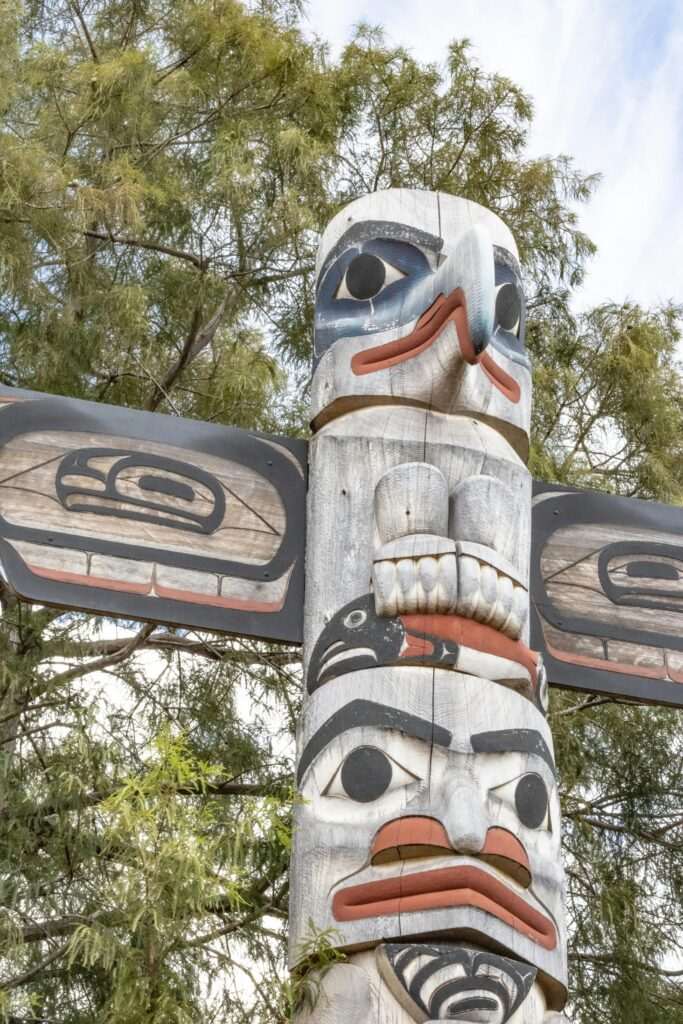
Tlingit and Haida (Southeast Alaska). The art traditions of the Tlingit and Haida peoples are perhaps the most visually recognized Alaska Native art globally: formline design — the system of ovoids, U-shapes, and flowing lines organizing animal forms — appears on totem poles, bentwood boxes, woven Chilkat blankets, and increasingly in contemporary silver and gold jewelry. Authentic formline art comes with provenance: the artist’s name, clan affiliation, and the narrative the work depicts. Generic “totem” imagery sold without any such context is almost certainly not genuine Southeast Alaska Native work.
Alutiiq/Sugpiaq (Kodiak Region). Alutiiq artists, centered on Kodiak Island and the outer Kenai Peninsula coast, are particularly known for woven grass baskets of exceptional technical quality, using rye grass harvested from coastal meadows and woven in coiled or plaited techniques that can require hundreds of hours for a single piece. Alutiiq weaving is among the most technically demanding Alaska Native crafts and commands prices that reflect that labor intensity.
Where to Shop Authentically in Anchorage
Anchorage Native Arts & Culture Festival. The Heritage Center on Glenn Highway northeast of downtown is Anchorage’s primary institution dedicated to Alaska Native cultures, operated by Alaska Native people. The gift shop carries authenticated work from across the state’s cultural regions and the staff can speak knowledgeably about the artists and traditions represented. For first-time buyers, beginning here provides a calibration for quality, materials, and price that makes subsequent purchases better informed.
Anchorage Museum. The Anchorage Museum gift shop maintains standards consistent with a major cultural institution — the work sold there has been vetted, and the curation reflects a genuine commitment to authentic Alaska Native and Alaska-made work. The museum itself houses permanent collections of Alaska Native art from all regions, providing context for understanding what you’re looking at in commercial settings.
Oomingmak Musk Ox Producers Co-operative. Located in a small storefront on 6th Avenue in downtown Anchorage — a short walk from the Alaska Railroad Depot — Oomingmak is one of the most direct connections between a visitor and Alaska Native artisans available in the city. The cooperative is owned and operated by Alaska Native women — primarily from remote Yup’ik and Inupiaq villages — who knit qiviut (musk ox underwool, one of the world’s warmest and finest natural fibers) into hats, scarves, stoles, and other items following traditional lace patterns specific to their home villages. Each item comes with documentation identifying the knitter and her community. Prices are significant — a qiviut hat runs $150–$300 depending on pattern complexity — but the value is proportional: musk ox fiber is extraordinarily rare, the knitting is expert, and every dollar goes directly to the women who made the work.
Local galleries. Several Anchorage galleries carry authenticated Alaska Native art with provenance documentation. The best maintain artist relationships and can connect buyers with specific artists for commissions or larger purchases. Be wary of galleries that cannot name the artist behind a specific piece; legitimate Native art dealers treat artist attribution as fundamental, not optional.
Native literature and research. Understanding the cultural context behind the art enriches the purchase and the relationship with it over time. The ZJ Loussac Public Library maintains a strong Alaska collection including books on Alaska Native art traditions, cultural histories, and contemporary Native writing. Title Wave Books, Anchorage’s major used bookstore, carries a broad selection of Alaska Native literature and cultural texts at accessible prices and is worth visiting alongside any art shopping. For visitors who prefer a guided introduction to Anchorage’s Native art scene, Adventures by True North offers small-group cultural experiences that include stops at several of the venues listed above.
Price Ranges and Red Flags
Genuine handmade Alaska Native art has minimum prices that reflect the labor, materials, and expertise involved. As rough benchmarks: a small handmade Yup’ik doll typically starts around $100–$200; a simple ivory carving from $150; an Athabascan beaded item from $200; a qiviut hat from $150; a woven grass basket from $200 for a small piece, into the thousands for complex or large-scale weaving. A formline silver bracelet by a recognized Tlingit artist typically starts at $400.
Items priced significantly below these ranges and sold without artist attribution or cultural provenance are almost certainly mass-produced imports. Mainstream retail shops in tourist areas — including the Tikahtnu Commons shopping mall and similar commercial venues — may carry Alaska-themed gifts, but the items in their gift sections typically lack authentication. Verify credentials before purchasing anything presented as Alaska Native art from a non-specialized retailer.
How to Ask Respectfully
Asking about the cultural context of a piece, the artist who made it, and the tradition it comes from is appropriate and welcomed at reputable galleries and the Heritage Center. The questions to ask directly: Who made this? What community are they from? Is there documentation? What tradition or cultural context does this work represent?
What to avoid: asking artists to demonstrate their craft as if performing, treating art shopping as an anthropological exercise rather than a commercial transaction between equals, or assuming that lower prices are a reasonable ask. The price of authentic Alaska Native art reflects the skill, time, and cultural knowledge embedded in it. Engaging with it at that level — as work made by specific people from specific places with specific meaning — is how the exchange stays valuable for everyone involved.



No comments yet.