
Bird Watching Near Anchorage Alaska 2026 — Potter Marsh & Beyond
Anchorage does not register on most birders’ target lists, which is exactly why it should. The city occupies a narrow strip of coastal lowland between Cook Inlet and the Chugach Mountains, and the habitats compressed into this geography — tidal flats, freshwater marshes, boreal forest, alpine meadows, and productive marine water — support an extraordinary diversity of species across the calendar year. Potter Marsh on the city’s south edge is among the most productive shorebird and waterfowl sites in Southcentral Alaska. The Eklutna Flats to the north concentrate migrating sandhill cranes in numbers that stop traffic. The Tony Knowles Coastal Trail runs for eleven miles along Cook Inlet, producing shorebird and raptor sightings on any fall morning. For birders willing to show up at the right time, Anchorage and its immediate surroundings offer species lists that rival dedicated birding destinations elsewhere in North America.
Potter Marsh Bird Sanctuary
The Potter Marsh Bird Sanctuary at mile 117.4 of the Seward Highway is the centerpiece of Anchorage birding. The site is a freshwater marsh created when the 1964 Alaska earthquake caused land subsidence that allowed tidal water to back up behind the railroad embankment south of Anchorage. The result is a productive wetland immediately adjacent to a major highway, with a free elevated boardwalk crossing the marsh that positions visitors directly over open water and marsh vegetation.
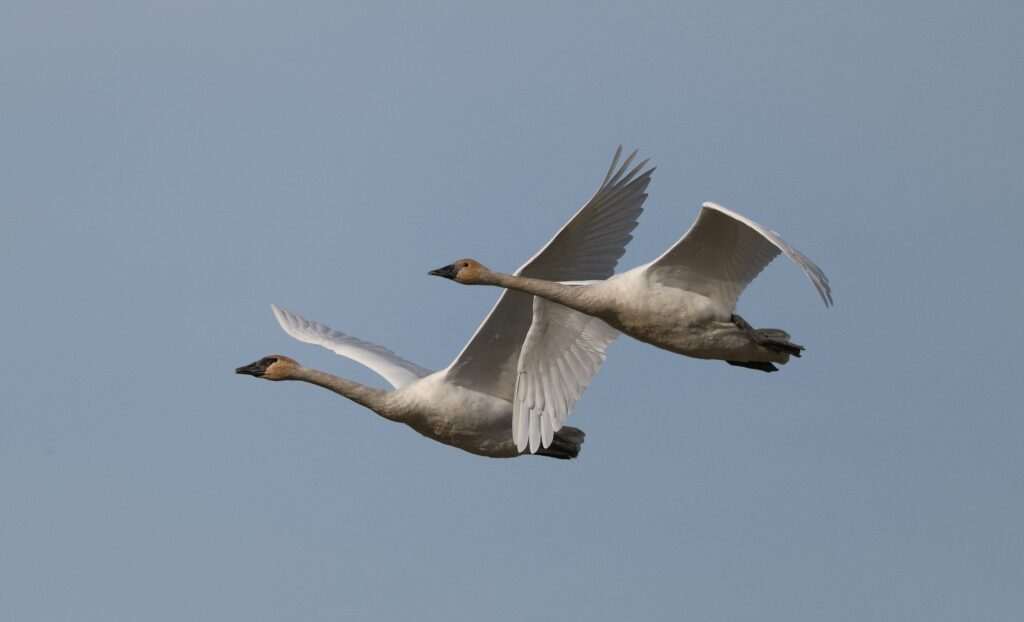
Trumpeter swans arrive at Potter Marsh in late April and remain through October, nesting in the marsh and producing cygnets that the adults escort through the summer. At their peak, a dozen or more trumpeter swans may be visible on the marsh simultaneously — they are Alaska’s largest waterbird, with wingspans exceeding six feet, and the combination of scale and white plumage makes them easy to locate from the boardwalk. Sandhill cranes pass through in May and August, sometimes landing in the marsh and surrounding uplands in substantial flocks. Arctic terns arrive in mid-May and can be seen hunting over the open water throughout the summer.
Waterfowl diversity at Potter Marsh is highest in May during spring migration. Lesser scaup, pintails, green-winged teal, buffleheads, American wigeons, and occasional rarities concentrate on the open water, and the elevated boardwalk allows observation without flushing birds. By June the marsh settles into its nesting configuration — dabbling ducks with ducklings, swans on nest mounds, red-necked grebes calling from the open water. The shorebird season runs from late July through September, when lesser yellowlegs, semipalmated sandpipers, dunlin, and pectoral sandpipers work the exposed mud edges. Admission is free. Parking is directly off the Seward Highway.
Westchester Lagoon and the Tony Knowles Coastal Trail
Westchester Lagoon sits at the north end of the Tony Knowles Coastal Trail system, a few minutes from downtown Anchorage. The lagoon is a tidal flat complex that fills and empties with Cook Inlet tides, and the transition zones between open water and exposed mudflat produce shorebird concentrations in late summer that are among the most accessible in the region. Western sandpipers stage at Westchester Lagoon in August by the thousands — a pre-migration gathering that peaks in the first half of the month before the birds move south — and the spectacle of sandpiper flocks wheeling over the inlet in synchronized formations is one of the more dramatic wildlife events within easy walking distance of a major city.
The Coastal Trail itself runs south from Westchester Lagoon along the inlet shore to Kincaid Park, with views west across Cook Inlet toward the Alaska Range and the active volcanoes of the Alaska Peninsula. Bald eagles are a daily presence on the trail — they perch in cottonwoods along the inlet margins and soar over the water hunting fish. Merlin and Peregrine falcons pass through in fall, hunting the shorebird flocks. The mudflats exposed at low tide between the trail and the inlet attract shorebirds, and birding in relation to tide matters: shorebirds concentrate on exposed flats during mid to low tide and disperse when the water rises.
Eagle River Nature Center and Eklutna Flats
The Eagle River Nature Center in the Chugach foothills twenty miles northeast of downtown Anchorage provides access to boreal forest and alpine edge habitats that complement the coastal birding at Potter Marsh and Westchester. The forest along the Eagle River trail system supports Three-toed and Black-backed woodpeckers, Boreal chickadees, American dippers along the river, and Varied thrushes in the dense spruce understory. The Nature Center maintains feeders that attract common redpolls, Pine siskins, and Black-capped chickadees year-round, and the open meadow areas produce sightings of Belted kingfishers, Common snipes, and Alder flycatchers during the breeding season.
Eklutna Flats, along the Glenn Highway north of Eagle River, is the best sandhill crane viewing site accessible from Anchorage. Sandhill cranes use the broad agricultural flats as a stopover during spring migration in May and fall staging in August and September; concentrations of several hundred birds are typical, and exceptional years have produced counts above a thousand. The cranes feed in fields visible from the highway and can be observed without any trail access. The Eklutna Flats area also attracts raptors during migration — Northern harriers, Rough-legged hawks, and occasional Golden eagles circle above the fields.
Turnagain Arm: Raptors and Tidal Flats
Turnagain Arm, the sixty-mile tidal inlet extending southeast from Anchorage, provides a productive birding corridor for any drive toward the Kenai Peninsula. The arm’s extreme tidal range — up to thirty-eight feet, among the largest in the world — exposes broad mudflats at low tide that attract shorebird concentrations comparable to Westchester Lagoon. Dunlin, Red-necked phalaropes, and Semipalmated plovers feed on the flats in late July and August when the tide is out. Timing a Seward Highway drive to coincide with a low tide is practical for shorebird viewing from pullouts along the highway.
Bald eagles are permanent residents along Turnagain Arm and visible year-round, but concentrations are highest in fall when spawned-out salmon in the arm’s tributary creeks attract eagles from a wide area. A single creek mouth in early October can hold a dozen bald eagles simultaneously. Peregrine falcons pass through during fall migration along the cliffs between Bird Point and Portage.
Seasonal Calendar
May is the peak month for Anchorage birding. Spring migration arrives with dramatic speed — swallows in the first week, shorebirds in the second, and by mid-May the full suite of breeding species is arriving simultaneously. Trumpeter swans and sandhill cranes arrive in late April and remain into May before settling into nesting areas. The combination of species diversity and moderate weather makes May the month to prioritize if you have only one window.
June and July are the nesting season. Birding activity slows relative to migration but remains productive for breeding species including Arctic terns, waterfowl with young, and boreal forest species at Eagle River. Late July marks the beginning of fall shorebird migration — the first southbound birds appear at Potter Marsh and Westchester Lagoon in late July and numbers build through August.
August and September are the fall migration peak. Western sandpiper staging at Westchester Lagoon is a highlight; so is sandhill crane concentration at Eklutna Flats. Bohemian waxwings move through Anchorage in large flocks in September and October, feeding on mountain ash berries in residential neighborhoods. Common redpolls and Pine siskins are reliable winter residents through November and occasionally into spring.
Beginner vs. Advanced Spots
Potter Marsh is the clearest beginner recommendation — the boardwalk is paved, flat, and fully accessible, parking is immediate, and the species are large and cooperative. Trumpeter swans at ten yards from a boardwalk require no optics and reward first-time birders immediately. Westchester Lagoon is similarly accessible, located at the end of a short paved path from the parking lot. Both sites are free.
Advanced birders should prioritize Eklutna Flats during May and September migration, time Westchester Lagoon visits to coincide with low tide in August, and explore the Eagle River Nature Center trails for woodpecker and forest species that don’t appear at coastal sites. The Coastal Trail between Westchester Lagoon and Kincaid Park during fall migration is productive for raptor watching if conditions — northwest winds, clear skies — push migrant falcons along the inlet.
What to Bring
Binoculars are essential. A 10×42 binocular is the practical standard for birding — sufficient magnification for shorebirds at distance, enough light-gathering for forest species in shade. A spotting scope on a tripod is useful at Potter Marsh and Westchester Lagoon for scanning distant waterfowl. For field guides, the Sibley Guide to Birds of North America covers all Anchorage species with regional context; the eBird mobile app (free) provides current sighting reports and allows real-time comparison of your observations with what other birders have seen at the same sites in recent days.
Rain gear and layering are practical for any Anchorage birding outing regardless of the forecast — conditions change quickly, and Potter Marsh and Westchester Lagoon are fully exposed sites. Insect repellent is advisable at Potter Marsh from late June through August; the marsh produces mosquitoes in numbers that will cut an unprotected visit short. Potter Marsh, Westchester Lagoon, the Coastal Trail, and Eklutna Flats are all free to access. The Eagle River Nature Center charges a small day-use fee for trail access.


No comments yet.