
Northern Lights Alaska Anchorage: 2026 Viewing Guide
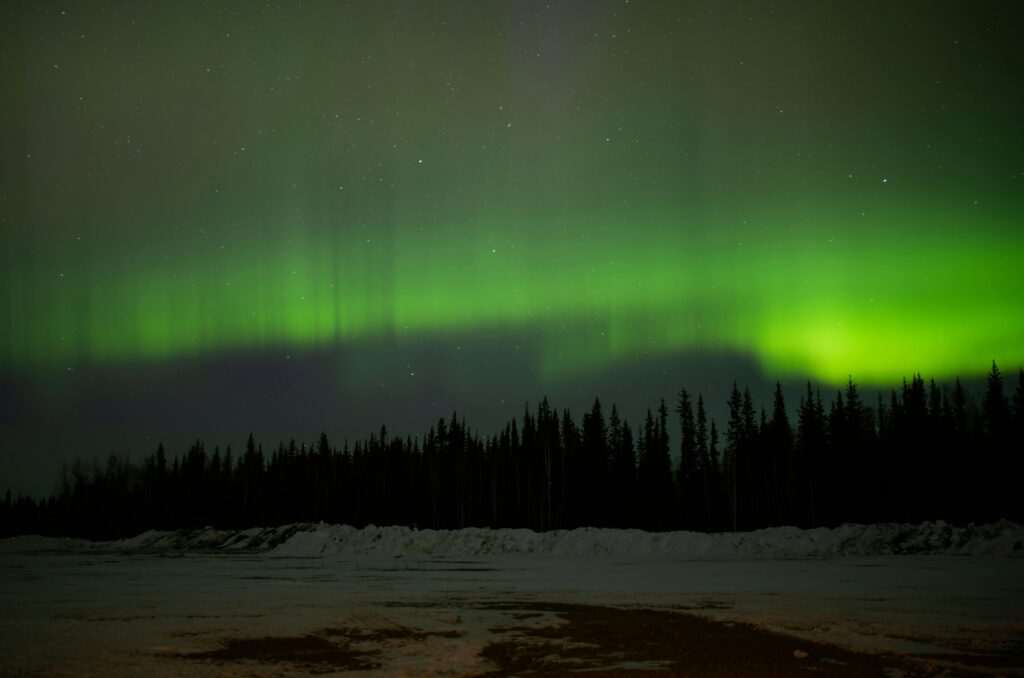
The northern lights don’t announce themselves. You walk outside on a cold September night and the sky is just sky — stars, darkness, a faint glow on the horizon that might be Anchorage’s light pollution. Then the green starts to move. It shifts and pulses and occasionally erupts into curtains of violet and white that fill the whole sky. Seeing the aurora borealis in Alaska is not a guaranteed experience, but it is a plannable one — and the difference between a successful chase and a frustrating night outdoors usually comes down to preparation. Here is what you need to know.
What Causes the Northern Lights
The aurora forms when charged particles from the sun — carried on the solar wind — collide with gases in Earth’s upper atmosphere near the magnetic poles. The collisions release energy as visible light: green from oxygen at lower altitudes, red from oxygen higher up, blue and purple from nitrogen. The intensity of the display corresponds to solar activity, measured by the Kp index (a scale from 0 to 9). For Anchorage-area viewing, you generally need a Kp of 3 or higher. Major geomagnetic storms (Kp 5+) can produce aurora visible as far south as the Lower 48.
When to See Northern Lights Alaska Anchorage
Aurora season near Anchorage runs from late August through April. The critical requirement is darkness, and Anchorage’s extreme summer daylight (nearly 20 hours near the solstice) makes summer aurora viewing impossible — the sky simply never gets dark enough. The realistic window opens around late August when astronomical darkness returns after the midnight sun season.
September and October are excellent starting months — nights are long enough, temperatures are still manageable, and early-season activity often coincides with autumnal equinox geomagnetic disturbances that reliably boost Kp values. November through March brings the longest dark periods and greatest statistical opportunity, but temperatures drop to -10°F or colder, which demands serious cold-weather preparation. March and April offer a balance: nights are still long, temperatures moderate, and spring equinox activity spikes aurora frequency again.
Best Viewing Spots Near Anchorage
The enemy of aurora viewing is light pollution, and Anchorage produces plenty of it. Getting even a few miles from the city core makes a significant difference.
Kincaid Park: The western edge of Anchorage, dark, west-facing, and away from the densest city lights. The bluff above Cook Inlet offers an open horizon with minimal light interference from behind. A 20-minute drive from downtown and free to access.
Arctic Valley / Chugach State Park: The road up to Chugach State Park‘s Arctic Valley ski area climbs above the city’s light dome and puts you in near-wilderness darkness within 30 minutes of Midtown. On nights with strong aurora, this is one of the most popular local spots.
South Glenn Highway pullouts: Driving south on the Glenn Highway toward Eagle River takes you out of the Anchorage bowl quickly. Pullouts along the Chugach foothills offer dark horizons and elevated views.
Hatcher Pass (70 miles north): The dark skies above Hatcher Pass are among the best accessible to Anchorage residents. The road to Independence Mine climbs above the Mat-Su Valley’s ambient light and offers spectacular aurora backdrops — snow-covered alpine terrain reflecting green light below a curtain of aurora. In winter the road may close above the lower parking area; check conditions before making the drive.
Fairbanks: If you’re serious about aurora, Fairbanks is the gold standard for Southcentral Alaska visitors willing to make the trip. Sitting directly under the auroral oval at 64° north, Fairbanks sees statistically more aurora nights than Anchorage. The Alaska Railroad runs the Aurora Winter Train between Anchorage and Fairbanks on select weekends in winter — a scenic option that avoids the 6-hour road drive in icy conditions.
Forecasting and Apps
Never drive to a dark sky site blind. Check the forecast first:
- UAF Geophysical Institute Aurora Forecast: gi.alaska.edu — the most Alaska-specific forecast available, updated daily with a 7-day outlook and cloud cover overlay
- Space Weather app (SpaceWeatherLive): Real-time Kp index, solar wind data, and push notifications when Kp crosses your threshold
- NOAA Space Weather Prediction Center: swpc.noaa.gov — the source data for all aurora forecasting; useful for 1-3 day outlooks
Set a notification for Kp ≥ 3 if you’re near Anchorage, Kp ≥ 2 if you’re in Fairbanks. When an alert fires, check cloud cover — clear skies are non-negotiable. The UAF forecast includes cloud cover, which is often the deciding factor in Alaska’s variable weather.
Practical Tips
- Give your eyes 30 minutes to dark-adapt. Put your phone face-down after arrival and resist the urge to check it constantly — every screen flash resets your night vision.
- Dress for 30 minutes colder than forecast. Standing still in an open field at 15°F feels like -10°F. Hand warmers, insulated boots, a balaclava.
- Be patient. Aurora comes in waves. A quiet sky can erupt within minutes. Give yourself at least two hours at the site before giving up.
- Face north. Aurora originates from the northern magnetic pole. Face north and scan from horizon to zenith on strong nights.
Aurora Photography Basics
Your phone camera will not capture a good aurora image on most nights. For serious photography:
- Tripod: Essential. Any camera movement during a long exposure ruins the image.
- Settings: Manual mode, widest aperture (f/2.8 or wider if available), ISO 1600–3200, shutter speed 10–20 seconds. Adjust ISO down if the aurora is strong and fast-moving.
- Focus: Manual focus set to infinity, or focused on a bright star. Autofocus will hunt in darkness and fail.
- Composition: Include foreground — trees, a lake reflection, a snow-covered peak — to give the image scale and drama.
For those who prefer a guided experience, several Anchorage tour operators offer dedicated aurora chase packages from September through April — providing transportation to dark-sky sites, photography instruction, and real-time Kp monitoring so you can focus on the sky rather than the forecast.
Featured photo by John De Leon on Pexels.


No comments yet.