
Anchorage Ship Creek & Rail Yards District 2026: Urban Fishing, Historic Rails & Waterfront Life
Most visitors to Anchorage spend their time in the downtown retail corridor, the Anchorage Museum, or heading south on the Seward Highway toward Kenai Fjords. Relatively few walk the ten minutes north from Fourth Avenue to the waterfront — and the ones who don’t are missing what may be the city’s most characteristically Alaskan neighborhood.
The Ship Creek and Rail Yards district is where Anchorage’s industrial, commercial, and wild Alaska collide. A working port. A historic railroad depot. A summer market under the tracks. And a salmon run in the middle of downtown so dense that anglers stand shoulder to shoulder on a concrete bank within sight of hotel windows.
Ship Creek Salmon Fishing: Alaska’s Most Urban Run
Ship Creek is a small stream by Alaska standards — nothing like the Kenai or the Susitna. But every summer, king salmon and silver salmon push up this creek through the middle of Anchorage, past the Port of Anchorage container terminals, under the railroad bridge, to the hatchery a mile upstream. They don’t care that they’re in a city. And starting in late June, neither do the anglers.
The lower Ship Creek fishing area — just north of the Alaska Railroad depot, accessible via a short walk or the guided fishing access from downtown — draws dozens of anglers daily at peak season. This is shore fishing, no boat required. You stand on a gravel or concrete bank, you watch fish holding in the current below you, and you cast. The setup is remarkably accessible for a place where the fish are real, the gear is minimal, and the stakes are a 30-pound king salmon.
What’s Running and When
- King salmon (chinook): Mid-June through July. The Alaska Department of Fish & Game opens and closes the king season based on run counts at the hatchery. Check the ADF&G website for current season status before visiting — the king season can be modified or closed if returns are below threshold.
- Silver salmon (coho): August through September. The silver run is generally more reliable and less subject to emergency closures than kings. Hatchery-origin silvers return in good numbers most years.
Gear Rental and Licensing On-Site
A small bait shop near the lower Ship Creek area rents rods and sells bait, lures, and fishing licenses during salmon season — eliminating the need to bring equipment or make a separate stop at a sporting goods store. If you’re staying downtown and want to fish for an hour before dinner, the entire setup is logistically simple. Buy your Alaska non-resident fishing license (required for anyone 16+), grab a rod, walk to the bank.
Note: king salmon fishing requires a separate king salmon harvest ticket in addition to your fishing license. Silver salmon do not require the additional stamp. The shop staff will walk you through current requirements.
Alaska Railroad Depot: The Active Heart of Rail Travel
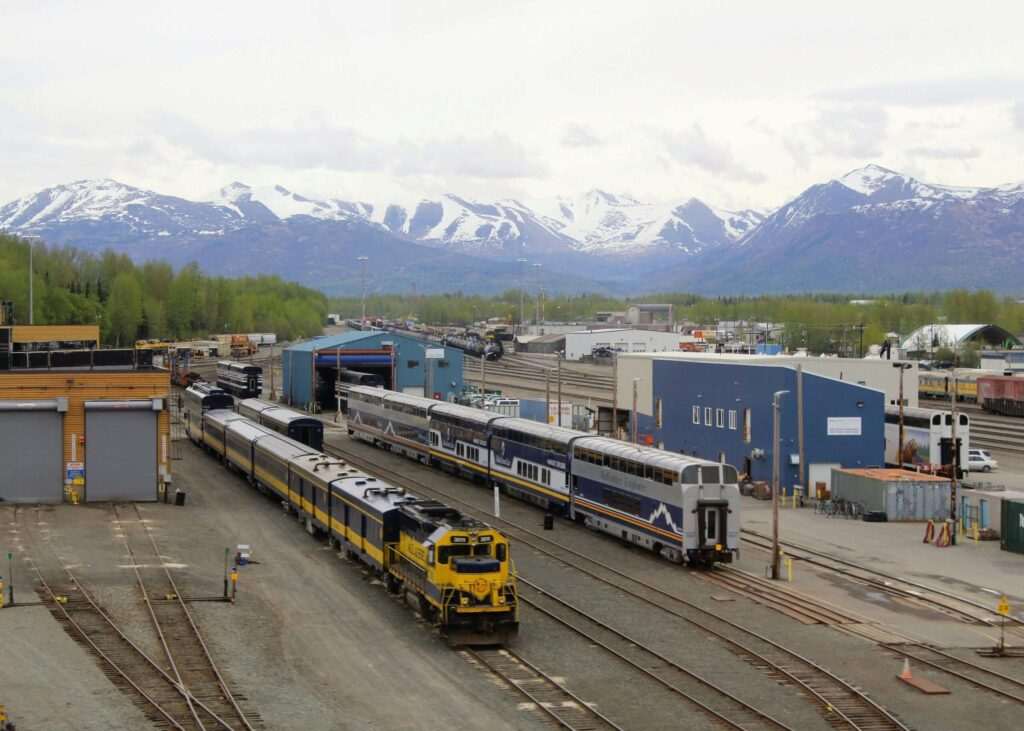
The Alaska Railroad depot in Ship Creek is not a museum piece. It is a working train station, and the Alaska Railroad’s two major passenger routes — the Denali Star to Fairbanks and the Coastal Classic to Seward — depart from this platform every morning during summer season.
The depot building itself dates to 1943 (the original 1915 station burned) and has been well maintained. The waiting area features historic photographs and interpretive displays on Alaska Railroad history, the construction of the original line through the Alaska Range, and the wartime role of the railroad in supplying military installations across the state. It’s worth fifteen minutes of exploration even if you’re not boarding a train.
The area around the depot — the rail yards themselves — offers views of the working infrastructure that keeps the railroad operating: locomotive maintenance facilities, freight cars, the switching yard that serves both passenger and freight operations. The railroad is one of the few in the United States that still provides both significant passenger service and extensive freight operations, including bulk fuel delivery to remote communities accessible no other way.
Rail Yards Market: Local Food and Artisans Under the Tracks
On summer weekends (roughly late May through mid-September), the Rail Yards Market operates in the open-air space adjacent to the railroad depot. This is a genuinely local market — not a tourist-facing craft fair — with a strong food vendor component alongside art, produce, and handmade goods from Anchorage makers.
The food vendor lineup rotates but typically includes Anchorage food trucks and pop-up operations with an Alaska focus: reindeer sausage, fresh-caught seafood, locally baked goods, and a range of international cuisines reflecting the city’s diverse population. Live music is a regular feature on Saturday afternoons.
The Rail Yards Market operates Saturdays and Sundays, typically 10 a.m. to 4 p.m. Arrive early for the best vendor selection; some popular food operations sell out before the market closes. Parking is available in the depot lot; the market is also easily walkable from downtown hotels via the Ship Creek trail.
The Ship Creek Trail: Connecting Waterfront to Downtown
The Ship Creek trail runs roughly 2.5 miles from the fish and wildlife viewing area near the hatchery downstream to the coastal trail along Knik Arm. It’s a flat, paved multi-use path — walkable, bikeable, accessible — that serves both recreational users and commuters connecting downtown Anchorage to the waterfront neighborhoods.
The section between the fishing area and the railroad depot passes through a mix of industrial waterfront and riparian habitat — a genuinely Alaskan juxtaposition of working port and creek ecosystem. Eagles fish the creek alongside human anglers in season. The contrast of container terminals and salmon runs, factory buildings and spawning fish, is unusual enough that it repays attention rather than dismissal.
The Port of Anchorage: Alaska’s Working Waterfront
The Port of Anchorage is not a scenic harbor. It is a functioning industrial port that handles approximately 70–80% of all goods shipped into Alaska — groceries, fuel, construction materials, vehicles. The container operations, fuel tank farms, and freight infrastructure visible from the Ship Creek trail and the surrounding area represent the logistics foundation of Alaska’s economy in a way that is invisible in more tourist-oriented parts of the state.
For visitors interested in how Alaska actually works — how an isolated population of 700,000 people in a state with limited road access to the rest of the country manages its supply chain — the port is a useful thing to see, even from a distance. The scale of dependency that the infrastructure implies says something true about Alaska that the mountain scenery doesn’t.
Earthquake Park and the 1964 Good Friday Earthquake
Earthquake Park sits about a mile west of the Ship Creek area along the Tony Knowles Coastal Trail, on a bluff above Knik Arm. On March 27, 1964, the Good Friday Earthquake — measuring 9.2 magnitude, the most powerful earthquake ever recorded in North America — struck south-central Alaska. The quake killed 139 people and destroyed large portions of downtown Anchorage. The Turnagain neighborhood near the park site was particularly devastated: a massive landslide collapsed bluff sections into Cook Inlet, carrying homes into the water.
The park preserves the disturbed topography from the landslide in its original form — the irregular ground, the humped and sunken terrain — as a permanent record of what happened here. Interpretive signage explains the earthquake’s geology and regional impact. Views from the bluff take in Knik Arm and the Alaska Range on clear days.
Earthquake Park is accessible by the coastal trail from the Ship Creek area — roughly a 20–30 minute walk or a 10-minute bike ride. It works well as the western endpoint of a Ship Creek / waterfront loop that returns via the coastal trail to downtown.
Waterfront Dining Near Ship Creek
The Ship Creek and Rail Yards area has developed a small cluster of waterfront restaurants and bars in recent years, several occupying spaces with views of the inlet and mountains. Options range from casual to sit-down dining, with a focus on seafood given the proximity to the harbor. The area is more local than the Downtown dining strip — fewer chains, more neighborhood character — and is worth exploring for an early dinner after a day at the market or on the fishing bank.
Putting It Together: A Ship Creek Day
A well-paced Ship Creek day from a downtown hotel looks like this: morning fishing at the lower creek (peak fish activity is early), a mid-morning exploration of the railroad depot and its exhibits, lunch at the Rail Yards Market (weekend only), an afternoon walk west on the coastal trail to Earthquake Park, and a return along the coastal trail to downtown in time for dinner. Total distance on foot is under five miles, entirely flat, with no driving required.
It’s the Alaska that doesn’t appear on most itineraries — industrial, historical, wild in unexpected places, and more honest about what the city actually is than the polished visitor center version. Ship Creek is worth the walk.



No comments yet.