Anchorage History Guide 2026: From Indigenous Roots to Boomtown to Modern City
Anchorage is one of the youngest major cities in the United States. It was a tent camp in 1915. It didn’t have paved roads until after World War II. It was reshaped by an earthquake so powerful that the ground itself changed shape. And yet the land it stands on has been home to people for thousands of years before any of that. Understanding that layered history — old land, young city — gives you a much richer sense of what Anchorage actually is.
The Dena’ina Homeland
Long before European contact, the Cook Inlet region was — and remains — the homeland of the Dena’ina Athabascan people. The Dena’ina are the only Athabascan group in Alaska with significant territory on tidal waters, which shaped their culture in distinctive ways: they were salmon fishers, marine mammal hunters, and traders alongside their inland practices of hunting and gathering.
The area now occupied by Anchorage was known to the Dena’ina as Dgheyay Kaq’ (“the place where the creek flows”) and was used seasonally for fishing and hunting. The Dena’ina had an established network of villages throughout the Cook Inlet basin, and their population numbered in the thousands before introduced diseases — arriving ahead of sustained European contact — dramatically reduced their numbers in the late 1700s and early 1800s.
The Dena’ina are still here. The southcentral Alaska Dena’ina community remains active, and their cultural and political presence in Anchorage is ongoing. The Anchorage Museum holds significant Dena’ina collections, and their language — a member of the Athabascan family — has active revitalization efforts underway.
Russian Exploration and the Fur Trade
Russian traders and explorers reached Cook Inlet in the 1780s, following the routes established by the 1778 voyage of Captain James Cook, whose name the inlet now carries. The Russians established a small outpost at Kenai in 1791, making it one of the oldest continuously occupied non-Native settlements in Alaska.
The Russian-American Company controlled Alaska’s fur trade through the mid-1800s, but their presence in the Cook Inlet region was never large. The main impact of the Russian period on the Dena’ina was disease, trade disruption, and gradual incorporation into the fur trade economy — not dramatic settlement or direct confrontation of the kind that characterized colonization elsewhere.
The United States purchased Alaska from Russia in 1867 for $7.2 million — famously derided at the time as “Seward’s Folly” — and took formal possession in Sitka that October. For the Cook Inlet area, the immediate practical change was minimal. The real transformation came later.
1915: A Tent City on the Inlet
The modern city of Anchorage was born in the spring of 1915 as a construction camp. The U.S. government had decided to build a railroad connecting the port of Seward to the interior goldfields of Fairbanks, and the flat bench above the inlet was chosen as the headquarters and supply hub for the project. Workers arrived by the hundreds. Tents went up. A lottery was held for the first permanent lots.
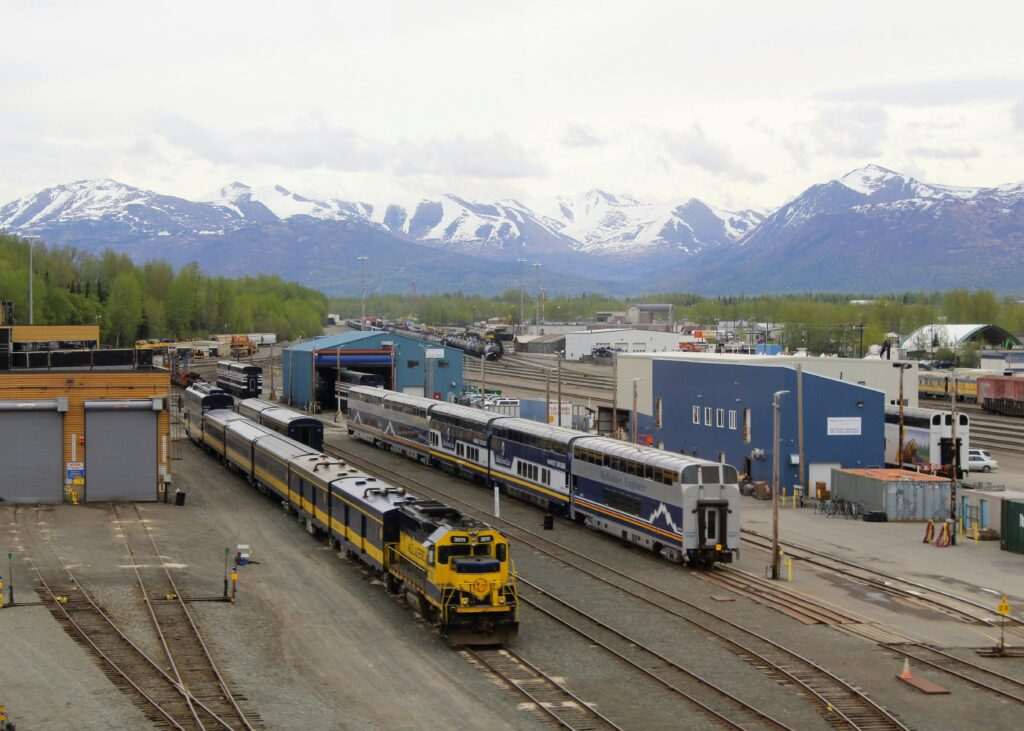
By summer of 1915, the tent city had a population of around 2,000 and the beginnings of a street grid. By the end of the year, Anchorage had wood-frame buildings, a hospital, a school, and the unmistakable energy of a boom settlement. The Alaska Railroad — still operating today as the only state-owned railroad in the U.S. — was completed in 1923 when President Warren Harding drove the golden spike in Nenana.
The railroad defined early Anchorage’s economy and identity. The city existed to move goods and people in and out of Alaska’s interior, and for the first decades of its existence, that was essentially its whole reason for being.
World War II: The City Transforms
The Japanese attack on Pearl Harbor in December 1941 triggered a transformation of Anchorage that the railroad never could have. Alaska’s strategic position — close to Japanese territory, astride the northern Pacific — made it suddenly critical to U.S. military planners. Fort Richardson and Elmendorf Air Force Base were massively expanded. Military personnel flooded in.
The population of Anchorage roughly tripled during the war years. Roads were built, infrastructure was laid, and the city acquired permanent institutions that gave it a permanent character beyond just a railroad hub. The Alaska Highway, completed in 1942 as a military supply route, connected Alaska to the continental United States for the first time by land.
After the war, many of the military personnel stationed in Anchorage chose to stay. The city they’d built a connection to offered land, resources, and opportunity in ways that postwar America elsewhere didn’t always match. This wave of postwar settlement cemented Anchorage as Alaska’s dominant city.
March 27, 1964: Good Friday
At 5:36pm on Good Friday, 1964, the ground beneath southcentral Alaska broke. The earthquake that followed — magnitude 9.2, the most powerful ever recorded in North America and the second most powerful in recorded history globally — lasted approximately four and a half minutes. The shaking was so sustained that witnesses described it as surreal, as if the world had simply stopped following the rules.
Anchorage was devastated. The Turnagain Heights neighborhood slid into the inlet as the clay soil beneath it liquefied. Fourth Avenue in downtown dropped more than ten feet. The J.C. Penney building collapsed. The port of Whittier was destroyed. Tsunamis generated by the quake killed people as far away as Oregon and California.
In total, 139 people died across Alaska. Given the scale of destruction, it was a remarkably low number — a function of the sparse population and the timing (a holiday Friday afternoon when businesses and schools were largely empty).
Earthquake Park, on the coastal trail near the western end of Northern Lights Boulevard, preserves a section of the original Turnagain Heights landslide terrain. The ground still shows the hummocky, disturbed topography of the 1964 slide. Interpretive signs explain what happened here. It’s one of the most tangible reminders in the city of how young and geologically active this landscape is.
The 1970s Oil Boom and What It Built
The discovery of oil at Prudhoe Bay in 1968 and the completion of the Trans-Alaska Pipeline in 1977 transformed Alaska’s economy overnight — and Anchorage most visibly. The city became the financial and corporate headquarters of the oil industry’s Alaska operations. Money arrived in quantities the state had never seen. Government services expanded. The skyline changed. The population grew from roughly 48,000 in 1970 to over 170,000 by 1980.
Much of what you see in Anchorage today was built in the oil boom decade: the downtown office towers, the expanded airport, the performing arts center, the hotel infrastructure. The Permanent Fund — established in 1976 to invest a portion of oil revenues for the future — continues to pay annual dividends to every Alaska resident today.
The boom also brought the stresses of rapid growth: housing shortages, infrastructure strain, and a boom-bust cycle that left Anchorage vulnerable when oil prices dropped in the mid-1980s. The city’s economy diversified over the following decades, expanding its healthcare, government, transportation, and tourism sectors.
Anchorage Today
Modern Anchorage is a city of about 300,000 people — nearly 40% of Alaska’s total population in a metro area the size of Rhode Island. It’s a genuinely diverse city, with significant Alaska Native, Pacific Islander, Filipino, Korean, and other immigrant communities alongside the descendants of the railroad workers, soldiers, and oil workers who came before them.
The city is still shaped by its history at every turn: the railroad still runs, the military bases are still active, the oil industry is still a major employer, and the Dena’ina language can be seen on street signs throughout downtown.
Where to Learn More
The Anchorage Museum is the best single source for the city’s history, with exhibits covering the full arc from pre-contact Indigenous cultures through the present. The Alaska Heritage Museum at Wells Fargo, free to visit, holds one of the most significant private collections of Alaska Native art and historical artifacts in the state. Earthquake Park on the Coastal Trail is free and always accessible. The Alaska Railroad Depot in downtown still functions as an active train station and has historical displays.
For visitors who want a guided orientation to Anchorage’s history and neighborhoods, Get Up and Go Tours offers city tours that provide historical context alongside the standard highlights. Adventures by True North runs small-group Anchorage experiences that draw on deep local knowledge. The Chugach Mountains rising behind the city are themselves part of the Dena’ina story — Chugach State Park sits on land that has been traveled, fished, and hunted for thousands of years before it had an official name.
Anchorage is young as cities go. But the stories embedded in it run much longer than the city itself, and taking the time to know even a few of them makes the place considerably richer to walk around in.
Featured photo by Howard Herdi via Pexels.

No comments yet.