
Alaska Dipnetting 2026: The Uniquely Alaskan Way to Fill Your Freezer with Salmon
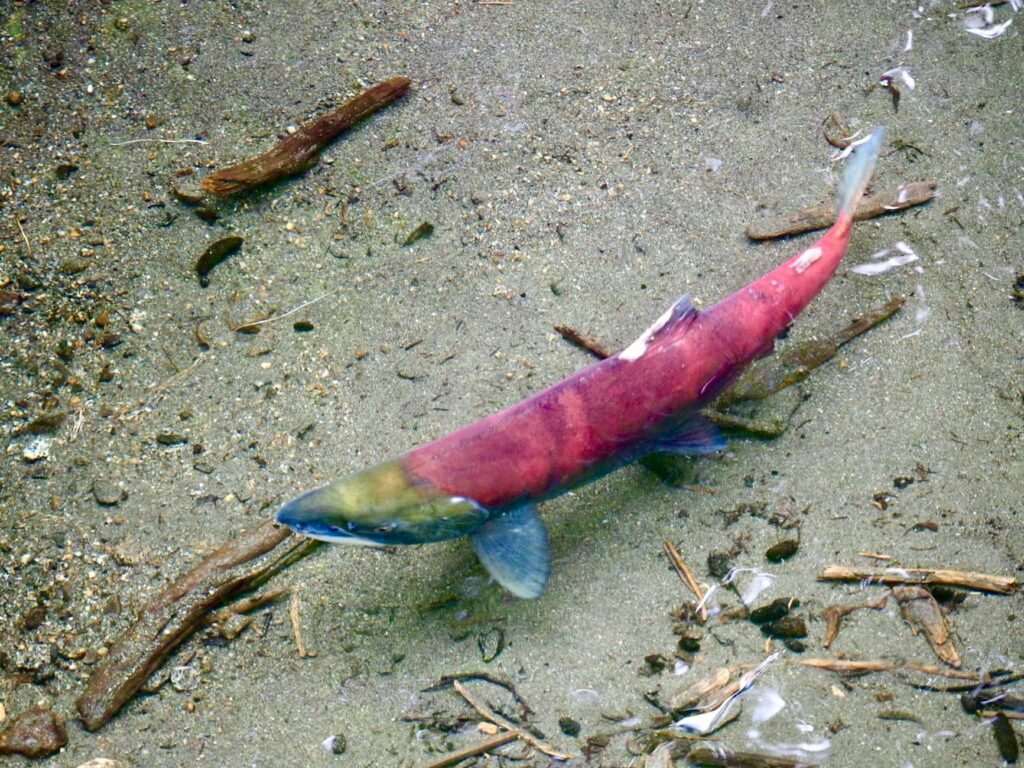
Dipnetting is legal in only a handful of states, and Alaska is the place where it happens at a scale that makes the word “harvest” accurate. During the peak sockeye runs of July, the mouth of the Kenai River at Kenai Beach becomes one of the strangest and most distinctly Alaskan spectacles in the state: hundreds of residents standing in the surf in waders, holding long-handled nets on 20-foot poles, waiting for the pulse of fish moving along the beach. They pull fish, club them, and pack them into coolers that will fill chest freezers for the winter. This is not sport fishing. It is subsistence-style food gathering, legal only for Alaska residents, and it represents a relationship with wild salmon that has no equivalent anywhere else in the United States. Visitors cannot dipnet, but they can watch — and what they see is worth seeing.
What Dipnetting Is
Personal use dipnetting is a harvest method unique to Alaska in which state residents are permitted to use large hoop nets — circular frames of 18 to 36 inches attached to long poles — to intercept salmon moving along river mouths and beaches during peak runs. It is distinct from sport fishing in every way: the nets scoop fish rather than hooking them, the limits are measured in dozens rather than daily bag limits of two or four, and the explicit purpose is filling a freezer for personal and family consumption rather than sport or recreation.
Alaska residents with a valid fishing license are permitted to take up to 25 sockeye salmon per household head plus 10 per additional household member during the Kenai River personal use fishery — a household of four can legally take 55 sockeye in a season. At an average of 6 to 8 pounds of meat per fish, that is several hundred pounds of wild sockeye salmon. The state manages the fishery by monitoring run strength; when escapement goals are met, the fishery opens. When runs are weak, it closes or restricts hours. The system has worked well enough that dipnetting has remained one of the most important food traditions in Alaska for the non-Native resident population.
Kenai Beach: The Premier Dipnetting Location
The mouth of the Kenai River at Kenai Beach, on the western edge of the Kenai Peninsula, is the most popular dipnetting location in Alaska and the one accessible from Anchorage in a reasonable day trip — approximately 2.5 hours via the Seward Highway and Sterling Highway. The fishery operates from the saltwater zone of Kasilof Beach extending to the Kenai River mouth, and during peak runs the beach is lined with dipnetters standing in the surf from early morning through evening.
The sockeye run at Kenai peaks in mid-July, though the fishery typically opens in late June and runs through late July depending on run strength. Peak weekend days in mid-July draw hundreds of participants and produce scenes that are genuinely extraordinary for a visitor to observe: coolers stacked on the beach, fish being cleaned at cleaning stations, families working together to handle the catch, and the continuous rhythm of nets going into the water and fish coming out. RV camping is available near the beach in the city of Kenai, and many Alaska families make the Kenai Beach dipnetting trip an annual summer tradition — several days of fishing, camping, and processing fish together before the freezer run home.
What visitors can do at Kenai Beach: Watch from the beach without a net. Buy fresh-caught sockeye directly from dipnetters who are often willing to sell — cash transactions for fish just pulled from the water are common and completely legal. Talk to people about the tradition. The scene is public and participants are generally friendly to observers who don’t interfere. A cooler with ice and a willingness to ask around can result in some of the freshest salmon you will ever eat.
Chitina: The Remote Alternative
The Copper River dipnetting fishery at Chitina operates under different logistics but comparable intensity. Chitina is a small community on the Edgerton Highway approximately 5 hours from Anchorage — a longer drive through the Matanuska-Susitna Valley, past Glennallen, and down the Edgerton toward the Wrangell Mountains. The drive is spectacular in its own right; the Wrangell-St. Elias peaks dominate the eastern horizon for the last 100 miles.
The Chitina fishery uses dip nets worked from platforms built over the canyon walls of the Copper River, where the salmon crowd against the canyon walls as they move upstream. The canyon setting is dramatic — the river runs fast and brown with glacial silt, the walls rise steeply above the water, and the nets go in at angles that require technique specific to the canyon geometry. The Copper River fishery typically opens in June and runs through August, with king and sockeye both present depending on timing.
Chitina is not a day trip from Anchorage in any comfortable sense — the 5-hour drive each way makes it a weekend or multi-day commitment. But for visitors who want to see a version of Alaska that hasn’t been optimized for tourism, the drive to Chitina through the Wrangell foothills, combined with the fishing scene at the canyon, is an authentic experience of Interior Alaska life. A campground operates near the dipnetting site for overnight stays.
The Residency Requirement and What It Means
Alaska residency is required to dipnet. There is no exception for long-term visitors, no permit system that opens the fishery to out-of-state participants, and no gray area. The Alaska Department of Fish and Game enforces the requirement with enforcement officers present at both major fisheries during peak season. Attempting to dipnet without Alaska residency is both illegal and detectable.
This is not a bureaucratic technicality. It reflects a deliberate policy choice that Alaska has maintained for decades: the state’s wild salmon resource belongs in a particular way to the people who live here year-round, pay taxes on it, and depend on it as a food source. The personal use fishery is not managed for sport — it is managed to allow residents to harvest food at a scale that is meaningful for a family’s annual protein supply. Visitors are not excluded out of hostility; they are simply outside the policy’s intended beneficiaries.
Salmon as Alaska Culture
Understanding dipnetting requires understanding what salmon means in Alaska beyond a menu item. Five species of Pacific salmon run through Alaska’s river systems from May through November, and the entire ecology of the state — bears, eagles, wolves, sea lions, and the forest soils that are fertilized by carcasses — is organized around them. Alaska Natives have managed and harvested salmon for thousands of years through subsistence practices that predate statehood and are governed by a separate tier of federal and state law. The personal use dipnetting fishery emerged in the 20th century as a way to extend a version of that relationship to the broader Alaska resident population.
When you stand on Kenai Beach in July watching people pull sockeye from the surf and pack them into coolers, you are watching an active expression of this relationship — not a historical reenactment, not an ecotourism experience, but a genuine contemporary practice that produces food for real households through the summer’s peak run. The scale of it, the efficiency of it, and the fact that it happens on a public beach accessible to anyone who drives to Kenai makes it one of the most honest windows into what Alaska actually is beneath the visitor-facing surface.
Dipnetting is not for everyone, and it is not available to visitors as participants. But as a spectacle of place — of what it means for a culture to organize itself around a wild resource — the beach at Kenai in mid-July is one of the most authentically Alaskan scenes in the state. Go and watch. Buy a fish if someone will sell you one. Understand that the freezer going home in the back of the truck is the whole point.
Featured photo by Timon Cornelissen on Pexels.



No comments yet.