
Mandala Drawing Workshops in Anchorage: Geometry, Spiritual Origins, and Creating Your Own (2026)
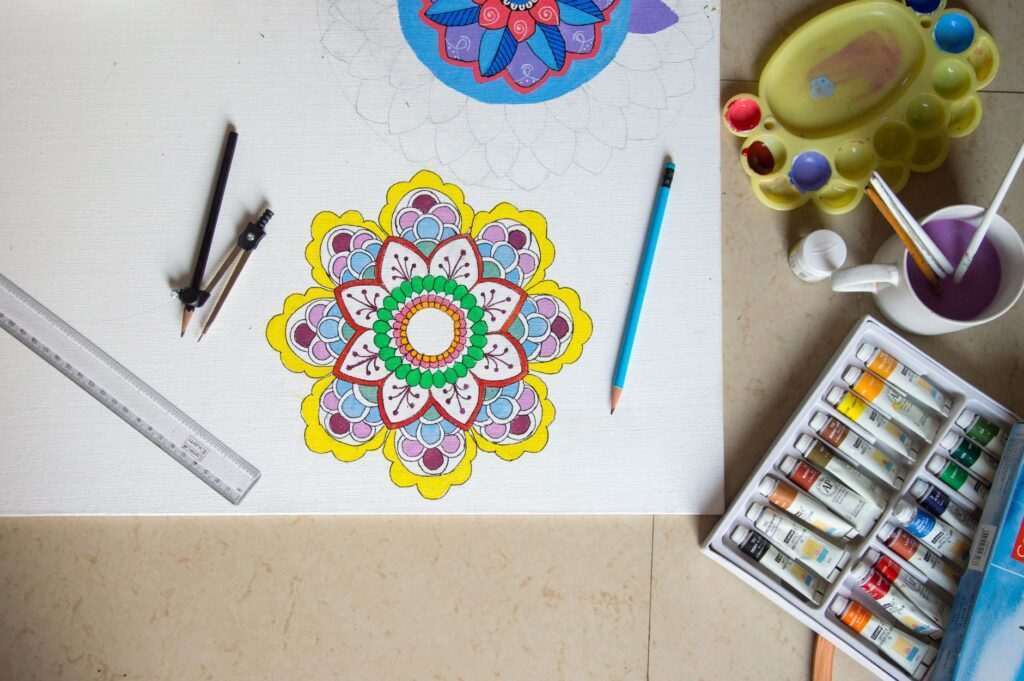
Mandala drawing — creating symmetrical, geometric designs radiating from a central point — is one of the most universal and psychologically resonant visual art forms in human history. The Sanskrit word “mandala” means “circle” or “container of essence,” and mandalas appear across cultures and centuries as representations of cosmological order, meditative focus objects, and expressions of the relationship between the individual and the infinite. Tibetan Buddhist monks spend days constructing sand mandalas from colored mineral pigments only to sweep them away at completion as a lesson in impermanence; Hindu temple architecture encodes mandala geometry in its floor plans; Carl Jung famously interpreted mandala-drawing as a spontaneous expression of the psyche’s drive toward wholeness, and began drawing mandalas himself as part of his self-analytic practice. Contemporary mandala drawing has moved well beyond these spiritual contexts into art therapy, mindfulness practice, and creative recreation — but the centering quality of working outward from a central point, building layer by layer of symmetrical pattern, connects the contemporary practitioner to that long history regardless of whether the activity is framed spiritually or secularly. In Anchorage, mandala drawing workshops attract practitioners from spiritual, artistic, and wellness communities, and the practice pairs naturally with the meditative craft culture that has flourished in the region. This guide covers spiritual origins, geometric construction methods, coloring vs drawing, digital tools, and how to create an original mandala from scratch in 2026.
Spiritual Origins: Tibetan and Hindu Traditions
Tibetan Buddhist Mandalas
In Tibetan Buddhism, the mandala represents the dwelling place of a specific deity — a cosmological palace depicted in two-dimensional form. The construction of a sand mandala is a religious practice of extraordinary precision and dedication: teams of monks use metal funnels (chak-pur) to pour colored sand grain by grain following traditional geometric specifications that encode theological meaning in every color, symbol, and spatial relationship. A large sand mandala takes four to six monks one to two weeks to complete. The destruction of the completed mandala — the sands mixed and poured into flowing water — embodies the Buddhist teaching of impermanence. The process is as significant as the product; the act of creation offered and released is the practice.
The mandala’s geometric structure in Tibetan tradition is precise: a central point (bindu), surrounded by lotus petals, then a series of concentric squares with gates in the four cardinal directions (representing the four walls of the deity’s palace), then concentric circles of protective and decorative elements. Each element follows traditional iconographic specifications established over centuries.
Hindu Yantras
The Hindu tradition’s mandala equivalent is the yantra — a geometric diagram used as a meditation focus and a representation of divine energy. The Sri Yantra, perhaps the most complex and celebrated of Hindu geometric diagrams, interlocks nine triangles (four pointing up, five pointing down) in a configuration that generates 43 smaller triangles, surrounded by lotus petals and concentric circles. The Sri Yantra’s geometry is so precise that reproducing it correctly requires mathematical knowledge; minor variations significantly change the energy the diagram is considered to embody. Yantras are used as visualization objects in meditation, drawn or painted on paper, copper, or gold.
Jung and the Western Mandala
Carl Jung began drawing mandalas spontaneously in 1916, recognizing in them an expression of what he called the “self” — the psyche’s organizing principle and drive toward wholeness. He wrote extensively about the mandala as a universal symbol that appears across cultures because it expresses something fundamental about human psychological structure. This Jungian framework underlies much of the contemporary art therapy use of mandala-drawing: the circular, symmetrical form is considered to activate organizing, centering psychic processes that have therapeutic value independent of spiritual belief.
Geometric Construction: Compass and Ruler vs Freehand
Compass and Ruler Construction
Geometrically precise mandala construction uses a compass (for circles), a ruler, and a protractor (for dividing the circle into equal angular segments). The standard approach:
- Draw a center point and a base circle with the compass.
- Use the protractor to divide the circle into equal segments — 8, 12, or 16 divisions are common starting points. Draw light pencil lines from the center through each division mark to the circle’s edge (these are the “spokes” of the mandala).
- Draw additional concentric circles at increasing radii, establishing the “rings” of the mandala where different pattern elements will be placed.
- Within each ring section, draw a design element in one segment, then repeat it exactly (using the pencil construction lines as guides) in every other segment around the circle.
The compass-and-ruler approach produces mathematically perfect symmetry and is the method closest to traditional sacred geometry. The construction lines act as a scaffolding that’s erased in the final artwork, leaving only the inked design elements.
Freehand Mandala Drawing
Many contemporary mandala artists work freehand — drawing directly without compass or ruler, developing a personal style where slight imperfections in symmetry give the work warmth and handmade quality. Freehand mandalas are faster to start and allow more spontaneous design choices, but require more developed visual judgment to maintain symmetry. Dot-grid paper (specifically designed for mandala drawing with pre-printed concentric circles and radial lines) is an excellent bridge between the fully geometric and fully freehand approaches — the grid provides structure without requiring compass setup.
Coloring Mandalas vs Drawing Original Mandalas
The mandala experience splits into two distinct practices with different purposes and skill requirements:
Coloring pre-drawn mandalas — applying color to a printed or traced mandala design — is a meditative activity that benefits from the design’s pre-established structure. The coloring practitioner makes color decisions and experiences the calming effect of systematic, repetitive work without needing to understand mandala geometry. Adult coloring books (the format popularized around 2015) brought pre-drawn mandala coloring to millions of practitioners. The activity’s documented stress-reduction benefits are real: the focused attention required for careful coloring within the mandala’s intricate lines produces the same kind of relaxed concentration as meditation.
Drawing original mandalas requires understanding the geometric structure and making design decisions at every level. It’s more challenging but produces a deeper engagement with the mandala form and the satisfaction of creating something genuinely original. Learning to draw mandalas is a skill that builds over time — early mandalas have simpler geometry and fewer rings; more experienced practitioners develop complex interlocking patterns across many concentric zones.
Digital Mandala Tools
Digital tools have transformed mandala creation by automating the symmetry — drawing one segment and having software repeat it perfectly across all divisions of the circle:
- Procreate (iPad): The “Drawing Assist” symmetry tool with radial symmetry mode creates mandalas in real time — a stroke drawn in one segment appears simultaneously in all others. Procreate’s pressure sensitivity and brush variety make it the most popular digital mandala tool for professional artists.
- Adobe Illustrator: Vector-based mandala creation in Illustrator produces mathematically perfect, scalable designs suitable for print or large-format reproduction. The “Rotate Tool” and “Pattern” functions allow precise repetition of design elements. Better for final production work than for exploratory drawing.
- Mandala Creator apps: Purpose-built apps (iOrnament, Mandala Maker) designed specifically for mandala creation with built-in symmetry and pattern tools. More accessible than Procreate or Illustrator for beginners who want the digital symmetry experience without a general-purpose drawing app learning curve.
Digital tools lower the technical barrier to sophisticated mandala design but lose the meditative quality of hand-drawing. Many practitioners use both — exploring designs digitally, then returning to hand-drawn work for the full meditative experience.
How to Create an Original Mandala from Scratch
A step-by-step approach for a beginner’s first geometric mandala:
- Set up the structure: On white cardstock or Bristol paper, draw a center point. Use a compass to draw five or six concentric circles at 0.5 cm, 1.5 cm, 3 cm, 5 cm, 7.5 cm, and 10 cm radius. Use a protractor to divide into 12 segments (30° each). Draw light pencil guidelines through all circles.
- Design the center: Draw a small lotus or geometric star in the innermost circle. This central element sets the visual theme of the whole mandala — keep it simple and bold.
- Build ring by ring: In the first ring (between circles 1 and 2), draw a small petal or teardrop shape in one segment, then repeat it 12 times. In the second ring, choose a different element (dots, diamonds, arcs) and repeat. Work outward, changing the design element in each ring.
- Ink over pencil: When the pencil design is complete, go over all design elements with a fine-tip waterproof pen (Micron 01 or 005). Work carefully and let dry completely.
- Erase construction lines: When the ink is fully dry, erase all pencil construction lines to reveal the clean design.
- Add color (optional): Colored pencils, watercolor, or markers can be applied to the inked design. Working from the center outward in a consistent color logic (warm center, cool outer rings, or complementary color progression) unifies the composition.
Mandala Drawing Workshops in Anchorage
Anchorage mandala drawing workshops run 2–4 hours depending on the approach — geometric construction sessions require setup time; coloring and freehand sessions move more quickly into the drawing itself. Workshops prices run $30–$70, with materials provided. Anchorage craft workshop participants can show and sell their finished work at year-round events including the Anchorage Market & Festival, the Anchorage Native Arts & Culture Festival, and the Alaska State Fair. Our free things to do in Anchorage guide covers the meditation centers, art studios, and community spaces where mandala drawing and other contemplative art practices appear in Anchorage’s wellness and arts programming. Our Anchorage hiking guide covers the natural environments where mandala-like patterns appear in Alaska’s landscape — the radial symmetry of wildflowers, the concentric rings of ripples on tundra pools, the circular ice patterns on frozen ponds — inspiring source material for original mandala design.




No comments yet.