
Northern Lights Near Anchorage 2026: Best Viewing Spots, Tours & Timing Tips
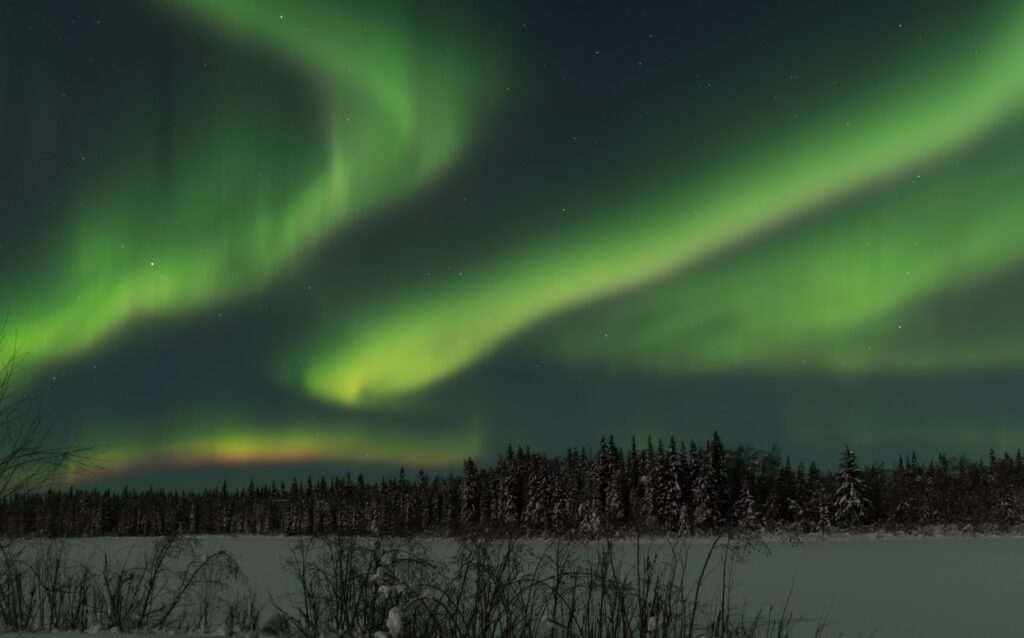
The aurora borealis is one of the most sought-after natural phenomena on the planet, and Anchorage sits squarely inside the auroral oval — the band of latitude where Northern Lights activity is most concentrated. That doesn’t mean you can step outside your downtown hotel and watch the sky light up. Anchorage itself has enough ambient light to wash out all but the strongest displays. But within 30 to 90 minutes of the city, you’ll find dark-sky sites and guided tour routes that deliver the full show when the conditions align. This guide covers everything you need to see the Northern Lights near Anchorage in 2026: where to go, when to go, how to read the forecast, and how to get there.
Aurora Season Near Anchorage
The Northern Lights are only visible at night, which means the aurora season is dictated by darkness — and Anchorage’s calendar is extreme on both ends. From late May through mid-July, the midnight sun keeps the sky too bright for any aurora viewing, regardless of solar activity. As darkness returns in late July, the first stars reappear and aurora season begins.
The practical viewing window runs from late August through March. The peak months are September–October and February–March, for two reasons: darkness is reliable and temperatures are still manageable for extended outdoor sessions, and the solar equinoxes tend to amplify geomagnetic activity. Midwinter (December–January) offers the longest dark windows but frequently brings heavy cloud cover and temperatures that can drop to -20°F or below — standing outside for an aurora watch at those temperatures requires serious preparation.
If you’re planning a trip specifically to see the Northern Lights, September through early October is the sweet spot: the nights are dark, the weather is relatively mild by Alaska standards, and the geomagnetic conditions are favorable. February and March run a close second, with the advantage of deep winter landscapes that make aurora photography particularly dramatic.
The Light Pollution Problem — and How to Solve It
Downtown Anchorage, Midtown, and the airport corridor are too bright for casual aurora viewing. On a KP 5 or higher event — strong enough to be visible even from the suburbs — you might catch a faint glow from the northern horizon in town, but anything below that requires leaving the city’s light dome behind.
The good news: significant darkness is achievable within 30 to 90 minutes by car. The Chugach Mountains to the east, the Mat-Su Valley to the north, and the Turnagain Arm corridor to the south all provide genuine dark sky once you’re a few miles from the nearest community. The three most productive directions for aurora chasers are: north toward the Mat-Su Valley (Hatcher Pass), east into Chugach State Park backcountry, and southeast along the Seward Highway where it clears the city’s southern light dome.
Best Dark-Sky Viewing Spots Near Anchorage
Hatcher Pass — The single best dark-sky destination accessible by road from Anchorage, located about 75 miles north in the Mat-Su Valley, roughly 1.5 hours from downtown. Hatcher Pass sits above treeline at over 3,000 feet, away from all significant light pollution, with open 360-degree sightlines across the valley. On active aurora nights, the lights here are frequently visible at full intensity — green curtains across the entire northern sky, sometimes stretching to overhead. The road is maintained through most of the winter, though a 4WD or AWD vehicle with good winter tires is strongly recommended for the upper section.
Knik River area — About 40 miles north of Anchorage near Palmer, the Knik River corridor sits in open glacial outwash terrain with excellent northern horizon views. This area is accessible and relatively flat, making it easier to set up photography equipment than elevated ridge viewpoints. The combination of open sky and proximity (under an hour’s drive) makes it a popular destination for local aurora chasers who don’t want to commit to a full Hatcher Pass run.
Eklutna Lake and Eagle River Nature Center — Both are accessed from the Eagle River corridor northeast of Anchorage, about 30–45 minutes from downtown. Eagle River Nature Center sits at the entrance to a glaciated valley in Chugach State Park and offers a legitimately dark eastern sky with mountain silhouettes. In winter, the center’s parking lot provides a stable, accessible platform for photography even when trails are iced. Eklutna Lake, slightly further into the park, adds open water reflections when the lake isn’t fully frozen — a spectacular foreground element for aurora photography in September and early October.
Glen Alps and Flattop Mountain area — For aurora chasers who want to stay closer to Anchorage, the Glen Alps Trailhead at 2,200 feet elevation sits above the worst of the city’s light dome and provides broad eastern and northern horizon views. The Flattop Mountain Trail rises further to just under 3,500 feet — genuinely dark at the summit on clear nights, with a 360-degree view. Both are about a 30-minute drive from midtown. Note that the upper Glen Alps area gets icy in winter; bring microspikes and a headlamp.
Kincaid Park coastal viewpoints — On the southwest edge of Anchorage, Kincaid Park is the closest legitimate dark-sky option inside the city boundary. The northern bluff overlooks face away from the worst downtown light and have clear sightlines toward the auroral horizon. KP 4 or higher events are occasionally visible from here without driving anywhere. It works best as a quick-check spot for strong aurora nights when you don’t want to drive 40 miles.
Guided Northern Lights Tours from Anchorage
Experienced local guides remove the logistical complexity from aurora chasing — they track the KP index, monitor cloud cover patterns, and know which routes to take when one area clouds over and another clears. A guided tour is particularly valuable for first-timers who aren’t yet familiar with reading aurora forecasts or driving Alaska’s winter roads at night.
Aurora Tours Anchorage by Greatland Adventures is the city’s dedicated Northern Lights tour operator, running evening chasing sessions that depart from Anchorage and adapt in real time based on cloud cover and aurora activity. Their guides carry photography equipment and will help you set up for aurora shots. Tours typically run several hours, often extending past midnight if conditions are developing. Booking in advance is recommended for September–November, which is peak demand season.
Self-guided aurora chasers should have a reliable AWD or 4WD vehicle with winter tires, at least a half-tank of gas (fuel up before leaving the city), and warm layers for extended outdoor exposure. Do not park on road shoulders on narrow mountain highways — find a proper pullout or designated viewing area before stopping.
How to Read an Aurora Forecast
Aurora forecasting comes down to two variables: solar activity and cloud cover. Both need to be favorable for a successful night.
The KP index is the primary measure of geomagnetic storm intensity, running from 0 (calm) to 9 (extreme). For Anchorage, the threshold is approximately KP 3 for viewing from well-dark areas like Hatcher Pass. KP 4 may produce visible aurora from the suburbs. KP 5 and above will show green glow even with moderate light pollution. For strong overhead displays with multiple colors, KP 6 or higher is typically required.
The NOAA Space Weather Prediction Center publishes real-time Kp values and a 3-day forecast at spaceweather.noaa.gov. The Geophysical Institute at the University of Alaska Fairbanks publishes a weekly aurora forecast with Alaska-specific viewing probabilities. For smartphone apps, My Aurora Forecast and SpaceWeatherLive both push notifications when activity exceeds your threshold — set alerts for KP 3 and above if you’re near Anchorage.
Cloud cover matters as much as the KP index. A KP 7 storm is invisible through thick overcast. Anchorage and the Chugach Mountains trap marine moisture from Cook Inlet, producing cloud cover that can differ significantly between downtown and areas 40 miles to the north or east. The Mat-Su Valley often clears when Anchorage is socked in. Learn to read the National Weather Service hourly cloud forecasts alongside the space weather data — and be ready to drive toward clear skies rather than a fixed location.
Photography Tips for Northern Lights
Aurora photography requires three things: a camera that allows manual settings, a wide-angle lens, and a sturdy tripod. Smartphones have improved dramatically but still lag behind a dedicated camera for capturing faint or fast-moving aurora.
Starting settings: ISO 1600–3200, aperture f/2.8 or wider, shutter speed 8–15 seconds. Faster aurora movement — when curtains are actively rippling — calls for shorter exposures (4–8 seconds) to avoid blurring the detail. A remote shutter release or 2-second timer eliminates camera shake. Focus manually to infinity; autofocus struggles in darkness.
Cold temperatures drain batteries rapidly. Keep a spare battery inside your jacket and rotate when the camera battery drops. At -10°F, a single battery may last only 45 minutes of continuous shooting. A fully charged backup is not optional — it’s essential.
Realistic Expectations: Planning for Aurora Variability
The most important thing to understand about Northern Lights viewing is that it is inherently unpredictable. Solar activity follows general patterns but cannot be reliably forecast more than 1–3 days in advance. Cloud cover adds another layer of uncertainty. On any given night within the aurora season, you may drive to a dark-sky site and see nothing — not because you chose the wrong spot, but because conditions simply weren’t there.
Plan a minimum of three nights in Anchorage if seeing the aurora is a primary goal of your trip. Three nights gives you statistically reasonable odds of at least one clear, active night. Five to seven nights significantly improves your chances. Stay flexible on timing: the best aurora events are often short and unpredictable, sometimes beginning at 11 PM and peaking at 2 AM.
Set your KP alert, check the forecast each afternoon, and treat every night as a potential. When the alert fires at midnight, the willingness to get out of bed and drive is often the difference between seeing the lights and missing them.
What to Wear for Aurora Watching
Standing still in the cold — which is what aurora watching requires — chills the body much faster than hiking. For September and October outings at dark-sky locations: base layer, insulating mid-layer, and a waterproof outer shell, plus insulated boots rated to at least 0°F. For December and January sessions: add insulated pants, a balaclava or face shield, and boots rated to -20°F. Hand warmers in your pockets and a thermos of hot liquid are practical additions, not luxuries.
Plan to stay outside for at least 45–90 minutes once conditions develop. Aurora displays often build slowly, peak, and fade over 1–2 hours, with additional activity possible throughout the night. Dress to outlast the cold rather than rushing back to the car.
Northern Lights Viewing Calendar
- August: First dark nights return after the midnight sun; early-season aurora possible, mild temperatures — best for first-timers nervous about cold.
- September–October: Peak season. Reliable darkness, manageable temperatures, frequent geomagnetic activity around the fall equinox. Highest tour demand — book early.
- November: Reliable aurora season continues; early snowfall improves landscape photography; temperatures dropping toward winter range.
- December–January: Maximum darkness — aurora possible every clear night. Temperatures routinely -10°F to -20°F; dress accordingly and limit outdoor exposure to 45-minute windows between warming up in the car.
- February–March: Strong aurora season resumes as equinox activity picks up; temperatures moderate from midwinter lows; many experienced aurora chasers consider this the best combination of darkness and bearable cold.


No comments yet.