
Glacier Hiking Alaska 2026: Matanuska, Knik & Root
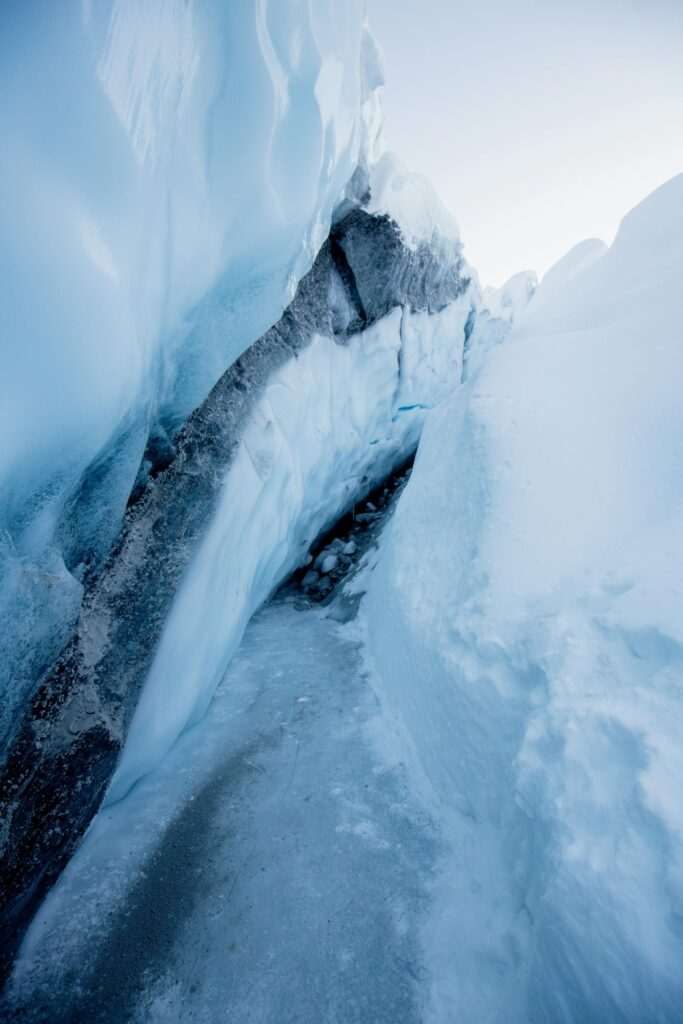
Walking on a glacier is unlike any other outdoor experience accessible from a city. The ice beneath your crampons is centuries old — compressed snowfall from storms that predate living memory, compacted by its own weight into something denser and bluer than ordinary ice. Meltwater streams cut channels across the surface and disappear into crevasses with a sound you feel more than hear. The scale is disorienting: a glacier 27 miles long and 4 miles wide presents itself as a featureless white plain until you’re standing on it, at which point the terrain resolves into a complex landscape of ridges, depressions, moulins, and seracs that guides spend years learning to read. Alaska’s glaciers — including several accessible from Anchorage within a day’s drive — offer guided ice walks that place this experience within reach of any visitor willing to strap on a pair of crampons and follow someone who knows where to step.
Safety First: Why Guides Are Non-Negotiable
Glaciers are dangerous terrain for anyone without mountaineering training. Crevasses — vertical fissures in the ice that can extend hundreds of feet — are often concealed beneath thin bridges of snow or refrozen melt. Ice conditions change daily with temperature and precipitation. Moulins (vertical drainage holes) can be hidden in depressions. None of the glacier hikes described in this guide should be attempted without a licensed guide unless you have formal glacier travel and crevasse rescue training. The operators listed here use certified guides, provide crampons and ice axes, and select routes appropriate to current conditions and group ability. The experience they deliver is both safer and far more interesting than unguided access — guides can read ice features, identify hazards, and explain the glacier’s history and dynamics in ways that transform a walk into an education.
Matanuska Glacier
The Matanuska Glacier is the most accessible large glacier in Alaska and the starting point for most visitors’ glacier hiking experience. Located approximately 100 miles northeast of Anchorage on the Glenn Highway, the glacier is Alaska’s largest accessible valley glacier — 27 miles long and up to 4 miles wide at its terminus. The blue-white ice face is visible from the highway itself before you even leave the road, giving you a preview of what’s ahead.
Access to the glacier surface runs through private land adjacent to the terminus. Multiple operators — including MICA Guides, which has operated on the glacier for many years — offer guided ice walks of two to four hours that cover the accessible lower glacier. A small site access fee (typically $25 to $40) is charged separately from the guided tour cost; guided walks run approximately $100 to $130 per person. Crampons and ice axes are provided; waterproof boots are the only gear you need to bring.
On the glacier surface, guides lead groups across crunching blue-white ice past meltwater streams and pools ranging from shallow runnels to pools deep enough to swim in. Ice caves form seasonally in the lower glacier where meltwater has carved vaulted chambers; availability depends on conditions and changes year to year. The backdrop — the Chugach Mountains rising on both sides of the valley, with the braided Matanuska River spreading across the outwash plain below — is spectacular on clear days. July and August offer the most stable ice conditions and the best weather probability; June and September are viable alternatives with fewer crowds.
The Matanuska Glacier makes an excellent Glenn Highway day trip from Anchorage. Sheep Mountain Lodge, about 10 miles past the glacier on the highway, is a well-regarded stop for lunch on the return drive. The round trip from Anchorage — drive, glacier access, guided walk, lunch — fits comfortably in a full day.
One feature that surprises most first-time glacier hikers is how varied the ice surface actually is. What looks uniform from the highway is, up close, a landscape of different ice textures: bubbly white ice where trapped air hasn’t fully compressed, translucent blue ice where compression is complete, black ice stained with rock flour carried by the glacier, and the grey rubble of medial moraines where rock debris from the valley walls has accumulated in long parallel bands. Guides can explain what each texture indicates about the ice’s history and the forces that shaped it, which turns a visual experience into an understanding of how glaciers actually work.
Knik Glacier
The Knik Glacier, located in the Knik River valley east of Palmer (roughly 75 miles from Anchorage), is substantially less visited than Matanuska but no less impressive. The glacier flows from the Chugach Mountains in a broad, heavily crevassed tongue and terminates in an outwash plain crossed by braided glacier-fed rivers. Access to the glacier edge requires either a guided 4WD vehicle excursion across the river bars — a route that changes with each melt season as the channels shift — or a helicopter approach from the Palmer area.
Helicopter glacier tours onto the Knik are among the more dramatic Alaska glacier experiences available near Anchorage. The aerial approach reveals the full extent of the glacier system and deposits you on the surface at points the ground-based routes can’t reach. Costs for helicopter glacier tours run $400 to $500 or more per person, reflecting the aircraft time involved. Ground-based tours are less expensive but require robust 4WD vehicles and guides who know the current river crossing conditions. Knik Glacier Tours operates in this area; verify current availability and pricing directly.
The Knik River valley approach also passes Lake George — a glacially dammed lake that historically drained catastrophically each summer in a jökulhlaup (glacial outburst flood) that briefly made the Knik River one of the largest in Alaska. Flood control works and glacier retreat have altered this dynamic in recent decades, but the landscape still shows the marks of those seasonal floods in the braided channels and gravel bars that make 4WD access to the glacier edge both necessary and interesting.
Root Glacier
Root Glacier, part of the vast Wrangell–St. Elias glacier system, represents a step up in both distance and commitment — roughly 300 miles from Anchorage via the Richardson Highway and the gravel McCarthy Road. The Kennicott and McCarthy area, where Root Glacier is accessed, is one of the most extraordinary places in Alaska: a National Park wilderness surrounding a preserved copper mining ghost town, accessible only by a 60-mile gravel road that rewards the effort with scenery and history that few Alaska visitors reach.
St. Elias Alpine Guides operates guided glacier walks on Root Glacier from the Kennicott base, ranging from introductory ice walks to full-day ice climbing instruction on the glacier’s crevasse walls. The experience here has an expedition quality that Matanuska, for all its accessibility, cannot fully replicate — the glacier is less modified by human traffic, the surrounding landscape is more remote, and the opportunity to combine glacier hiking with the Kennecott Mine National Historic Landmark makes the trip more layered. Plan at least one night in McCarthy or Kennicott; the glacier and the mine together warrant a full day each.
The approach to McCarthy along the 60-mile gravel McCarthy Road is itself part of the experience — the road follows the old Copper River & Northwestern Railway grade through boreal forest and river valleys, with views of the Wrangell Mountains deepening as you travel east. The town of McCarthy, population roughly 40 year-round, sits at the end of a footbridge across the Kennicott River; the Kennecott Mine — a National Historic Landmark — is a five-mile walk or shuttle ride above town. For visitors considering this trip, the combination of glacier, mine, and mountain landscape makes it one of the most rewarding destinations in Alaska outside the national park visitor centers.
Exit Glacier: A Different Kind of Glacier Visit
Exit Glacier in Kenai Fjords National Park, about 130 miles south of Anchorage via the Seward Highway, offers glacier access of a different kind. The roadside trail system allows visitors to walk to the glacier’s edge without crampons or guides — but Exit Glacier is not a hiking glacier in the same sense as Matanuska or Root. The marked paths approach the terminus from the side and below, not from above, and walking onto the ice itself is neither permitted nor safe without mountaineering equipment.
What Exit Glacier does offer is one of the most striking visual records of glacial retreat accessible by road in North America. Markers along the trail note the glacier’s position in previous decades — 1951, 1961, 1980, and annually into the 2020s — each one further up the valley than the last, with the retreat accelerating visibly in the most recent years. The Harding Icefield Trail above Exit Glacier is a serious day hike — 8.2 miles round-trip with 3,500 feet of elevation gain — that ends at the edge of the Harding Icefield, the largest icefield in the United States outside of Alaska’s other icefields. You see the icefield from above rather than walking on it, but the scale of what you’re looking at — a continuous ice mass covering more than 700 square miles — is its own form of glacier awe.
What to Wear and Bring
Waterproof hiking boots are the core requirement — crampons strap over boots, and wet feet on a glacier make for a miserable experience regardless of the ice quality. Waterproof pants and a waterproof jacket matter more on a glacier than in most Alaska hiking contexts: glaciers create cold, damp micro-climates regardless of the air temperature in the valley below, and meltwater encounters are frequent. Glacier glasses or sunglasses with UV protection are essential in midsummer, when sunlight reflecting off blue ice at elevation can cause snow blindness faster than most visitors expect. Water and snacks for tours of three hours or longer are worth carrying even when weight feels unnecessary.
For winter glacier experiences — ice climbing on frozen waterfalls and canyon walls near Anchorage rather than walking on glaciers — operations like Matanuska Glacier offer complementary cold-weather activities for visitors returning in shoulder season.
Cost and Planning Overview
A Matanuska Glacier guided walk typically costs $100 to $130 per person for the tour itself, plus a $25 to $40 site access fee — total roughly $125 to $170, making it the most affordable on-glacier experience near Anchorage. Knik helicopter glacier tours run $400 to $500 or more per person. Root Glacier guided day tours through St. Elias Alpine Guides run approximately $150 to $250 per person. All pricing should be verified directly with operators; rates change seasonally. For visitors interested in combining glacier hiking with broader guided Alaska adventure itineraries, operators like Adventures by True North offer multi-activity packages that incorporate glacier experiences alongside other Anchorage-area activities.
Book guided glacier tours in advance for July and August — the peak window fills, particularly for the Matanuska operators whose group sizes are limited by access permits and guide ratios. The glacier will still be there in September; the departure times won’t be.


No comments yet.