
Copper Center & the Wrangell-St. Elias Gateway 2026: Where to Stop, Stay & What to Know
Not every destination is a destination. Some places matter because of what they lead to — and Copper Center, Alaska is exactly that kind of place. Sitting at the junction of the Glenn Highway and the Richardson Highway — roughly four hours from Anchorage, 190 miles east of the city, and 105 miles north of Valdez — Copper Center is where you fuel up, eat a meal, check your oil, and orient yourself before heading into Wrangell-St. Elias National Park — the largest national park in the United States. That function doesn’t make it uninteresting. The Copper River runs through it, the Wrangell Mountains rise on the horizon, and the town carries several thousand years of human history in its landscape. But if you’re here, you’re almost certainly on your way somewhere else. This guide helps you make the most of both.
Getting to Copper Center
The drive from Anchorage to Copper Center is approximately 190 miles and takes about 3.5–4 hours depending on conditions and stops. The Glenn Highway Scenic Drive is the primary route — east from Anchorage through the Matanuska-Susitna Valley, past Palmer and Wasilla, then climbing into the dramatic terrain of the upper Matanuska River valley before crossing into the Copper River basin near Glennallen. The scenery along the Glenn Highway is exceptional: the Matanuska Glacier is visible from the road, the Chugach and Talkeetna ranges frame the valley, and the transition from the lush coastal forest to the drier interior landscape is perceptible over the drive.
Glennallen, 15 miles north of Copper Center, is the larger service hub and the last town with a full range of grocery, fuel, and supply options. Stock up here if you’re planning an extended trip into Wrangell-St. Elias — Copper Center has limited supplies, and the communities inside the park have almost none.
From Valdez, the Richardson Highway runs north through the Alaska Range to reach Copper Center — a 105-mile drive through Thompson Pass and the Keystone Canyon, one of the most dramatic highway corridors in Alaska. If you’re approaching from the south via ferry (Alaska Marine Highway to Valdez), this is your route in.
Lodging in Copper Center
Given its role as a gateway community, Copper Center has lodging options ranging from upscale wilderness lodge to historic inn to basic camping:
Copper River Princess Wilderness Lodge is the flagship lodging option — a well-appointed wilderness lodge on a bluff above the Copper River with views of the Wrangell Mountains that are, on clear days, genuinely stunning. It operates on a seasonal schedule (roughly May through September) and caters primarily to Princess Cruises passengers on land packages, but independent travelers can book rooms. Amenities include a full-service restaurant, which makes it the only upscale dining option within a significant radius.
Copper Center Lodge is the historic alternative — a roadhouse that has been serving travelers at this junction since the early 1900s. The building’s history predates most of Alaska’s statehood-era infrastructure, and staying here is a different kind of experience than the Princess Lodge: more rough-edged, more historically textured, more authentically Alaskan in the roadhouse tradition. Basic accommodations, reliable meals, and the feeling that you’re sleeping in a building that has watched a century of Alaska history pass through its doors.
Squirrel Creek State Recreation Site, about 19 miles south of Copper Center on the Richardson Highway, provides campsite access in a riverside setting — a good option for those traveling by RV or tent who don’t need indoor accommodations. GoNorth Alaska rents RVs and camper vans well-suited for the Glenn/Richardson Highway corridor, making self-contained travel through the Copper River basin straightforward.
The Wrangell-St. Elias National Park Visitor Center
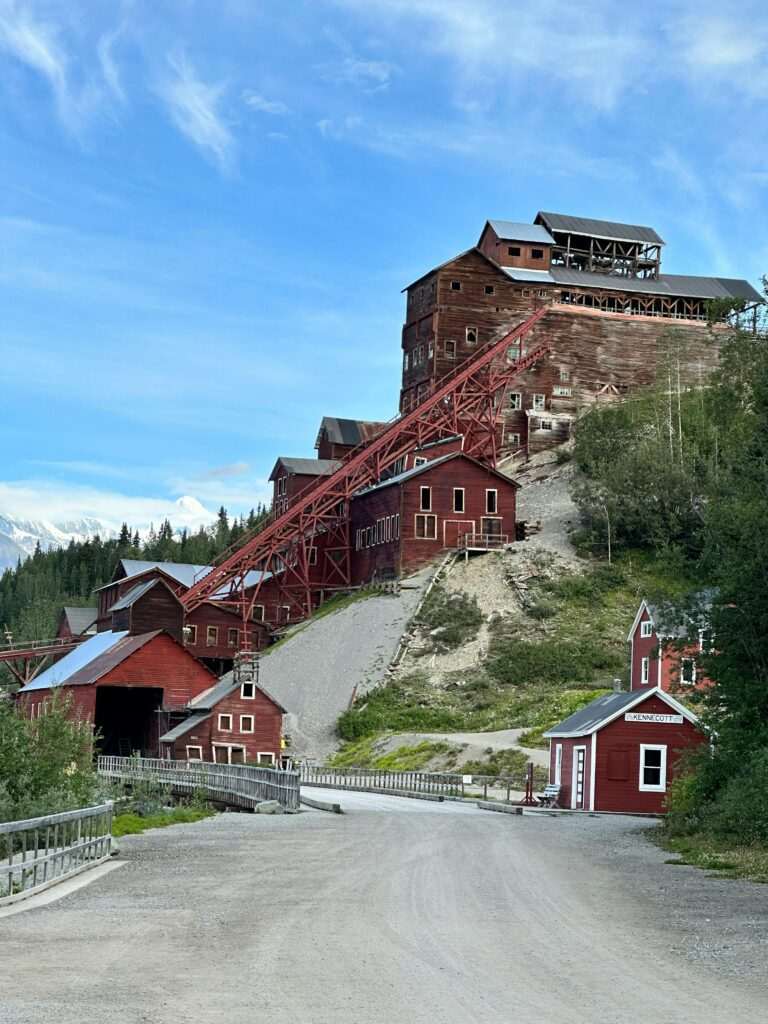
One of the most valuable stops in the Copper Center area is the Wrangell-St. Elias National Park Visitor Center, located on the Old Richardson Highway just south of the Glennallen-Copper Center corridor. This is where you orient before entering the park: rangers on staff can answer questions about road conditions on the McCarthy Road, current bear activity, water levels, weather forecasts, and any emergency conditions affecting the backcountry. The exhibits cover the park’s natural history, its mining heritage (including the Kennecott Mines context), the Indigenous Ahtna Athabascan culture that has inhabited this river basin for millennia, and the ecology of a park that spans five distinct ecosystems from coastal rainforest to Arctic tundra.
Don’t skip this stop. The McCarthy Road is 60 miles of unpaved gravel with no services, and the park interior has no cell service. Arriving at the visitor center informed — with current road conditions, a physical map, and a ranger-recommended itinerary — meaningfully improves the trip that follows.
The Copper River: World-Famous Salmon and a Working River
The Copper River running through and around Copper Center is the same river that produces the world-famous Copper River King and Sockeye salmon — the most prized and priciest wild salmon sold in high-end markets from Tokyo to New York. First Kings typically arrive in mid-May; Sockeye peak in June and July. From Copper Center, the river is visible in multiple locations and fishable at legal access points for those with a valid Alaska sport fishing license.
Beyond sport fishing, the Copper River has a dipnetting tradition among Alaska residents — a subsistence and personal use fishery where residents scoop fish from the river using large nets on long poles. Non-residents cannot participate in dipnetting, but watching the dipnetters work the fast current at the Chitina dipnetting site (about 35 miles south on the Edgerton Highway) is a genuine glimpse into Alaska’s subsistence culture. Alaska Good Time Charters can connect visitors with guided sport fishing options in the region.
History: Gold Rush, Copper Mining, and Ahtna Athabascan Heritage
Copper Center has been a stopping point on human routes through the Copper River basin for thousands of years. The Ahtna Athabascan people have lived in this drainage since time immemorial, establishing trade and travel routes along the Copper River and its tributaries that European prospectors later followed during the gold rush era. The 1898 gold rush brought the first major wave of non-Native travelers through Copper Center — the town became a supply post on the trail north toward the Klondike and the interior goldfields, and the Copper Center Roadhouse opened to serve them.
What followed was the copper era: the discovery of the Kennecott copper deposits in the Wrangell Mountains in 1900, the construction of the Copper River and Northwestern Railway (completed 1911), and a decade and a half of industrial extraction that made Kennecott one of the richest copper mines in history. Copper Center sat on the supply corridor for all of it. The George I. Ashby Memorial Museum in Copper Center holds artifacts, photographs, and documents from the gold and copper eras — a small but substantive collection that puts the surrounding landscape into historical context.
Driving to McCarthy and Kennicott
The route from Copper Center to the McCarthy Road trailhead follows the Richardson Highway south to the Edgerton Highway junction at Chitina — approximately 35 miles. From Chitina, the 60-mile McCarthy Road runs east along the old Copper River and Northwestern Railway bed to the Kennicott River footbridge. Total driving time from Copper Center to the footbridge is roughly 2 hours under normal conditions.
The Edgerton Highway from Copper Center to Chitina is itself a scenic route — paved, winding through spruce forest and river bluffs, with views of the Wrangell Mountains growing more dramatic as you head southeast. Chitina is a tiny community with limited services but genuine character: an old railroad town that has been quietly existing at the edge of the wilderness since the copper era ended in 1938.
Weather and Road Conditions
Copper Center sits at the interior Alaska climatic boundary — hotter summers and colder winters than Anchorage, with less precipitation. Summer highs regularly reach the low 70s°F (occasionally 80s), which is warm enough to make the Copper River basin feel genuinely different from the coastal Alaska most visitors experience. Mosquitoes are significant in June and July; bring repellent regardless of how hardened you think you are.
Winter temperatures are serious — lows of -30°F or colder are not unusual, and the highway can be icy and occasionally closed due to conditions. The spring shoulder season (April–May) brings breakup conditions: soft roads, high water, and unpredictable weather. The McCarthy Road is typically not passable until late May or early June. Always check the Alaska 511 road conditions system (511.alaska.gov) before driving the Glenn or Richardson Highways in shoulder seasons.
What to Do in Copper Center Itself
If your itinerary includes time in Copper Center beyond transit, the highlights are modest but genuine:
- George I. Ashby Memorial Museum: Local history artifacts from the Ahtna, gold rush, and copper mining eras. Small, free or low-cost, and worth an hour.
- Wrangell-St. Elias NP Visitor Center: As covered above — essential for park planning, genuinely interesting exhibits even if you’re not entering the park.
- Copper River viewpoints: Multiple pullouts along the old Richardson Highway provide river views with the Wrangell Mountains as backdrop. On a clear morning before the valley haze builds, this is striking.
- The junction itself: The convergence of the Glenn and Richardson Highways at Glennallen/Copper Center is one of the significant crossroads in Alaska’s interior. Maps of the state make more sense standing at this intersection — the distances to Fairbanks, Valdez, Anchorage, and McCarthy written on a highway sign convey the scale of the country around you in a way that a screen doesn’t.
Logistics Summary: The Numbers That Matter
- Anchorage → Copper Center: ~190 miles, 3.5–4 hours via Glenn Highway
- Valdez → Copper Center: ~105 miles, 2 hours via Richardson Highway
- Copper Center → Chitina (Edgerton Hwy junction): ~35 miles, 45 minutes
- Chitina → McCarthy Road footbridge: 60 miles of gravel, ~2 hours
- Glennallen (full services) → Copper Center: 15 miles north
- Nearest large grocery/supply store: Glennallen (Tazlina Store/IGA), or stock up fully in Anchorage
- Cell service: variable in Copper Center, generally absent on McCarthy Road
- Fuel: available in Glennallen and Copper Center; fill up before the McCarthy Road
Copper Center is where the highway Alaska most visitors see transitions into the wilderness Alaska that defines the state. It’s a fill-up-and-orient moment, but it’s also a genuine place — one that has been at the crossroads of Alaskan history for longer than Alaska has been a state. Give it the hour or two it deserves, then point your vehicle toward the mountains.
Photo by John De Leon via Pexels


No comments yet.