
Alaska Puffin Watching 2026: Tufted & Horned Puffin Guide
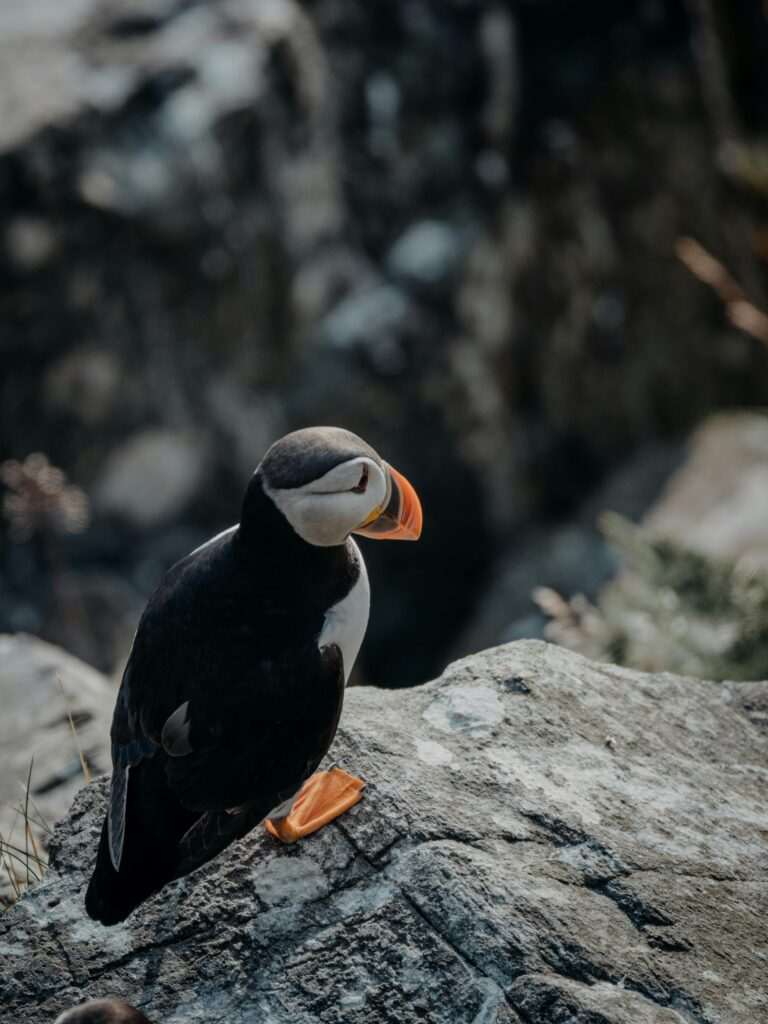
Alaska is home to two species of puffin, both nesting on the sea cliffs and rocky outcrops of the state’s southern coastline from May through August. Tufted puffins and horned puffins share the same colonies along the Kenai Fjords and Kachemak Bay, and both species are reliably visible on wildlife boat tours out of Seward and Homer during summer — often flying close to the boat, diving off the bow, and floating in rafts on the open water between feeding dives. For a visitor based in Anchorage, a full-day Kenai Fjords cruise is the most direct path to guaranteed puffin sightings, with the Alaska SeaLife Center in Seward providing a reliable backup option on any weather day. This guide covers both species, the best locations, the season, and how to make the most of the encounter.
Tufted vs. Horned Puffin: Telling Them Apart
Tufted puffin (Fratercula cirrhata) is the larger of the two species and the more visually striking. In breeding plumage (May–August), adults have an all-black body, white face, large orange-red bill, and the distinctive golden tufts of feathers that curve back from each eye like an elaborate mustache. The tufts are only present during breeding season — winter plumage is plain dark grey with a smaller, duller bill. Tufted puffins nest in earthen burrows on grassy clifftops, which makes them more visible from above on certain seabird colony tours.
Horned puffin (Fratercula corniculata) is slightly smaller and has a cleaner black-and-white body with a white face, large colorful bill, and the small dark “horn” — a fleshy protrusion above each eye — that gives the species its name. The horn is easier to see through binoculars than at a distance; from a boat, the white face and bright triangular bill are the most reliable field marks. Horned puffins nest in rock crevices and cliff ledges rather than burrows, so they are often visible perched on exposed rock faces.
Both species are stocky, short-winged birds that look comically aerodynamically challenged in flight — wings beating rapidly, body angled steeply downward on landing approaches — but underwater they are excellent swimmers, using their wings to “fly” after fish at depth. At sea, both species are often found rafting together with other alcids, so you will frequently see both from the same boat on the same day.
Kenai Fjords National Park: The Primary Destination
The sea cliffs and offshore rocks of Kenai Fjords National Park hold some of the densest seabird colonies in Southcentral Alaska. The outer headlands — particularly around Chiswell Islands, Cape Aialik, and the Resurrection Bay approaches — support mixed colonies of tufted and horned puffins alongside common murres, thick-billed murres, black-legged kittiwakes, pigeon guillemots, and pelagic cormorants. Numbers at the outer colonies can reach into the tens of thousands of birds during the nesting peak in June and July.
All Kenai Fjords wildlife cruises depart from the Small Boat Harbor in Seward, 127 miles south of Anchorage on the Seward Highway. The full-day tours (8–9 hours) reach the outer fjord colonies and give the best puffin viewing — the Chiswell Islands, in particular, are one of the most reliably productive seabird stops in the park. Half-day tours reach inner Resurrection Bay and may encounter puffins at closer-in rocky outcrops, but the density is lower than the outer park. Seward Ocean Excursions offers both half-day and full-day Kenai Fjords wildlife cruises from the Small Boat Harbor. Book full-day tours in advance; they sell out weeks ahead on summer weekends. Tours operate rain or shine.
Alaska SeaLife Center: Guaranteed Up-Close Viewing
The Alaska SeaLife Center in Seward houses both tufted and horned puffins in its seabird exhibit — a large naturalistic tank with underwater viewing windows, rocky nesting areas, and the opportunity to watch puffins diving, swimming, and interacting at arm’s length. For visitors who want extended close-up observation rather than spotting birds from a boat in open water, the SeaLife Center delivers the more intimate encounter. It is also the logical complement to a boat tour day — open before most cruises depart and a good way to spend the afternoon after returning from the fjords.
The center’s puffins are part of an active research program. Staff naturalists conduct feeding demonstrations on a posted schedule; attending one gives you context on the birds’ diet, behavior, and conservation status that enriches any subsequent field encounter. General admission runs approximately $30/adult; open daily year-round.
Kachemak Bay and Homer: A Second Major Location
Homer, 226 miles from Anchorage on the Sterling Highway, sits across the water from Kachemak Bay State Park — 400,000 acres of coastal wilderness accessible only by water taxi from the Homer Spit. The outer headlands of the park and the offshore rocks of Kachemak Bay hold puffin colonies, and several wildlife-focused water taxi operators, including Lazy Otter Charters, run guided bay tours specifically for birding and wildlife viewing. The combination of proximity to the colonies and the smaller boat format of most Kachemak Bay tours makes this an excellent puffin-viewing experience with a more intimate feel than the larger Kenai Fjords cruise boats.
Homer is also the base for accessing Gull Island — a small rocky outcrop in Kachemak Bay that holds one of the most accessible and prolific seabird colonies in Cook Inlet, with puffins, kittiwakes, murres, and cormorants in nesting concentrations visible from a circling boat. Most Homer-based wildlife tours include a Gull Island pass as part of the standard route. The Danny J ferry, running between Homer Spit and Halibut Cove, passes near productive seabird areas and makes a reasonable wildlife cruise alternative for visitors not booking a dedicated birding charter.
Peak Season: When to Go
Both puffin species are present on the nesting colonies from late April through August. The optimal viewing window is June through mid-July: birds are actively attending nests, flying frequently between the colony and open water, and often carrying multiple small fish crosswise in their bills — a diagnostic and photogenic behavior that marks active chick-feeding. By late August, adult puffins begin dispersing from the colonies to spend the fall and winter at sea, and sighting rates on boat tours decline. May sightings are possible but less reliable as birds are just arriving and establishing territories.
What Else to Expect: The Seabird Colony Experience
Puffin colonies are mixed-species affairs. The following birds are regularly seen alongside puffins on Kenai Fjords and Kachemak Bay boat tours:
- Common murre and thick-billed murre: The most abundant cliff-nesting alcids in Alaska; large, upright-standing birds on ledges, often in the thousands. Both species dive deeply for fish and are strong fliers.
- Black-legged kittiwake: A graceful white gull with black wingtips that nests in dense stacked colonies on narrow cliff ledges; their constant calling is the background soundtrack of any seabird colony.
- Pigeon guillemot: A smaller black alcid with distinctive white wing patches and bright red feet; often seen close to the boat in sheltered water near rocky shores.
- Pelagic cormorant: A slender iridescent dark cormorant that nests on vertical cliff faces; the smallest of the three cormorant species present in Kenai Fjords.
- Steller’s sea lion: Not a seabird, but haul-outs on exposed rocks near puffin colonies are common; the noise and scale of a sea lion rookery is one of the memorable sensory experiences of the outer fjords.
Photography Tips from a Boat
Puffins in flight are fast and erratic — a challenging subject from a moving boat. A zoom lens in the 100–400mm range is the standard tool for seabird colony photography; longer is better but harder to stabilize in ocean swell. Use continuous autofocus (AI Servo on Canon, AF-C on Nikon/Sony) and a shutter speed of at least 1/1600s to freeze wing movement. Shoot in burst mode and expect a high percentage of out-of-focus or motion-blurred frames. The best shots often come when puffins are floating on the water near the boat — they are far less skittish on the surface than in the air, and still-water portraits with colorful bills are among the most rewarding seabird photographs you can make from a Kenai Fjords deck.
Puffins are one of those wildlife encounters that photographs never quite capture — the sight of a hundred birds simultaneously launching from a cliff face, or a tufted puffin landing three feet from the bow rail, carries a physical presence that has to be experienced on the water. Book the full-day cruise, bring binoculars, and give yourself the outer fjords. The puffins will be there.
No comments yet.