
Blog: Wildlife Safety in Anchorage 2026: Bears, Moose & How to Stay Safe Outdoors
Anchorage is a city where moose walk through school parking lots, bears cross bike trails, and bald eagles perch on backyard fences. Wildlife encounters are not rare events that happen to unlucky hikers — they are a routine part of living in and visiting Alaska’s largest city. The good news: serious injuries from wildlife are uncommon, and virtually every dangerous encounter can be avoided or safely managed with a few key practices. This guide gives you what you actually need to know.
Bears: Black vs. Brown — Know the Difference
Two bear species live in the Chugach and occasionally enter Anchorage’s urban fringe: black bears (Ursus americanus) and brown bears (Ursus arctos, also called grizzlies). Knowing which you’re looking at matters, because the recommended response to a predatory attack differs by species.
Black bears are the smaller species — adults typically weigh 150–350 pounds. In Alaska, black bears are often cinnamon or brown in color (not always black), which causes confusion. Key identifiers: a straight facial profile, rounded ears, and no visible shoulder hump. Black bears are generally timid and more likely to flee than confront. They are more common in Anchorage’s Hillside neighborhoods and Campbell Creek corridor.
Brown bears are larger — adults weigh 300–700 pounds or more. Identify them by the prominent muscular shoulder hump, a dished facial profile, and small rounded ears. Brown bears are less common immediately around Anchorage but present throughout Chugach State Park, particularly in the Eagle River and Eklutna drainages. A brown bear’s tracks show long front claws in a line roughly continuous with the toe pads; a black bear’s claws curve more sharply and appear separated from the toe pads.
Bear Spray: Your Most Effective Defense
Bear spray — a capsaicin aerosol canister designed to deter charging bears — is more effective than firearms in stopping bear attacks according to multiple peer-reviewed studies. It works on both black and brown bears and requires no aiming precision under stress.
Carry it in a hip holster where you can draw it in two seconds. Know how to remove the safety clip before you need to. Practice the motion. The effective range is 25–30 feet; deploy it when a charging bear is within that range, sweeping the spray in a cloud at nose level. Wind direction matters — never spray downwind toward yourself.
Bear spray is available for purchase or rental in Anchorage at outdoor gear stores. Alaska Outdoor Gear Rental is one option for visitors who don’t want to carry canisters on flights. Every member of your hiking party should carry their own.
What to Do in a Bear Encounter
Prevention first: Make noise on trails — talk loudly, clap, call out “hey bear” on blind corners and in dense brush. Most bears will move off long before you see them if they hear you coming. Hike in groups when possible. Never hike with earbuds in both ears in bear country.
Food storage: On day hikes, never leave food unattended and never bury or discard food on the trail. In backcountry camps, hang food and scented items (toothpaste, sunscreen, lip balm) at least 10 feet off the ground and 4 feet from the trunk, or use a certified bear canister.
If you encounter a bear: Stay calm. Do not run — running triggers predatory pursuit instinct. Make yourself appear large, speak in a firm low voice, and back away slowly while keeping the bear in sight. Most encounters end with the bear leaving.
If a bear charges: Stand your ground and deploy bear spray when it’s within 30 feet. Many charges are bluffs that stop short. If a brown bear makes contact despite spray, play dead — lay flat on your stomach, hands clasped behind your neck, legs spread to make rolling you over harder. Remain still until the bear leaves the area. If a black bear attacks, fight back aggressively — target the nose and eyes.
Moose: The More Likely Danger
Alaska Fish and Game data consistently shows that moose injure more people per year in Alaska than bears do. Moose are large (cows weigh 800–1,100 pounds; bulls up to 1,600 pounds), fast (up to 35 mph), and poorly understood by visitors who assume they are docile like deer. They are not.
Moose become most dangerous in two seasonal windows:
Spring (May–June): Cows with newborn calves are intensely protective. A cow moose will charge any perceived threat to her calf — including dogs, joggers, and hikers who get between cow and calf without realizing it. If you see a calf, assume the cow is nearby. Give them a minimum of 50 yards of space and do not approach for photos.
Fall rut (September–October): Bull moose become aggressive and unpredictable during the breeding season. They have been documented charging vehicles, cyclists, and people who walk too close during this period.
If a moose charges: Run and put a solid object between you and the moose — a large tree, a car, a building. Unlike bears, moose usually stop pursuing once a barrier interrupts their charge. If knocked down, curl into a ball, protect your head, and move to cover as soon as the moose disengages. Bear spray has been shown to deter moose charges as well.
Never let your dog approach a moose. Dogs provoke moose easily, and a moose-dog interaction frequently ends with the moose turning on the owner. Keep dogs on leash in all Anchorage parks and trails.
Where Encounters Most Commonly Occur in Anchorage
Wildlife does not confine itself to designated wilderness. Encounters occur throughout the city:
- Campbell Creek greenway: The Campbell Creek Trail runs through the heart of Anchorage’s residential east side and is the city’s most common moose encounter corridor. Moose regularly bed in the streamside vegetation. Walk this trail with awareness, especially early morning and evening.
- Hillside and Far North Bicentennial Park: The trail network here borders prime bear and moose habitat. Black bear encounters on Hillside trails occur several times each summer.
- Kincaid Park: The Kincaid Park Trail System sits at the tip of a peninsula that funnels wildlife movement. Moose are frequently seen here year-round. Brown bear activity has been documented in recent years.
- Chugach State Park front range: The Chugach State Park Trail Systems access points — particularly Glen Alps, Powerline Pass, and the South Fork — are genuine bear country. Always carry spray here.
- Suburban neighborhoods: Moose routinely wander into yards on Anchorage’s Hillside, Abbott Loop, and Basher Drive areas. Bears visit bird feeders and unsecured garbage cans. Keep garbage secured until the morning of pickup.
Debunking Common Myths
Myth: Climbing a tree will save you from a bear. Black bears are excellent climbers and will follow you. Brown bears can climb young trees. Trees are not a reliable escape.
Myth: Playing dead works for all bears. Only for defensive brown bear attacks. For a black bear making contact, or for a predatory brown bear attack (one that follows you, approaches silently, or returns after you play dead), fight back aggressively.
Myth: Menstruating women attract bears. Peer-reviewed research has found no evidence supporting this. Normal hygiene practices are sufficient.
Myth: Bears are most dangerous in spring when hungry after hibernation. Bears are actually well-fueled on cached fat reserves in spring; late summer hyperphagia (pre-denning feeding frenzy) is when bears are most food-motivated and food-related encounters are most likely.
Reporting and Resources
Report any aggressive bear or moose encounter immediately to the Alaska Department of Fish and Game at (907) 267-2257 (Anchorage area office). This allows biologists to track habituation and intervene before animals become truly dangerous. The Alaska Wildlife Conservation Center, about 50 miles south of Anchorage, is an excellent place to safely observe Alaska’s wildlife — including bears and moose — before heading into the backcountry, so you know what you’re looking at.
Wildlife safety in Anchorage is not complicated. Most of it comes down to making noise, carrying bear spray, giving animals space, and knowing the difference between a bluff charge and a predatory one. Millions of people hike, bike, and run Anchorage’s trails every year without incident. The goal is to keep it that way — for visitors and wildlife alike.
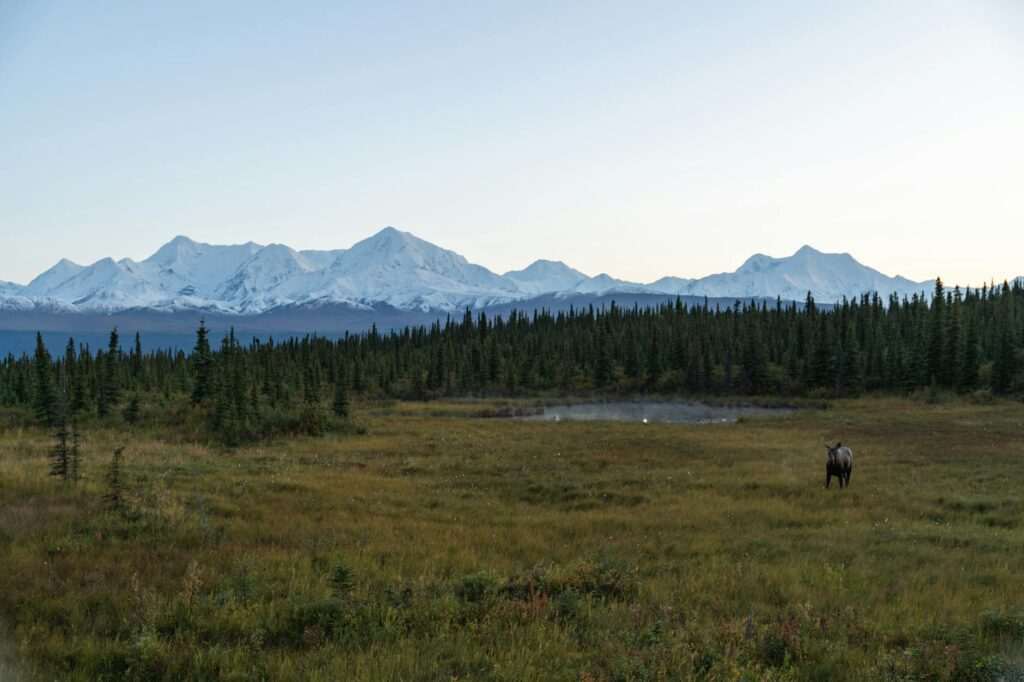
Featured image: John De Leon via Pexels. Photo shows a moose in a vast Alaskan landscape with mountains and forest at sunrise.


No comments yet.