
Anchorage Weather Guide 2026: What to Expect Month by Month
Anchorage weather doesn’t follow the single-season script most visitors expect from “Alaska.” Summers are mild and startlingly bright — 19 hours of daylight in late June, temperatures in the 60s, wildflowers on the hillsides. Winters are genuinely cold but drier and sunnier than Seattle or Chicago. The shoulder seasons can surprise you in either direction. What distinguishes Anchorage from other cold-weather destinations is how dramatically the conditions shift month to month — and how much those shifts affect what you can do and what you should pack. Here’s the full breakdown.
Monthly Conditions at a Glance
| Month | Avg High | Avg Low | Daylight | Precipitation |
|---|---|---|---|---|
| January | 22°F / -6°C | 9°F / -13°C | 5.5 hrs | Snow |
| February | 27°F / -3°C | 13°F / -11°C | 8 hrs | Snow |
| March | 35°F / 2°C | 20°F / -7°C | 12 hrs | Snow/rain mix |
| April | 46°F / 8°C | 30°F / -1°C | 15 hrs | Rain/snow mix |
| May | 55°F / 13°C | 39°F / 4°C | 18 hrs | Rain, occasional snow |
| June | 65°F / 18°C | 48°F / 9°C | 19.5 hrs | Rain, sunny stretches |
| July | 65°F / 18°C | 51°F / 11°C | 18 hrs | Rain, sunny stretches |
| August | 62°F / 17°C | 49°F / 9°C | 15 hrs | Rain |
| September | 52°F / 11°C | 40°F / 4°C | 12 hrs | Rain, early snow above treeline |
| October | 38°F / 3°C | 26°F / -3°C | 9 hrs | Rain and snow mix |
| November | 24°F / -4°C | 13°F / -11°C | 6.5 hrs | Snow |
| December | 19°F / -7°C | 6°F / -14°C | 5.5 hrs | Snow |
Season by Season
Winter: November through February
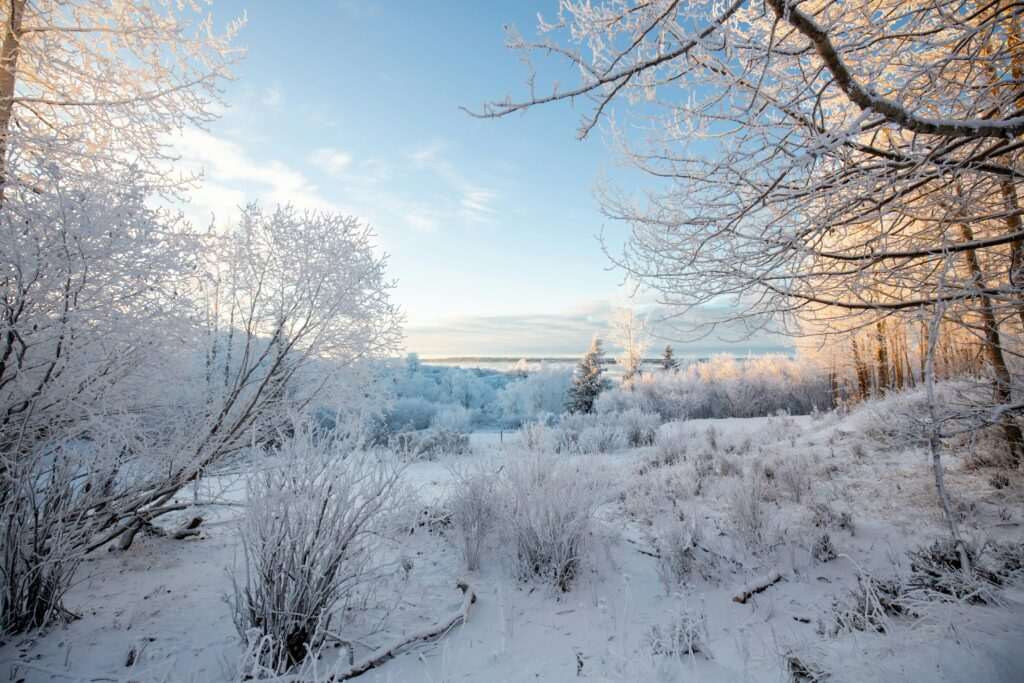
Anchorage winters are cold but not brutally so by Interior Alaska standards — sustained temperatures of -20°F or below are rare in the city, while Fairbanks sees them routinely. The bigger factor for visitors is darkness: December and January average just 5.5 hours of daylight, with sunrise around 10 AM and sunset by 3:30 PM. This compresses the outdoor activity window significantly.
What remains open and excellent: the Hillside Park trail network operates groomed Nordic ski trails most of the winter season, lit trails extend usable hours, and Flattop Mountain draws snowshoers on clear days. The Alaska Native Heritage Center, Anchorage Museum, and the downtown cultural corridor are unaffected by darkness. Northern lights (aurora borealis) are most reliably visible November through March; the Chugach foothills 20 minutes from downtown provide good viewing away from city glow.
Pack for winter: Insulated waterproof boots rated to at least -20°F (-29°C), heavyweight base layers (merino wool or synthetic), a down or synthetic-fill parka, wool or fleece-lined pants, hat covering ears, neck gaiter, insulated gloves with liners, and chemical hand warmers as backup. Traction devices (Yaktrax or similar) for icy sidewalks are strongly recommended.
Spring: March and April
March is Anchorage’s most deceptive month. Daylight increases rapidly — from 10 hours to nearly 15 hours by month’s end — and the light is brilliant reflecting off snow cover. Temperatures are still cold (highs in the mid-30s to mid-40s) but the angle of the sun feels genuinely warm on clear days. April brings the first serious melt and mud, known locally as “breakup.” Trails become wet and icy simultaneously. The Iditarod Trail Sled Dog Race finishes in Anchorage in early March, drawing crowds; the ceremonial start downtown is worth catching.
Pack for spring: Layering system with waterproof outer shell essential — morning freeze, midday melt cycles require flexibility. Waterproof boots with traction. Sunglasses are critical in March; snow-reflected glare is intense.
Summer: May through August
This is when Anchorage earns its reputation. May through August brings mild temperatures (high 50s to mid-60s°F), long days, and an outdoor activity calendar that runs from rafting and hiking to paddleboarding on coastal lakes. July is the warmest month, with occasional stretches reaching the low 70s — considered a heat wave here. Rain is consistent throughout summer, particularly in August, but rarely the all-day soaking variety. Expect morning cloud and afternoon sun, or vice versa, on many days.
The Tony Knowles Coastal Trail hums with cyclists and runners; beluga whales surface along Cook Inlet most mornings. Chugach Adventures and other operators run the full range of guided summer experiences — hiking, rafting, flightseeing — with maximum availability from mid-June through August.
Pack for summer: Light layers are the core. A waterproof rain shell is non-negotiable. Midday temperatures rarely require more than a fleece or light insulating layer underneath. Bring insect repellent — mosquitoes are significant from late May through July, particularly in wooded areas and near standing water. A buff or neck gaiter doubles as insect protection and light wind layer.
Fall: September and October
September is one of Anchorage’s best-kept secrets. Crowds drop sharply after Labor Day, fall color peaks on the hillsides and in the Chugach valleys through mid-September, and the weather remains reasonable (high 40s to low 50s). Trails are drier than summer and the light is lower-angle and golden. Bears are actively foraging before hibernation — carry bear spray on any trail. October brings the first heavy snows above treeline and rain-snow mix in the city, marking the effective end of summer trail season.
Pack for fall: Warm layers escalating from September (light fleece base, rain shell) to October (insulated layer, waterproof boots). Bear spray if hiking.
The Extremes: Midnight Sun and Deep Winter Darkness
Midnight Sun (June–July)
Around the summer solstice (June 20–21), Anchorage sees 19.5 hours of civil daylight. The sun dips below the horizon for only a few hours — it never gets fully dark. This is disorienting in the best possible way: you can hike at 10 PM in full light, eat dinner at 9 PM without it feeling late, and lose all track of time. Visitors who plan to sleep need blackout curtains or an eye mask; Anchorage hotels typically provide them, but confirm when booking. The flip side: energy is abundant, activities run late, and the golden midnight light makes for extraordinary photography.
The phenomenon begins in earnest in late May and persists through mid-July. By August, the nights return noticeably — sunset by 9:30 PM — and by September, daylight is back to a familiar 12-hour cycle.
Deep Winter Darkness (November–January)
The inverse applies in deep winter. On the winter solstice (December 21), Anchorage has 5 hours and 28 minutes of daylight. Sunrise arrives after 10 AM; darkness falls by 3:45 PM. This affects everything: outdoor activity must be planned around the short daylight window, car headlights are needed mid-afternoon, and seasonal affective disorder (SAD) is a known health consideration for long-term residents. Visitors on a one- or two-week trip usually find it atmospheric rather than debilitating, but it does demand intentional morning scheduling to maximize outdoor light.
The compensation: winter nights are when the aurora borealis appears. Clear cold nights from October through March produce the best viewing conditions. The Knik and Eagle River areas northeast of Anchorage offer dark-sky viewing away from downtown light pollution.
Anchorage Microclimates
Anchorage weather is not uniform across the city. Three distinct microclimate zones affect conditions meaningfully:
- Downtown and the coastal strip: Cook Inlet moderates temperature — the water’s thermal mass keeps downtown slightly warmer in winter and cooler in summer than inland areas. Wind off the inlet can make 35°F feel much colder. Fog is more common near the water in summer.
- Hillside and the Chugach foothills (500–2,000 ft): Temperatures run 5–10°F colder than downtown year-round. Snowpack persists longer in spring; trail mud season is more pronounced. Wind exposure increases with elevation. Views are dramatically better.
- Eagle River and the Matanuska-Susitna Valley (northeast corridor): Continental influence dominates here — colder winters, hotter summers, and lower precipitation than the coast. Eagle River can be 10–15°F colder than downtown in January and several degrees warmer in July. The valley microclimates are where Anchorage residents experience the most “real Alaska” temperature swings.
Layering Strategy for Anchorage
Alaska weather shifts within hours, not days. The layering system — base, mid, outer — is not a travel cliché here, it’s the functional solution to a 30°F temperature swing between morning and afternoon in shoulder seasons.
- Base layer: Moisture-wicking merino wool or synthetic. Cotton is useless when wet — don’t bring it for outdoor use.
- Mid layer: Fleece or light down jacket. In summer, a fleece pullover often suffices. In winter, a heavy down or synthetic-fill parka replaces the mid layer entirely.
- Outer layer: A waterproof, breathable shell is the most important single piece of gear for any Anchorage visit. It serves as wind barrier, rain protection, and temperature moderator. Gore-Tex or equivalent; knee-length or longer for serious weather.
- Footwear: Waterproof boots year-round. Insulated to at least -20°F for November–March. Trail runners are acceptable for summer hiking on maintained paths; anything technical requires hiking boots.
Anchorage weather is not a reason to skip Alaska — it’s a reason to pack correctly. The city’s outdoor culture operates year-round precisely because locals have internalized the layering system. Match their approach and the weather becomes part of the experience rather than an obstacle to it.
Featured photo by Angelica Reyn on Pexels.

No comments yet.