Chugach State Park 2026: Complete Guide to Anchorage’s Backyard Wilderness
Chugach State Park is one of America’s great wilderness secrets hiding in plain sight. At 495,000 acres, it is one of the largest state parks in the United States — bigger than Rhode Island — and its eastern boundary begins just minutes from downtown Anchorage. Residents can hike into genuine backcountry, spot moose and bears, ski untracked powder, and be back in the city for dinner. For visitors to Alaska, the park offers world-class outdoor adventure without the logistical complexity and expense that makes many remote Alaska destinations hard to access.
Established in 1970 under Governor Keith Miller, Chugach State Park was created specifically to preserve wild land on the doorstep of Alaska’s largest city. Today it protects glaciers, alpine tundra, spruce forest, and river valleys that would otherwise border suburban neighborhoods. The park’s elevation ranges from sea level at Turnagain Arm to peaks exceeding 8,000 feet in the Chugach Mountains interior.
Whether you are a first-time hiker looking for a manageable summit, a mountain biker seeking technical singletrack, a backcountry skier hunting fresh lines in December, or a family watching Dall sheep on cliff faces above the highway, Chugach State Park delivers across every season and every skill level.
The Main Access Areas
The park wraps around Anchorage’s eastern and southern edges, with several distinct entry points, each offering a different character and set of trails.
Glen Alps Trailhead and Flattop Mountain is the most visited access point in the park. Located at the end of Upper Huffman Road in south Anchorage, the Glen Alps parking area sits at roughly 2,200 feet elevation — meaning you gain significant altitude before you even start walking. From here, the Flattop Mountain Trail begins, along with trails into the Chugach Front Range, Powerline Pass, and the park’s remote interior. The parking fee is $5 per vehicle year-round, collected via iron ranger.
Eagle River Nature Center sits at the head of the Eagle River valley, about 12 miles from downtown Eagle River (itself 20 minutes from Anchorage). The center sits at the base of a dramatic glacially-carved valley surrounded by 6,000-foot peaks. It offers year-round programming, a small interpretive center, and access to trails ranging from short riverside walks to multi-day backcountry routes including the famous Crow Pass Trail. The Eagle River Nature Center charges a $5 vehicle fee and is open daily year-round.
Eklutna Lake is the park’s largest lake and the longest access corridor into the Chugach interior. Located about 30 miles northeast of Anchorage off the Glenn Highway, the lake stretches more than 7 miles and offers flat, family-friendly lakeshore biking and hiking as well as access to alpine terrain via the Eklutna Glacier Trail. The Eklutna Lake Trail is one of the park’s best multi-use corridors, with primitive campsites available for overnight trips. The access road is closed in winter, but the lake corridor remains accessible by foot and fat bike.
Hiking in Chugach State Park
The Chugach State Park trail network spans over 280 miles, with routes for beginners, intermediates, and experienced backcountry travelers. Here are the three hikes that define each level.
Beginner: Flattop Mountain (3.5 miles, 1,300 ft gain)
Flattop is the most-climbed peak in Alaska. The trail from Glen Alps climbs steadily through alpine meadow and tundra to a broad, rocky summit plateau at 3,510 feet, offering 360-degree views of Anchorage, Cook Inlet, Mount Susitna, and — on clear days — Denali to the north. The route is well-marked and popular enough that help is never far. Plan 2–3 hours round trip. In summer, wildflowers carpet the approach slopes; in late September, the tundra turns crimson and gold. Children with basic fitness can handle the climb; steep sections near the summit require use of hands on rock.
Intermediate: Williwaw Lakes (13 miles, 1,500 ft gain)
Starting from the Glen Alps trailhead, the Williwaw Lakes route follows the Powerline Pass trail east before branching south into a glacially-carved basin holding several turquoise alpine lakes. The terrain is open and exposed, with panoramic views into the park’s interior. At 13 miles round trip, this is a full-day objective; leave early to avoid afternoon weather. Wildlife encounters — particularly moose, Dall sheep, and ground squirrels — are common. Carry bear spray. The trail is unmaintained beyond the first few miles, requiring basic route-finding across tundra and boulder fields.
Advanced: Crow Pass Trail (26 miles one-way, point-to-point)
The Crow Pass Trail is one of Southcentral Alaska’s classic backpacking routes, originally part of the historic Iditarod Trail. It runs 26 miles one-way from the Crow Pass Trailhead near Girdwood to the Eagle River Nature Center, crossing a 3,550-foot pass, traversing the edge of the Raven Glacier, and following the Eagle River valley through prime bear country. The river crossing at approximately mile 15 can be knee-to-thigh deep and fast in July — use a trekking pole, unbuckle your pack, and cross carefully; mid-August through September crossings are generally calmer. Allow 2–3 days. Permits are not required but pack out all waste.
Mountain Biking
Eklutna Lake is the park’s mountain biking center. The 13-mile Eklutna Lakeside Trail runs the full length of the lake on a smooth gravel path connecting to rougher terrain beyond, and it is the most family-accessible multi-use trail in the park. The Bold Ridge Trail climbs steeply from the north shore to Bold Ridge Overlook, with technical rocky sections and rewarding views of the lake from above. Rentals and trail maps are available in Anchorage; the Alaska Outdoor Gear Rental outfits mountain bikers for Eklutna and other park access points.
The Powerline Pass Trail at Glen Alps is also popular with mountain bikers — it rolls along a power line corridor for roughly 11 miles one-way and connects to multiple singletrack spurs. Fat bikes are permitted on most park trails in winter, and the Eklutna Lake corridor becomes a de facto groomed corridor from December through March.
Winter Activities
Chugach State Park doesn’t close in winter — it transforms. The park receives substantial snowfall from October through April, and the terrain rewards multiple winter disciplines.
Cross-country skiing is best at Eklutna Lake, where the flat lakeshore trail is packed by a community of regular visitors and provides a peaceful, sheltered corridor through snow-draped spruce forest. The Glen Alps area sees heavy traffic from snowshoers and skiers working the Front Range slopes above.
Backcountry skiing and snowshoeing are the park’s winter showstoppers. The same peaks that offer summer hiking deliver excellent ski mountaineering and touring from November through May. Flattop’s broad summit bowl is accessible with touring gear; more advanced lines exist throughout the Front Range and deep into the Chugach interior. Avalanche terrain is present throughout the park — always check the Chugach National Forest Avalanche Center forecast and carry a beacon, probe, and shovel before entering any open slope steeper than 30 degrees.
Wildlife watching in winter is often easier than in summer. Moose tracks in fresh snow are unmistakable, and the cleared sight lines through leafless birch and alder stands improve visibility dramatically. Lynx, wolverine, and fox are occasionally spotted near the park boundaries in January and February.
Wildlife Watching
Chugach State Park is genuine bear habitat. Both black bears and brown bears (grizzlies) use the park year-round. Bears are most active from June through October, particularly near berry patches in late summer. Make noise on the trail, carry bear spray and know how to use it, and never approach wildlife.
Moose are the most commonly seen large mammal and are involved in more human injuries in Alaska than bears annually. Give them wide berth — particularly cows with calves in May and June. A moose that flattens its ears and raises its hackles is about to charge.
Dall sheep are visible year-round on rocky ridgelines throughout the park’s southern portions, particularly along the Seward Highway between Anchorage and Girdwood. Binoculars will reward patient observers. Golden eagles, common ravens, and ptarmigan are regular sightings above treeline.
Safety Tips for Visiting
Weather in the Chugach changes rapidly. A clear morning at the Glen Alps trailhead can turn to whiteout conditions by afternoon above 3,000 feet. Carry rain gear, insulating layers, a headlamp, and more water than you think you’ll need regardless of season. Hypothermia risk is real even in July. Cell coverage is unreliable or absent in most of the park’s backcountry.
Leave-No-Trace principles apply throughout the park. Pack out all trash, use designated fire rings where fires are permitted (check current fire restrictions), and camp on durable surfaces in the backcountry.
Planning Your Visit
Most trailheads with parking facilities charge $5 per vehicle, collected via iron ranger (cash only). No reservations are needed for day use. Backcountry camping is permitted throughout the park with Leave No Trace practices — bear canisters are strongly recommended for overnight trips. No campfires are permitted in the park outside of designated fire rings.
Anchorage is the gateway city, offering lodging, equipment rentals, and dining within 20–30 minutes of every major park trailhead. Eagle River and Girdwood also provide lodging options closer to specific access points. Most visitors use Anchorage as their base and make day trips into the park.
The Alaska State Parks system does not charge an annual entrance pass for this park — the per-vehicle fee at each trailhead is the only cost for day use. The park is open year-round with no general closure dates, though some access roads close in winter due to snow conditions.
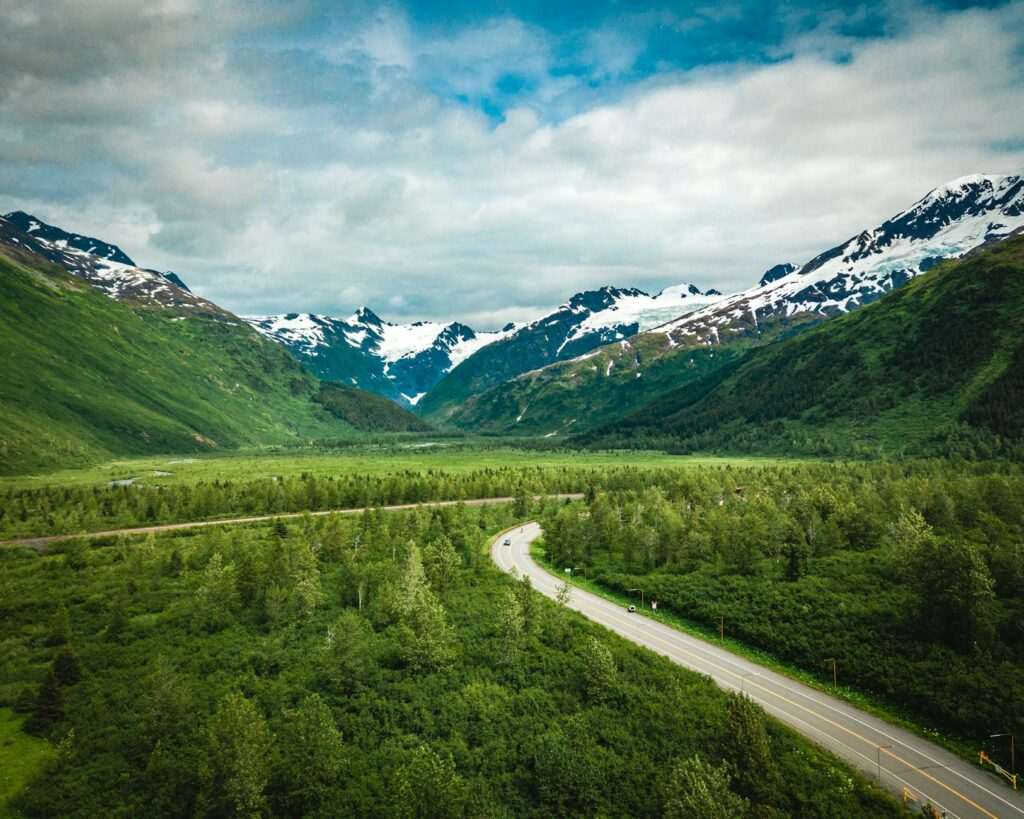
Featured image: Andrew Hanson via Pexels. Photo shows a breathtaking aerial view of a lush green valley and winding road in the Alaskan mountains.

No comments yet.