
Best Photography Spots in Anchorage 2026: Scenic Views & Instagram Locations
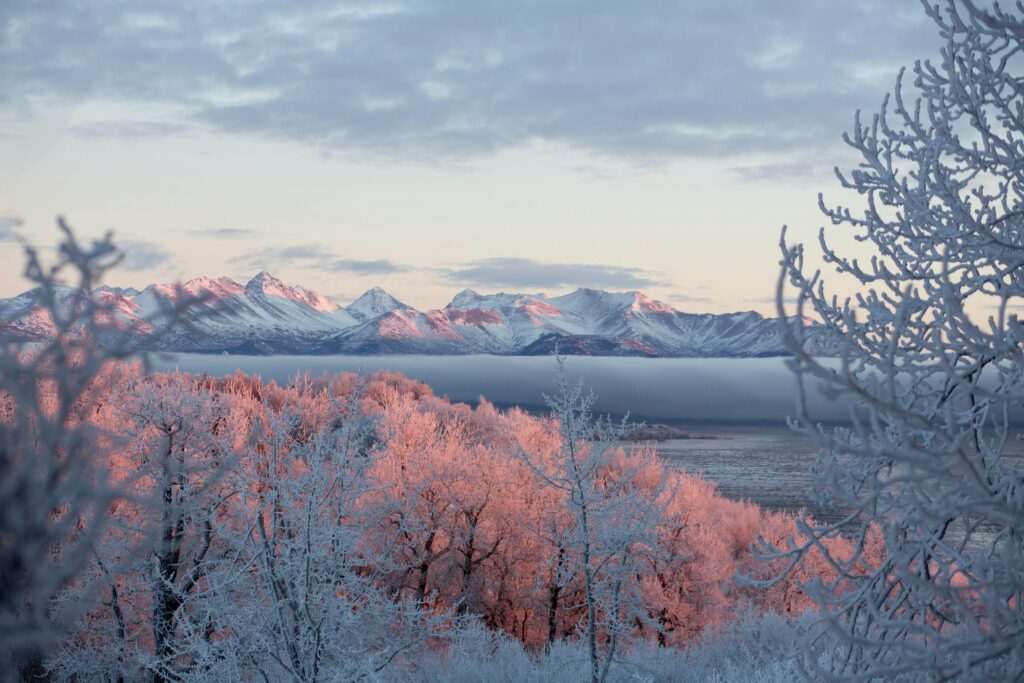
Anchorage is one of the most underrated cities in North America for photography. Within 30 miles of downtown you can frame glaciated peaks, tidal mudflats at golden hour, floatplanes on glassy water, urban murals, and forest-framed wildlife. In June you’ve got more than 19 hours of usable light — and not the harsh midday kind. That much continuous golden hour is something most photographers never encounter outside of Iceland.
Here are the spots worth your memory card.
1. Tony Knowles Coastal Trail
Address: West end of 2nd Avenue, downtown Anchorage; trail runs 11 miles to Kincaid Park
GPS start: 61.2157° N, 149.9099° W
Best time: Sunset (9–11 PM in summer) or early-morning fog
Best season: May–September; also beautiful in winter snowpack
Gear: Wide-angle for trail-to-mountains compositions; polarizer for inlet reflections
On a clear day, Denali is visible from sections of this trail — a 20,320-foot peak rising above Cook Inlet roughly 130 miles away. The light does unusual things near the inlet at dusk: the Alaska Range picks up pink and orange tones while the water goes silver. This is Anchorage’s most-visited photo location, and it earns that reputation every single clear evening.
2. Earthquake Park
Address: W Northern Lights Blvd & Point Woronzof Rd, Anchorage, AK 99502
GPS: 61.2114° N, 149.9268° W
Best time: Late afternoon through sunset
Best season: Year-round; winter ice floes in the inlet add drama
Gear: Wide-angle for the inlet sweep; 200mm+ telephoto for Alaska Range detail
The 1964 earthquake dropped this section of coastline 8–12 feet, leaving a distinctive bluff above Cook Inlet with views across to the Alaska Range. The fractured terrain gives you foreground texture — slumped earth, exposed roots, rusted interpretive signs — that most coastal viewpoints don’t have. It’s not a pretty park in the conventional sense, but it photographs interestingly.
3. Potter Marsh Bird Sanctuary
Address: Seward Highway (AK-1), MP 117.4, south of Anchorage
GPS: 61.0751° N, 149.8327° W
Best time: Early morning (6–9 AM) for mirror-flat water
Best season: May–September; peak shorebird activity July–August
Gear: Telephoto (300mm+) for wildlife; tripod for low-light reflection shots
Potter Marsh delivers the moose reflection shot that gets pinned and reshared. The boardwalk keeps you at water level — you’re shooting across rather than down, which is the difference between a documentary snapshot and an image worth printing. Trumpeter swans, Arctic terns, and shorebirds all use this marsh in season. Arrive at first light for the stillest water and best colors.
4. Flattop Mountain Summit
Address: Glen Alps Trailhead, 7010 Upper Huffman Rd, Anchorage
GPS summit: 61.0792° N, 149.7282° W
Best time: Late evening for city lights below and alpenglow above
Best season: June–September (winter summit approach requires microspikes or crampons)
Gear: Wide-angle for the panorama; fast prime (f/2.8 or wider) for twilight city shots
Chugach State Park’s most-climbed peak puts you above the Anchorage grid at 3,510 feet. The city below, Cook Inlet to the west, the Alaska Range north, and the Kenai Peninsula south — it’s a 360-degree composition challenge. The hike is 3.5 miles round trip from Glen Alps. Evening alpenglow on the Chugach peaks behind you while the city glitters below is a scene that doesn’t require much compositional skill. It just works.
5. Ship Creek
Address: Ship Creek Ave, Anchorage (north end of downtown, below the Hilton)
GPS: 61.2204° N, 149.8928° W
Best time: Golden hour (summer evenings); or salmon-run midday for action
Best season: July–September during king and silver salmon runs
Gear: Wide-angle for the industrial context; telephoto for fishing action shots
Ship Creek runs through the port district, which gives you the unusual juxtaposition of combat fishing and shipping cranes in the same frame. During salmon runs, the creek fills with both fish and anglers — sometimes dozens of people shoulder-to-shoulder in waders with container ships docked 200 feet behind them. It’s an Anchorage-specific scene you won’t find anywhere else.
6. Downtown 4th Avenue Murals
Address: 4th Ave between A and F Streets, downtown Anchorage
GPS: 61.2181° N, 149.8999° W
Best time: Overcast days (soft, even light); or late evening for texture
Best season: Year-round
Gear: Standard zoom or phone camera; wide enough to include context
Anchorage has invested seriously in public art, and the mural corridor along 4th Avenue is where most of it concentrates. The best compositions here layer the urban environment — murals behind pedestrians, reflections in storefronts, the mountains visible above rooflines on a clear day. Overcast light beats direct sun for mural photography: the colors are truer and you won’t be fighting shadows.
7. Beluga Point on the Seward Highway
Address: Seward Highway MP 110.5 pullout, ~10 miles south of Anchorage
GPS: 60.9893° N, 149.7648° W
Best time: Incoming tide for water movement; sunset for color on the flats
Best season: Year-round; September–October for fall color above the inlet
Gear: Wide-angle for tidal flat sweeps; 200mm+ if belugas are present
Turnagain Arm’s tidal range can hit 35 feet here — among the highest in the world. The retreating tide leaves a vast patterned mudflat with braided channels cutting through it, framed by the Kenai Mountains across the inlet. In fall, cottonwood and birch on the slopes go yellow and orange. If you see white shapes moving in the water, those are belugas. Have your telephoto ready when you pull in.
8. Knik Glacier Viewpoint
Address: Knik Glacier Rd, Palmer AK (~50 miles northeast via Glenn Highway)
GPS viewpoint: 61.7982° N, 148.7612° W
Best time: Midday for blue ice color; late afternoon for shadow detail on the ice face
Best season: June–September (check road conditions — it can be rough)
Gear: Wide-angle for the full glacier face and terminal lake
Knik Glacier is one of the most accessible active glaciers in Southcentral Alaska. You’re at ground level looking across the terminal lake at a moving wall of blue ice with lateral moraines on both sides — scale that aerial shots can’t replicate. Adventures by True North and other Anchorage tour operators can arrange glacier area access if you’d rather not navigate the access road independently.
9. Lake Hood Seaplane Base
Address: 4750 W International Airport Rd, Anchorage (adjacent to Ted Stevens Airport)
GPS: 61.1826° N, 150.0420° W
Best time: Early morning for glass-calm water; late afternoon for approach shots
Best season: May–September (ice-free); late winter has its own moody appeal
Gear: Telephoto for landing approach shots; wide-angle for ramp-to-mountains compositions
Lake Hood is the world’s busiest seaplane base by aircraft movements — more than 800 registered floatplanes, with summer days seeing 200+ departures. The composition opportunities are everywhere: planes on final approach with the Alaska Range behind them, floats on glass-calm water at dawn, morning fog with plane silhouettes. The viewing area is free and open year-round.
10. Glen Alps Overlook & Chugach Front Range Trails
Address: 7010 Upper Huffman Rd, Anchorage
GPS: 61.1004° N, 149.7384° W
Best time: Early morning for mist in the valleys; any time on a clear day
Best season: June–October for wildflowers and fall color
Gear: Wide-angle for valley sweeps; macro lens if wildflower season interests you
Even if you’re not hiking to Flattop, the Glen Alps parking area and the lower section of the Chugach trail system give you sweeping views of the Anchorage bowl and the Chugach front range without the full summit effort. In July, the tundra is covered in fireweed, lupine, and blueberries. In September, the willows and birch go yellow against the grey rock. Both are worth the drive up Huffman.
The Midnight Sun Advantage
June is Anchorage’s photography month. The city sees more than 19 hours of daylight at the summer solstice, with the sun not setting until after 11 PM and the sky staying in a perpetual blue-to-golden-hour gradient for most of the night. That means you’re not racing against darkness — you have hours of side-light quality every single day.
The practical result: you can shoot Tony Knowles at 10 PM in the same warm light you’d normally associate with 5 PM in summer elsewhere. You can do Flattop summit at 9:30 PM and still have clean visibility. Plan your late-evening sessions as your primary shoots, not an afterthought. This is what makes a June photography trip to Anchorage unlike anything in the continental US.
Featured photo by Angelica Reyn on Pexels.

No comments yet.