
Alaska Wilderness Survival Courses 2026: Chugach Skills
Wilderness survival training in the continental United States typically means learning to navigate forest trails or build a debris shelter in a temperate woodland. Alaska wilderness survival training is a fundamentally different proposition. The terrain around Anchorage involves subarctic plant communities with edible and medicinal species that don’t appear in lower-48 field guides, bear encounters that require specific protocols developed for brown bear behavior in dense brush and on open tundra, permafrost that affects shelter site selection, and weather windows that can shift from comfortable to life-threatening within hours at elevation. The Chugach Mountains rise immediately behind the city, and instruction that actually prepares students for Alaska conditions draws on all of this. Wilderness survival courses near Anchorage have expanded in recent years to serve both residents and visitors who want to spend serious time in the backcountry with the knowledge to handle what Alaska genuinely presents.
Why Alaska Survival Training Differs
Subarctic wilderness presents a specific set of challenges that general outdoor survival curricula don’t cover. The plant communities around Anchorage — particularly in the Chugach and along the Kenai Peninsula — include edible and medicinal species like fireweed, spruce tips, nagoonberries, Labrador tea, and highbush cranberry that are essential to foraging knowledge in this region. The same landscape includes plants that cause serious harm if misidentified, making plant identification in the Alaska context more consequential than in regions where foraging mistakes are typically less severe.
Bear country protocols for brown and black bears, which coexist in much of the Anchorage area, involve specific behaviors around camp placement, food storage, and bear encounter response that differ from the mountain lion or black bear scenarios taught in lower-48 courses. Brown bears — which are present in the Chugach front range throughout summer — are larger, more territorial, and require a different decision tree than any bear species encountered outside of Alaska, coastal British Columbia, or the Yukon. Alaska-specific survival training addresses this explicitly.
Core Skills in Alaska Survival Courses
The curriculum at most Anchorage-area wilderness survival programs covers a set of foundational skills adapted to subarctic conditions:
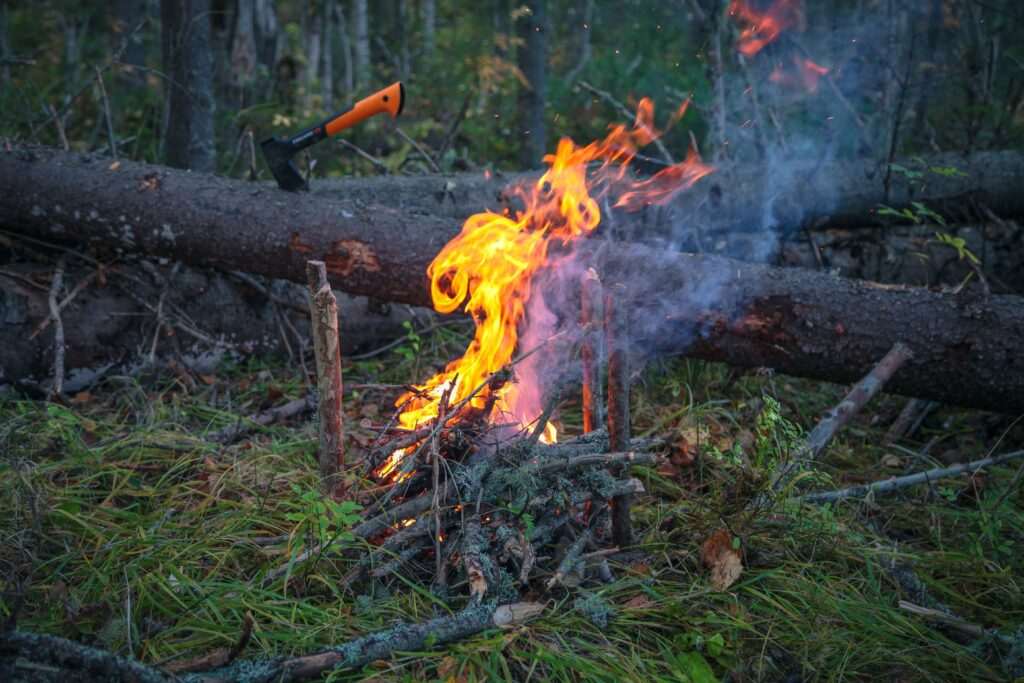
Fire starting in Alaska conditions — wet tundra, rain-soaked boreal forest, high-humidity environments — requires both waterproofed tinder preparation and the ability to find dry material under green canopy. Fire starting on permafrost requires specific site management to avoid ground heat loss. Courses typically cover multiple ignition methods from modern ferrocerium strikers through primitive friction techniques.
Shelter construction in the Chugach means working with spruce boughs, snow pack in shoulder seasons, and the specific micro-terrain features — creek banks, ridge deflectors, treeline transitions — that create defensible sleeping sites in Alaska mountain terrain. Winter shelter techniques, including basic quinzhee and lean-to construction, extend the training window into the cold months.
Navigation in terrain where GPS devices are relied upon until they fail covers map and compass fundamentals, contour reading for the distinctive Chugach terrain, and landmark-based navigation in above-treeline environments where visual reference points are abundant but trails are not. Courses emphasize the difference between navigating marked trails and moving through unmarked alpine terrain.
Water procurement and purification from Alaska sources — glacial streams, tundra ponds, and snowmelt — addresses the specific issues of glacial silt (which requires settling before treatment), giardia prevalence in high-traffic Chugach drainages, and the use of both chemical treatment and filter systems in freezing temperatures where filter elements can crack.
Signaling and emergency communication covers signaling mirrors, ground-to-air signals, PLB (personal locator beacon) operation, and the differences between helicopter rescue approaches in mountainous vs. tundra terrain — information that is genuinely Alaska-specific given the frequency of SAR operations in the Chugach and Kenai ranges.
Day Courses and Multi-Day Programs
The Anchorage-area survival training market includes both entry-level day courses and multi-day immersive programs. Day courses — typically 6 to 8 hours — introduce foundational skills and are appropriate for hikers and backcountry travelers who want practical competency without committing to a residential program. These courses typically cost $150–$300 per person and are offered by Alaska-based outdoor education providers through summer and early fall.
Multi-day wilderness immersion programs — ranging from 3-day intensives to full week-long courses — put participants in the field overnight, testing skills under actual conditions with instructor supervision. These programs typically include scenario-based training where participants practice building emergency shelters and signaling while managing the physical and psychological demands of an unplanned wilderness scenario. Week-long programs generally run $800–$2,000 per person including equipment and meals in the field. NOLS (National Outdoor Leadership School) operates a robust Alaska curriculum out of its Palmer base and offers courses ranging from week-long to semester-length wilderness programs in the Kenai and Chugach ranges.
The Chugach as Training Ground
Chugach State Park encompasses nearly 500,000 acres of accessible wilderness immediately east of Anchorage, and most Anchorage-based survival instructors use the front range as their primary classroom. The terrain transitions from dense spruce-hemlock forest at the lower trailheads to open tundra at 3,000 feet and technical alpine above 4,000 — a full range of Alaska terrain types within a 30-minute drive of downtown. The concentration of different ecosystem types in a compact elevation range makes the Chugach exceptionally efficient for survival training that covers multiple skill environments in a single day.
The park’s proximity to Anchorage also means that course operators can conduct training with the confidence that emergency extraction is accessible if needed — a meaningful factor for courses that involve scenario-based scenarios with novice participants. As training intensity increases, courses typically move deeper into the Kenai Peninsula and the Talkeetna range for full wilderness immersion.
Eagle River Nature Center
Eagle River Nature Center in the Eagle River valley serves as both a launching point for Chugach backcountry access and a venue for structured outdoor programming. The nature center’s interpretive programs cover plant identification, wildlife awareness, and navigation in the Eagle River corridor — skills that directly support wilderness survival competency. For visitors new to Alaska wilderness, a guided interpretive walk at the nature center is a practical first step toward understanding the plant communities and terrain features that more advanced survival courses build upon. The center’s location at the end of Eagle River Road puts participants on the edge of genuine Chugach wilderness within 30 minutes of downtown Anchorage.
Gear Preparation and REI
Wilderness survival course operators typically provide core training equipment, but students are expected to arrive with personal outdoor gear appropriate for the season. For a summer day course in the Chugach, this means layered clothing for temperatures that can range from 50 to 70°F, waterproof outer layers for rain, and sturdy hiking footwear. Multi-day programs have more specific packing lists provided at registration.
REI Co-op Anchorage is the most fully stocked outdoor gear retailer in the city and also offers its own outdoor skills classes through the REI Outdoor School — navigation clinics, wilderness first aid introductions, and gear-use workshops that complement or serve as prerequisites for more intensive third-party survival programs. For visitors who want to build competency before committing to a full survival course, an REI navigation or wilderness basics clinic is a practical starting point. The store’s staff knowledgebase on Alaska-specific gear — including bear spray, PLBs, and subarctic layering — is also useful for students preparing for their first backcountry survival course.
Best Season and Fitness Requirements
Wilderness survival courses near Anchorage run from May through September, with the most diverse curriculum available in June through August when all terrain types are snow-free and accessible. Late summer (August–September) adds plant identification richness as berries ripen and mushrooms emerge. Winter survival courses exist but are specialized programs for participants with prior cold-weather outdoor experience.
Day courses require basic hiking fitness — the ability to walk 5–8 miles on uneven terrain and handle light elevation gain. Multi-day programs in the Chugach or Kenai require the physical capacity for sustained backcountry travel with a loaded pack. Most program operators list fitness requirements explicitly; contact them directly to confirm your current fitness level is appropriate for the specific program. Prior hiking experience in subarctic terrain is beneficial but not required for entry-level courses.
Where can I take a wilderness survival course near Anchorage?
Several Alaska-based outdoor education providers offer courses in the Chugach and Kenai ranges. NOLS Alaska operates out of Palmer and offers week-length and longer programs. Local wilderness instructors offer day courses and multi-day intensives in Chugach State Park. REI Co-op Anchorage runs shorter outdoor skills clinics as a starting point.
What makes Alaska wilderness survival training different from other courses?
Alaska-specific training covers subarctic plant identification (edible and hazardous species not found in lower-48 guides), brown bear encounter protocols, permafrost-aware shelter site selection, glacial water treatment, and rescue signaling specific to Alaska SAR operations. These are genuinely different skills from what general outdoor survival curricula teach.
How much does a wilderness survival course near Anchorage cost?
Day courses (6–8 hours) typically run $150–$300 per person. Multi-day immersive programs range from $800 to $2,000+ depending on length, provider, and whether meals and gear are included. NOLS programs are at the higher end of the range but include highly structured curriculum and professional certification pathways.
What season is best for Alaska wilderness survival training?
June through September offers the widest range of skills — full terrain access, maximum plant identification opportunity, and the longest daylight for field time. August adds berry and mushroom identification to the plant curriculum. Winter survival courses are available for experienced practitioners who specifically want cold-weather and snow shelter training.
Featured photo by Nikita Belokhonov on Pexels.

No comments yet.