
Ship Creek Salmon Fishing in Downtown Anchorage 2026 — Kings, Pinks & Urban Combat Fishing
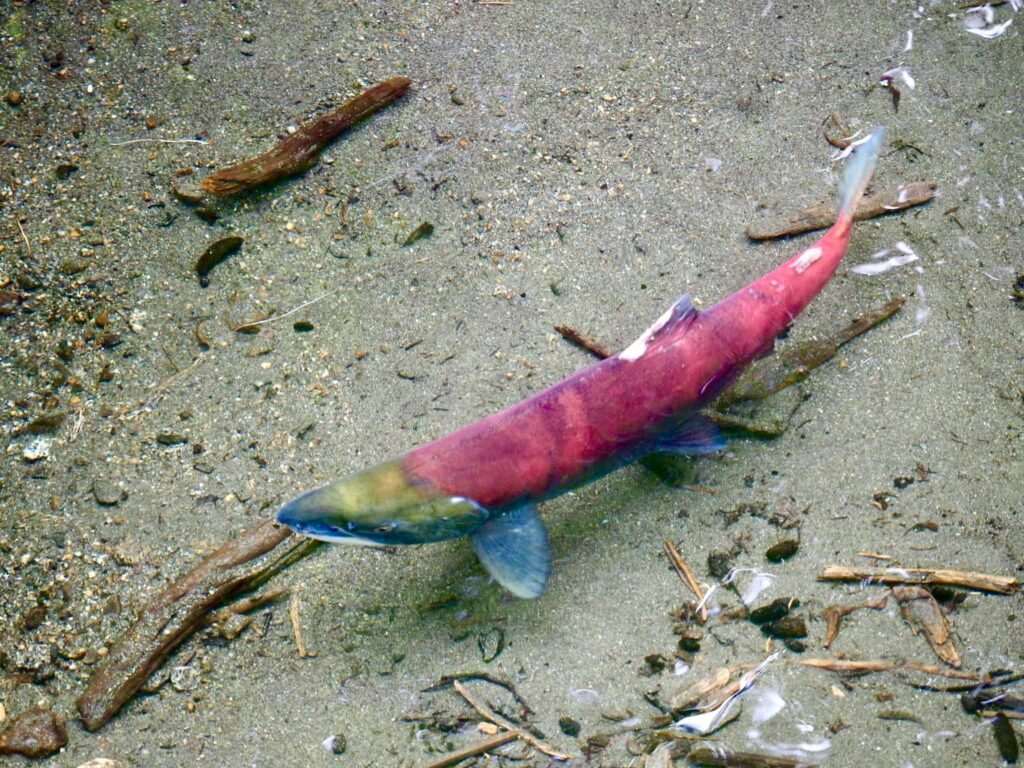
There is no other urban fishery in the United States that looks quite like Ship Creek in downtown Anchorage. The creek flows through the industrial heart of the city — past the Alaska Railroad yard, under a bridge on Whitney Road, below the backs of office buildings and hotels — and every summer it fills with wild Pacific salmon that have navigated Cook Inlet, found the creek mouth, and begun the final push upstream. On a July morning at peak king season, you can stand on the bank of Ship Creek with a fly rod, a hundred people within arm’s reach fishing the same pool, and the Anchorage skyline forty feet behind you. This is combat fishing. It is also one of the most remarkable free wildlife spectacles in any American city, and it is two blocks from most downtown hotels.
The Salmon Runs
King (Chinook) salmon are the premier run at Ship Creek and the reason most visiting anglers make the trip downtown. Kings arrive in mid-June and run through early July, with peak concentration typically in the third week of June. Ship Creek kings are mature fish that have been at sea for three to five years; most weigh 15-40 pounds, and fish over 50 pounds are caught every season. The daily bag limit is typically one king salmon per angler per day — verify the current Alaska Department of Fish and Game emergency order each year at adfg.alaska.gov, as limits and open periods are adjusted based on run strength. King season at Ship Creek is the most crowded and most intense fishing in Anchorage, and for many visitors it is the centerpiece of their Alaska trip.
Pink (Humpy) salmon return in even-numbered years in substantially larger numbers than odd years — 2026 is an even year, meaning the pink run will be the strong cycle. Pinks arrive in late July and run through August, filling the creek in numbers that can make the water appear to turn. They are smaller than kings (3-6 lbs average) but aggressive strikers on light tackle; catching pinks on a spinning rod or 6-weight fly rod is straightforward even for beginners and produces near-constant action during peak days. Pink salmon are excellent table fish when caught fresh and handled well, though they soften quickly and should be iced immediately.
Coho (Silver) salmon enter Ship Creek in late August and run through September. Coho are widely regarded as the best-eating Alaska salmon and as strong fighters for their size (8-15 lbs average). The Ship Creek coho run is smaller than the king and pink runs but provides good fishing into fall when most summer visitors have left. September coho fishing at Ship Creek is significantly less crowded than the summer peak and is an underrated window for visitors in town during that period. Coho will hit a wide variety of lures — spinners, spoons, and streamers all work — and the fight-to-weight ratio makes them popular with sport anglers who find king fishing’s heavy gear less appealing. The Anchorage fall weather in September is often crisp and clear, making a Ship Creek coho session one of the more pleasant fishing experiences of the Alaska season.
The ADF&G Weir and Viewing Platform
The Alaska Department of Fish and Game operates a counting weir on Ship Creek that intercepts and counts salmon moving upstream to assess run strength and set in-season harvest limits. The weir creates a holding pool below it where fish stack in large numbers, visible from the adjacent public viewing platform. During king season, standing at the platform and watching 30-pound Chinook holding in the current below the weir — fins out, bodies torquing against the flow — is one of the most accessible large-fish wildlife experiences in Alaska. No fishing license, no gear, no planning required: the viewing platform is public, free, and open during daylight hours.
The platform and weir area draws both serious anglers working the pool and visitors who have no intention of fishing but want to see wild salmon up close. Both are legitimate uses and the site accommodates both. In July, expect a crowd at the platform during morning hours.
Combat Fishing: What It Is and How to Navigate It
Combat fishing is the colloquial Alaska term for fishing elbow-to-elbow with a dense crowd on a productive run. Ship Creek during king season is the defining combat fishing experience in Southcentral Alaska. Understanding the etiquette is essential to having a functional experience and not creating conflict on the bank.
The core rules, observed by most experienced anglers: when someone hooks a fish, everyone near them reels in and gives the hooked fish room to run — a king salmon on light tackle will take 50-100 feet of line in a single run and the hooked angler needs space to follow. Respect that space; do not keep fishing through someone else’s fight. Keep your back-cast tight and controlled if fly fishing in crowds — an open back-cast in combat fishing is dangerous and will end your morning quickly. Do not crowd into a gap between two anglers who have clearly established positions. Wait your turn for a spot to open.
Snagging — intentionally hooking fish in the body rather than the mouth — is illegal in Alaska and results in a citation. Fish must be hooked in the mouth to be legal. The ADF&G has enforcement officers at Ship Creek during peak season; they watch for snagging and will check licenses.
Licenses and Gear
An Alaska sport fishing license is required for anyone 16 or older. For king salmon specifically, an Alaska King Salmon stamp is required in addition to the base license. Both are available online at adfg.alaska.gov, or in person at Fred Meyer on Northern Lights Boulevard (approximately 10 minutes from downtown), REI, or Cabela’s. Purchase before arriving at the creek — there is no license sales point at the fishing site itself.
For king salmon, the standard Ship Creek setup is a medium-heavy spinning rod (8-10 foot, 15-30 lb line) with a salmon-weight spinner, spoon, or cured egg cluster, or an 8-10 weight fly rod with a sink-tip line and a chartreuse or pink Popsicle or Egg Sucking Leech fly. The fish are not leader-shy in combat fishing conditions; presentation matters less than getting the lure in front of fish. For pink salmon, a light to medium spinning rod with a small pink or chartreuse spinner (Mepps or Blue Fox #3-4) is more effective than heavy gear; pinks will hit a lure almost anywhere it lands during a strong run. Bring a net — a landed king salmon on a slippery creek bank without a net is an embarrassing situation that ends many fishing stories poorly. Waders are useful but not essential for bank fishing; the most productive spots can be reached from dry ground. Polarized sunglasses are valuable for spotting fish holding in the water before casting to them.
Access and Parking
Ship Creek is accessible by foot from most downtown Anchorage hotels in 15-20 minutes. Walk north from 4th Avenue toward the rail yard; the creek is visible below the road embankment. The Alaska Native Heritage Center follows the creek through this area and provides easy access to the fishing sections. The Ship Creek boat launch area off Whitney Road provides dedicated parking and the easiest vehicle access to the fishing area. The parking lot fills on peak king season mornings — arrive before 7 AM to secure a spot. Street parking is available on Whitney Road and adjacent blocks as overflow, though the walk to the creek from street parking adds 5-10 minutes. The Ship Creek area is actively being developed as a visitor destination; the Anchorage Port area renovation has added improved pedestrian access from downtown. The walk from the Hilton, Hotel Captain Cook, or Marriott downtown is entirely flat and straightforward. The Alaska Railroad depot on 2nd Avenue is a five-minute walk from the creek; train-watchers and railfans often combine a Ship Creek visit with watching Alaska Railroad traffic from the public area near the depot.
After the Catch
A cleaning station is available at the Ship Creek boat launch area for anglers to process their fish. Bring a sharp fillet knife and a cooler with ice — salmon degrade quickly at ambient temperature and should be on ice within minutes of landing. Several Anchorage fish processing and smoking operations handle sport-caught fish for a fee, including vacuum-sealing and flash-freezing for travel. New Sagaya City Market on Northern Lights has a full-service fish counter and can connect visitors with processing resources. If you are flying home, Alaska Airlines and most major carriers allow frozen, vacuum-sealed salmon as checked baggage; verify current weight and packaging requirements before your departure day.
Sightseeing Value Without a Rod
Ship Creek during salmon season is worth visiting even if fishing is not your interest. The visual spectacle of large wild salmon in an urban waterway — the fish visible from the road bridge, stacking below the weir, rolling at the surface — is genuinely striking and photogenic. The industrial backdrop of the rail yard and the city buildings rising above the creek makes the scene unlike any standard Alaska wilderness image. Bald eagles work the creek during salmon season and can often be seen at close range from the viewing platform, competing with anglers for fish. The combination of wildlife, urban landscape, and human activity concentrated in one small area makes Ship Creek one of the most distinctly Anchorage things you can witness.
Ship Creek is what Anchorage is: a city that never fully separated itself from the wilderness it was built on. The salmon don’t care about the office towers. They’ve been using this creek since before the towers existed, and they’ll be using it after.
The Tony Knowles Coastal Trail begins a short walk west of Ship Creek and connects through Anchorage’s downtown waterfront parks — worth combining with a creek visit for a full morning in this part of the city.


No comments yet.