
Anchorage to Valdez Road Trip 2026: Glenn Highway, Thompson Pass & Tidewater Glaciers
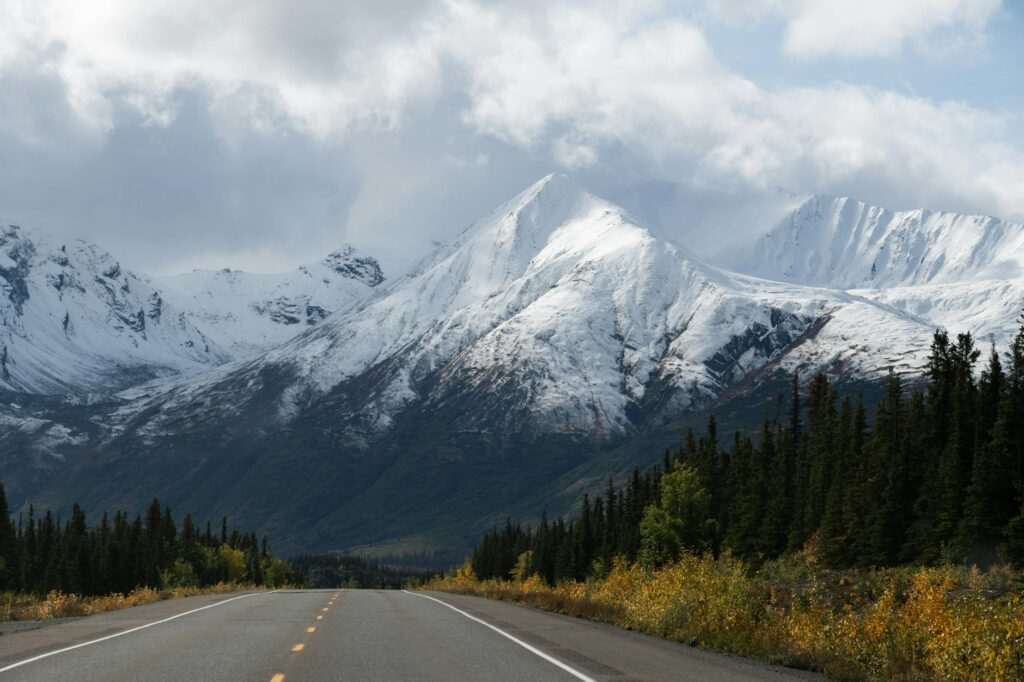
Alaska has no shortage of spectacular drives, but the route from Anchorage to Valdez earns a special category: the kind of road trip where you stop counting the viewpoints because stopping for all of them would take until dark. The drive east on the Glenn Highway and south on the Richardson to the Valdez fjord covers roughly 300 miles and 6.5–7 hours of driving time — enough to justify an overnight stay, and enough scenery to make you want two.
The Route at a Glance
Anchorage → Glenn Highway east → Palmer and the Matanuska Valley → Glennallen → Richardson Highway south → Thompson Pass → Worthington Glacier → Keystone Canyon → Valdez.
The first 45 minutes of the drive, east out of Anchorage on the Glenn Highway, deliver the Chugach Range on one side and the Knik Arm of Cook Inlet on the other before the highway rises into the Matanuska Valley. If you’ve already done the Mat-Su Valley day trip, this section will feel familiar — Palmer and Wasilla are well off this route and can be skipped. The highway continues east toward Sutton and begins climbing into increasingly remote terrain as civilization thins out.
The Matanuska Glacier Corridor
Around mile 100 on the Glenn Highway, the road enters one of the most dramatic glacial corridors in Alaska. The Matanuska Glacier comes into view from the highway — a river of blue-white ice pushing out of the Chugach Mountains into the valley floor. At 27 miles long and 4 miles wide, it’s one of the largest glaciers accessible by road in the United States. You can pull off at the Glenn Highway viewpoint for photos, or turn in at the private access road for a guided walk on the glacier surface itself (a separate fee and approximately 2-hour detour if you want the full experience).
Even if you skip the glacier walk, pull over here. The scale of what you’re looking at takes a moment to register — the deep crevasse lines and pressure ridges visible from the road are hundreds of feet deep.
Glennallen: The Crossroads
About 190 miles from Anchorage, the Glenn Highway meets the Richardson Highway at Glennallen. This is the last reliable fuel and food stop before Valdez, and you should treat it as a mandatory pit stop regardless of your gas gauge. Glennallen is a small service community — it’s not a destination, but the fuel station and diner at the junction exist for exactly this reason. Fill up, grab food, and top off your water.
From Glennallen, turn south on the Richardson Highway. The landscape shifts almost immediately. The broad agricultural valley gives way to the foothills of the Wrangell-St. Elias range — a different visual register entirely. The Wrangells are among the most massive mountain concentrations in North America, home to several peaks over 14,000 feet. You won’t see their full scale from the Richardson, but the foothills alone are commanding.
Thompson Pass
Thompson Pass sits at approximately 2,678 feet elevation, making it one of the highest road passes in Alaska. The statistics alone don’t convey what arriving here feels like. The highway leaves the treeline behind and enters a broad alpine bowl that feels genuinely remote — the kind of place where weather can change in twenty minutes and often does. On a clear summer day, the pass delivers 360-degree views of glaciated peaks, hanging glaciers, and vast snowfields. On a socked-in day, it delivers a grey wall of cloud and a sense of the road’s exposure.
Thompson Pass holds the Alaska record for single-season snowfall — 974.5 inches in the winter of 1952–53. The highway department keeps it open year-round, but outside of June through September, driving conditions can be serious. Snow on the pass as late as June and as early as September is common; check road conditions before attempting shoulder-season travel.
Even in summer, pull over at the summit. The silence, the scale, and the lack of any infrastructure in sight is a reminder of where you actually are.
Worthington Glacier State Recreation Site
A few miles south of Thompson Pass, a short paved spur off the Richardson leads to Worthington Glacier State Recreation Site — one of the most underrated stops on any Alaska road trip. The glacier here flows directly to the parking lot. You can walk to the terminal moraine and touch the ice without a guide, without a fee, and without any particular hiking ability. There’s a viewing platform for those who want to stay dry, but the real experience is walking the moraine field to where the ice front meets the gravel.
Worthington is a study in glacial recession — interpretive signs mark where the glacier terminus stood in previous decades, and the distance between those markers and the current ice front is sobering. Budget 30–45 minutes here. It’s a free stop and one of the best glacier access points in the state.
Keystone Canyon
The final dramatic element before Valdez is Keystone Canyon, where the Richardson Highway threads through a narrow river gorge cut by the Lowe River. In summer, waterfalls drop directly onto the highway corridor from the canyon walls — Bridal Veil Falls and Horsetail Falls are both visible from pullouts within the canyon. In winter, the falls freeze into dramatic ice columns and attract ice climbers from across Alaska and beyond.
The canyon is a few miles long and the highway doesn’t slow down much, but there are pullouts. Take them.
Valdez: End of the Road
Valdez sits at the head of a fjord surrounded by mountains on three sides and open to Prince William Sound on the fourth. The setting is almost unfairly beautiful — the kind of small Alaska town (population around 4,000) that rewards a slow day of wandering. The most visited landmark is the Trans-Alaska Pipeline Marine Terminal, the southern endpoint of the 800-mile pipeline from Prudhoe Bay. The terminal itself isn’t publicly accessible, but a viewpoint on the edge of town lets you see the tank farm and the loading infrastructure. It’s a strange industrial footnote in an otherwise pristine landscape, and strangely worth seeing.
Columbia Glacier, one of Alaska’s most dynamic and rapidly retreating glaciers, calves into Prince William Sound about 30 miles west of Valdez. Day cruise operators run glacier tours from the Valdez small boat harbor — if you’re spending a night, this is the activity to book in advance. The Columbia is one of the largest tidewater glaciers in North America and the calving is spectacular.
Valdez is also one of Alaska’s top silver salmon fisheries. The town’s small boat harbor has charter operations running throughout the summer season. For charter options and fishing logistics, Alaska Fishing Adventures covers what to expect from Alaska’s guided fishing scene. Valdez also has a handful of kayak rental operators for those who want to explore the fjord at their own pace — the calm inner waters are suitable for beginners, while the outer sound requires experience and weather awareness.
Day Trip or Overnight?
Be honest with yourself: this is an overnight trip. Six and a half hours of driving each way, plus stops at the Matanuska Glacier, Worthington, and Keystone Canyon, plus time in Valdez, is too much for a single day. The math doesn’t work, and rushing the stops defeats the point. Plan a minimum of two days: drive to Valdez on day one with stops along the way, spend the night and take a glacier cruise or fish on day two, then return. Budget motels exist in Valdez; book ahead in July and August when the fishing crowd fills everything up.
If you are committed to a day trip, leave Anchorage no later than 6:00 AM, skip extended stops, and arrive in Valdez by early afternoon for a 2-3 hour turnaround. You’ll see the highlights but miss the depth.
Best Season and Practical Notes
Best months: June through August. September is possible but Thompson Pass conditions deteriorate quickly after Labor Day.
Fuel: Fill up in Anchorage, in Palmer, and again at Glennallen. Options south of Glennallen are very limited until Valdez.
Cell service: Essentially nonexistent between Palmer and Valdez. Download offline maps before you leave Anchorage.
Wildlife: Moose, Dall sheep, black and brown bears, and bison (a small introduced herd near Delta Junction) are all possible along the route.
Weather: The Chugach and Wrangell ranges create their own weather. Check the National Weather Service forecast for Thompson Pass specifically before departure.
Photo: John De Leon / Pexels

No comments yet.